

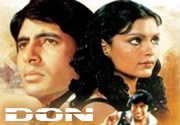
Don (old)
Synopsis:
Halfway through the movie, Amitabh Bachchan is just lying there on the floor of some abandoned warehouse making these terrible groaning noises and everyone around him is totally freaking out because he's supposed to be the baddest criminal in the whole city, but he's actually dead and gone forever, which is a massive problem for the police inspector who was using him to infiltrate the gang. But to understand why the cop is sweating bullets over a corpse, you have to look at how this whole crazy mess started in the first place, back when Don was just running his smuggling empire with absolute impunity and treating his loyal girlfriend Roma, played by Zeenat Aman, like she's just another piece of office furniture even though she's constantly glaring daggers at him and waiting for a chance to avenge her brother's death.
Let's take a quick second to talk about the belt Don wears during that one confrontation on the rooftop, because it is just this massive piece of shiny brass hardware with a gigantic buckle shaped like an eagle or a hawk or something equally ridiculous that catches the studio lights every single time he turns around, and honestly I couldn't stop staring at it for a solid ten minutes while they were shouting at each other about stolen diamonds. It's just so wonderfully distracting, and then out of nowhere the police show up, a chase ensues, and Don gets accidentally killed during a scuffle with the cops, leaving the entire criminal underworld headless and the authorities completely panicked.
So then Inspector D'Silva, played by Pran with that great tired look he always has, realizes he's got the ultimate opportunity to bust the rest of the syndicate if he can find someone who looks exactly like the dead kingpin, which leads him to the streets where Vijay is performing these awful street songs for loose change while trying to take care of two little kids who aren't even his. Vijay doesn't know anything about crime, but he's got the exact same face as the fugitive, so the cop convinces him to swap places and pretend to be the villain so they can gather intelligence from the inside, and man, this is where the plot just really gets going in terms of classic bollywood style and energy. Amitabh Bachchan is honestly doing double duty here, playing both the ruthless mastermind and the goofy street performer, and the contrast is just hilarious, especially when Vijay has to suddenly start acting tough around hardened criminals who are wondering why their boss is acting so weird all of a sudden.
The funny thing is that nobody in the gang really questions the personality change too much because they just assume he's being moody, except for Roma, who is still lurking around with murder on her mind and doesn't know the guy she's trying to stab is actually an innocent street singer just trying to earn enough money for the kids. She confronts him and he's totally sweating and trying to explain that he's not who she thinks he is, and she doesn't believe him for a second until things get super complicated because the corrupt cops find out what D'Silva is up to, and then D'Silva gets bumped off in a surprise twist, leaving poor Vijay completely stranded with nobody who can prove he's just a decoy. He's trapped. Absolutely trapped.
Right after that, everyone is chasing him around, the real gang wants him dead because they realize he's been playing them, and the police want him locked up because they think he's the actual mastermind since the only guy who knew the truth is dead. He has to run through alleys and hide in weird corners while dodging bullets and trying to find the little notebook where D'Silva wrote down all the proof of his innocence, which is hidden behind some random painting or loose brick or something. It's totally frantic, and watching these older hindi films always makes you appreciate how much narrative they could cram into two and a half hours without getting too bored. He fights his way through the henchmen, dodging punches and kicking tables over, proving he's just as tough as the guy he was impersonating.
Anyway, he finally gets his hands on the diary that clears his name, but not before Roma figures out the whole truth and realizes she was trying to kill an innocent man who was just helping the cops, and she has to quickly switch gears from wanting to murder him to helping him survive the rest of the goons. They team up for the final showdown against the remaining syndicate members who have gathered in that creepy warehouse to figure out who's taking over the operation now that everything is falling apart. It's a huge free-for-all brawl with people swinging from ropes and throwing chairs at each other and shouting dramatic dialogue back and forth while the background music goes totally wild in typical bollywood movies fashion, bringing together all the classic tropes of hindi movies that Chandra Barot directed with such chaotic flair. Vijay manages to outsmart the last few bad guys, the police sirens start wailing in the distance as the cavalry finally shows up to arrest the surviving thugs, and Vijay stands there in the middle of the ruined room catching his breath.
The zipper on Zeenat Aman’s jumpsuit is just barely catching on the fabric around her collarbone in that one warehouse scuffle, and every time she turns her head sharply to the left you can see the tailor’s white basting thread still hanging off the inside seam like a little frayed nerve. It is a small thing to fixate on while watching a picture that supposedly changed the temperature of popular Indian cinema forever, but if I'm honest, those tiny production scars tell you more about the frantic energy of 1978 filmmaking than any dusty archival essay ever could. Most bollywood movies from that stretch of the decade look like they were thrown together with old burlap sacks and three cans of burnt-umber lacquer, yet Chandra Barot keeps his frame moving with an oily kind of slickness that refuses to settle down. Nobody involved in this production thought they were making art for the archives. They were rushing to beat a printing deadline at the lab and trying to keep the arc lights from shorting out in the monsoon humidity, which probably explains why the boom mic drops into the top of the wide shots during the second reel twice in succession without anyone bothering to yell cut.
Nariman Irani’s cinematography isn't particularly fancy or revolutionary, leaning instead on a kind of bruised twilight palette that makes Bombay look less like a romantic capital and more like a hot, crowded train station where everyone is sweating through their synthetic shirts. You get these long, unbroken takes of Amitabh Bachchan walking down concrete stairwells where the paint is peeling off in great scabby flakes, and the camera just stays behind him, tracking the heavy slouch of his shoulders while Kalyanji-Anandji’s bassline thumps away on a harmonium that needs tuning. It’s gritty without making a big deal out of it. The sound design is a different story altogether, featuring gunshots that sound like someone slamming a heavy encyclopedia down on a wooden desk and car tires screeching with a metallic whine that cuts right through your molar fillings. There is a specific recurring acoustic cue every time the villain narrows his eyes—a tinny xylophone plink that happens so often by the time the narrative hits the hour mark that you start wondering if the foley artist had only three sound effects left on his master tape and decided to use them until they dissolved.
Everybody remembers the swagger and the songs, obviously, but the real engine driving the whole machine is Barot’s refusal to let the pace sag for even a single minute of screen time, barreling through plot holes big enough to drive an Austin Cambridge through. When the protagonist switches places with his mild-mannered double, the movie doesn’t pause to explain the logistics of village life or spend twenty minutes establishing how a rural schoolteacher learns to smoke imported cheroots with that specific crooked sneer. It just cuts to the chase, literally, with men in flared trousers vaulting over wicker fences while Pran looks mildly annoyed behind a pair of tortoiseshell glasses that keep sliding down his nose. Compared to the bloated, three-hour domestic melodramas that were clogging up Hindi films around the same period, this thing moves like a greyhound chasing a greasy rag, trimming away all the fat until you are left with just pure, propulsive movement.
Bachchan plays the dual role not by changing his voice or putting on funny fake teeth, but simply by adjusting the angle at which he holds his chin when people talk to him. As the criminal mastermind, his head is tilted back just enough to look down his nose at everyone in the room, while the innocent double keeps his shoulders bunched up near his ears like he’s bracing for an unexpected slap from a disapproving uncle. It’s an efficient piece of acting that relies entirely on posture rather than internal monologues or dramatic weeping. The supporting players mostly exist to shout exposition into telephones or get thrown through breakaway glass panels by stuntmen wearing terrible crepe-hair wigs, though Helen gets about three minutes of screen time to do a cabaret number that leaves the rest of the cast looking like they’re moving through molasses. She doesn't even look at the camera most of the time; she’s just inhabiting the physical space with a terrifying kind of indifference that makes the male leads look like amateurs reading lines off a chalkboard.
The script, credited to Salim-Javed, has this weird habit of dropping plot points down a well and never checking to see if they hit the bottom, leaving characters to wander into scenes they have no logical reason being in just because the director needed someone to hand Bachchan a loaded revolver. You stop asking questions about police jurisdiction or international banking laws about twenty minutes in, mostly because the editing is so aggressive that it won't let your brain linger on any single narrative inconsistency for more than a heartbeat. It’s the kind of storytelling where people escape from maximum-security lockups by hiding inside a laundry basket and nobody on the guard detail thinks to check if the sheets are unusually heavy, which feels less like a polished thriller mechanism and more like an improvisation cooked up over lunch breaks on the Mehboob Studio backlot. If you put this side by side with a tightly wound Hollywood picture from the same era like The Taking of Pelham One Two Three, the seams on the Indian production are hanging out everywhere, from the mismatched continuity cuts during the fight scenes to the extras in the background who clearly have no idea where they are supposed to be walking.
There is an underlying ruthlessness to the character dynamics that separates this project from the standard sentimental moralizing common to many commercial hindi movies of the late seventies, where bad guys always had to wear a badge of childhood trauma before they were allowed to steal a car. Here, the villain is just bad because he likes money and fast cars and wearing silk shirts with oversized collars, and nobody feels the need to invent a dead mother or a ruined family farm to justify his criminal enterprise. That lack of psychological clutter is probably why the picture still has teeth fifty years later, refusing to apologize for its own surface-level mechanics or pretend it’s about the soul of the nation when it’s really just about a guy in a white suit running across rooftops. You watch the final confrontation in the abandoned mill, with dust motes dancing in the shafts of yellow light coming through the broken roof tiles, and you realize that nobody involved was trying to build a monument.
The film just wanted to keep you awake on a Tuesday afternoon with cheap soda and salted peanuts, and honestly, that’s about as much as you can ask from any piece of pop entertainment exported out of bollywood back then or right now. Barot never directed anything of note again, which feels entirely appropriate for a career built on one frantic lightning strike that somehow managed to hit every target while the thunder was still rolling across the sky. The final frame cuts to black so abruptly that the projectionist probably didn't even have time to lift his hand off the reel brake, leaving the audience sitting in the sudden, hot dark with the sound of the projector gears clicking away behind their heads long after the last credit has vanished off the screen. It is an abrupt, unceremonious exit for a narrative that spent two hours tearing up the pavement, and it leaves you feeling slightly cheated out of a proper curtain call, which is probably the best way for a picture like this to go out.