

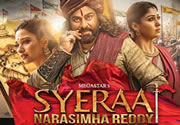
Sye Raa Narasimha Reddy
Synopsis:
Big B is yelling at a bunch of people while looking thoroughly majestic and exhausted all at once.
Okay so before that chaotic shouting match happens in Sye Raa Narasimha Reddy, we need to talk about how this massive epic fits into the wider conversation of historical epics in regional cinema, even though it feels a lot like those giant historical hindi movies we used to watch on lazy Sunday afternoons back in the day, starring Chiranjeevi as the titular freedom fighter who refuses to bow down to the East India Company.
Gosayi Venkanna is hanging out, played by Amitabh Bachchan with this insanely detailed fake beard that probably took three hours in the makeup trailer every single morning, and he's basically the mentor figure who trains our main guy and drops all kinds of ancient wisdom while looking like he'd rather be taking a nap.
And then Siddhartha Reddy is running around doing hero stuff, and there is this random romantic track with Nayanthara playing Siddhamma who is just gazing longingly at Narasimha Reddy during a village festival song that stops the plot dead in its tracks just so everyone can dance in sync, which is honestly standard procedure for big budget bollywood movies and indian cinema at large, but man did it drag down the pacing right when things were getting good.
Tamannaah is also in this as Jaavali, and she's totally devoted to our hero, dancing with swords and showing immense loyalty while the British officers are just sitting in their fancy red coats drinking tea and plotting evil colonial tax hikes.
Stuff happens, local chieftains argue about unity, and people give long passionate speeches about mother India that make you want to stand up and cheer in your living room, and then boom, the interval block hits right when Narasimha Reddy is covered in blood and standing on a pile of defeated soldiers after a jaw-dropping battle sequence that honestly left me gasping for air.
After the popcorn break, Vijay Sethupathi shows up as Raja Pandi, and his entrance is just incredible because he wields this massive heavy sword like it's a feather and brings so much gritty energy to the screen, teaming up with our main squad to form an unstoppable rebellion against the oppressive British rule led by the smug villain Watson.
Betrayal happens because of a greedy local spy, standard stuff really, and suddenly the British forces surround the fort with massive cannons blasting away at the stone walls while people are flying everywhere and slow-motion tragedy is striking every single side character we spent the last two hours getting attached to.
Narasimha Reddy gets captured after a brutal, exhausting hand-to-hand combat sequence that goes on forever and features way too much red fake blood splattering on the camera lens.
They march him to the gallows in front of a huge silent crowd of villagers who are crying their eyes out, and he looks straight up at the sky with total defiance, refusing to show any fear as the British commander gives the final signal.
The executioner drops the lever, the rope tightens, and his body goes still.
Amitabh Bachchan wears a white beard that looks like it was glued on by a particularly tired production assistant working the graveyard shift in Hyderabad, and yet he still manages to sell every single line of dialogue about soil and sacrifice.
Sure, the movie runs close to three hours, which is about forty minutes too long for any historical epic that relies this heavily on slow-motion horse charges and guys getting thrown through thatched roofs. Sure. But director Surender Reddy has an eye for staging mass movement that keeps things afloat even when the screenplay starts repeating its own talking points about freedom and duty. He doesn't reinvent the wheel, but he greases the axle enough to keep the carriage moving through some seriously heavy mud. You can feel the budget up on the screen in almost every frame, though occasionally the digital fire looks like it crawled straight out of a mid-tier 2010 cutscene from a PlayStation 3 game. It's a small thing, but it bugged me every time the background burst into cheap crimson pixels.
Megastar Chiranjeevi takes the lead as Uyyalawada Narasimha Reddy, the Rayalaseema chieftain who decided to annoy the British East India Company a full decade before the 1857 rebellion gets all the ink in textbooks. He has this weary authority that anchors the chaos around him. He walks through battlefields like a man doing chores he's already done twice that morning. When he faces off against English officers who speak with that very specific, elongated theatrical sneer usually reserved for Shakespearean villains in high school auditoriums, he doesn't have to yell to command the frame. He just glares.
Nayanthara plays his wife, Siddhamma, with a quiet dignity that mostly involves looking concerned near doorways and holding lamps while dramatic percussion plays on the soundtrack. It is a thankless, underwritten part that reduces one of our best actors to a narrative prop who exists entirely to validate the hero's moral clarity. Meanwhile, Vijay Sethupathi shows up halfway through as Raja Pandi, an abrasive, sword-wielding rebel from the south who gets precisely three scenes to chew the scenery and promptly steals the whole second act out from under the main cast. He plays the role with a loose, slightly unhinged energy that reminds you of how much fun movies can be when someone stops posing for the poster and just acts.
The cinematography by Rathnavelu is drenched in dust, gold, and copper tones that occasionally cross the line into looking like a dusty amber Instagram filter left on for too long. But when the camera tracks low across the red earth as hundreds of foot soldiers swarm a British outpost, the sheer scale hits you in the chest. Too bad the editing by A. Sreekar Prasad gets choppy during the combat sequences, cutting away too fast from the physical impact just when you want to see where the sword actually landed. You get three quick flashes of a blade, a reaction shot of a guy in a red coat falling backward, and then we are on to the next wide shot of a fortress wall exploding. It makes the action feel less like a tangible physical struggle and more like a geography lesson delivered via fireworks.
Historical epics in India have spent the last decade trying to capture the sweeping, hyper-stylized nationalist fervor of Baahubali, but Sye Raa operates on a slightly more grounded, albeit still thoroughly melodramatic, frequency. It shares more DNA with old-school Bollywood movies of the JP Dutta variety than it does with modern mythological fantasies, leaning hard into speeches about motherland and martyrdom that would feel completely archaic if the cast wasn't selling them with such utter, terrifying sincerity. Even when the script relies on clunky exposition to explain troop movements and taxation laws to the audience, the actors treat every single syllable like it's inscribed on stone.
The soundtrack by Amit Trivedi attempts to blend orchestral bombast with traditional folk instrumentation, and while the battle anthems work well enough to juice up the charging cavalry, the romantic numbers hit the brakes hard. Every time the narrative builds up actual momentum with the rebellion spreading from village to village, the film halts dead for a choreographed dance number in a sunlit courtyard where everyone wears impossibly clean linen. It kills the tension instantly. If I'm honest, historical accuracy went out the window the second everyone started looking like they stepped out of a high-end designer catalog, but stopping a siege to sing a lullaby feels like a bridge too far even for Telugu masala cinema.
What keeps the whole enterprise from completely collapsing under the weight of its own solemnity is the sheer physical commitment of the supporting players, who seem to understand that they are making a popcorn-chomping crowd-pleaser dressed up in historical drapery. You have Tamannaah Bhatia as Lakshmi, executing complex classical dance routines while simultaneously functioning as a spy, and Kiccha Sudeep popping in as a warlord with a fantastic feathered turban and zero patience for British diplomacy. They fill in the gaps left by a screenplay that treats its historical figures less like complex human beings and more like action figures to be smashed together against redcoats.
There is an exhaustion to watching another three-hour historical epic about colonial oppression, a feeling that we have seen these exact same beats played out on the exact same dirt roads with the exact same dialogue about blood and soil. Yet Sye Raa Narasimha Reddy manages to rise above its predictable structure through sheer cinematic volume and the magnetic presence of its lead actor, who carries the final forty minutes on his shoulders alone.
When the dust finally settles and the credits start rolling over a montage of real-world freedom fighters whose names most viewers won't recognize, you realize the movie didn't need to be this long to make its point. It just needed to be loud enough to drown out the silence.