

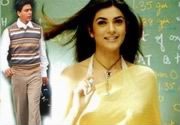
Main Hoon Na
Synopsis:
Picture the scene where Shah Rukh Khan is sitting in a college chemistry lab wearing a totally normal sweater over a shirt and tie, but he is also awkwardly trying to hide his massive adult frame behind school desks while frantically splashing chemicals everywhere because he's trying to impress a bunch of nineteen-year-olds who think he's just a really old freshman. Right after that, things get wild, but to understand why a decorated army major is sitting in a classroom pretending to be a student in one of the most iconic bollywood movies ever made, you have to go back to the very beginning where General Amarjeet Bakshi gets assassinated by a rogue military officer named Raghavan who hates the idea of peace between India and Pakistan. Before the General dies, he asks his loyal soldier Ram Prasad Sharma to find his estranged eldest son and protect his daughter Lucky, which sounds like a standard setup for a gritty war drama, but this is a Farah Khan picture so it's actually an excuse for musical numbers, slow-motion jacket flips, and heavy amounts of high school melodrama. So then Ram goes undercover at St. Paul's College in Darjeeling because that's where Lucky is studying, and he has to juggle his secret mission with dodging a corrupt military conspiracy and dealing with a physics professor who wears the absolute most distracting sheer sarees you've ever seen.
The funny thing is, the entire subplot involving Sushmita Sen as Miss Chandni and her constant wind-machine hair blowing through every single hallway is given way too much screen time compared to the actual espionage plot, and I swear she has about twenty different outfits that all seem to defy the laws of physics and regular campus dress codes. Ram falls instantly in love with her whenever she walks into a room because the chalk dust literally sparkles around her, and she can't stop staring at him either, especially when he starts doing dramatic guitar solos during the college talent show or randomly breaking into choreographed dance steps in the middle of a lecture hall. Anyway, Lucky is played by Zayed Khan with frosted tips and a permanent attitude, and he totally bullies Ram at first because he doesn't know Ram is actually his half-brother, which leads to a ridiculous rowing race where Ram has to save the day using sheer determination and patriotic background music. That whole rivalry gets resolved fast.
Raghavan finds out about Ram's true identity and he sends his henchmen to the college campus, and pretty soon there are machine guns firing at the dormitories and explosions happening right outside the library while students are just trying to study for midterms, and honestly it's a miracle anyone graduated. Ram manages to kick down doors and throw bad guys through windows while using a chalkboard as a shield, and he protects everyone because that's just the kind of hero he is in these big hindi films. He uses a special gadget watch to figure out the mastermind's plan, and he realizes he has to take the fight straight to the enemy base to save the day once and for all. Main Hoon Na really delivers on the action front when it counts.
Right after the campus gets wrecked, Ram packs his bags and heads off to confront Raghavan directly at the project milap headquarters where the historic peace summit is happening, and he has to sneak through ventilation shafts and fight off a bunch of heavily armed mercenaries in hand-to-hand combat while dodging bullets left and right. The fight choreography gets super intense with glass shattering and tables breaking, and Ram takes a few heavy hits but he keeps getting back up because he's got unfinished business and a promise to keep to his dying general. He finally corners Raghavan on the roof during a stormy climax, and after a brutal fistfight that leaves them both bruised and exhausted, Ram overpowers the traitor and drops him off the edge, leaving him hanging by his fingertips before pulling him back up just enough to deliver a punchline and hand him over to the authorities. Ram salutes his superior officers, reunites his broken family by revealing the truth to Lucky and his stepmother, and walks off into the sunset with Chandni by his side as the whole cast bursts into one final energetic dance number that wraps up another classic entry in the rich history of hindi movies and broader bollywood culture.
Farah Khan is doing too many things with the camera in the opening sequence of Main Hoon Na and honestly it makes my eyes hurt a little bit, all those rapid pans and sudden digital zooms that belong on a soap opera rather than a major studio picture with Shah Rukh Khan on the poster. If I'm honest, the whole prologue set during a terrorist attack on a bridge looks like it was lit with hardware store worklights and edited by someone who had just discovered the dissolve transition, which sets an alarming tone for a movie that cost a fortune and bears the weight of launching a new directorial career. Yet somehow, right as you are ready to write the thing off as another over-budgeted mess of the early noughties, the narrative shifts gears so violently that you are forced to recalibrate your expectations, moving from a geopolitical thriller that makes absolutely zero sense into a college musical about estranged brothers and secret service missions disguised as chemistry lectures.
The plot, if one can dignify such a sprawling contraption with that word, concerns Major Ram Prasad Sharma going undercover at St. Paul's College in Darjeeling to protect the daughter of a general while simultaneously fulfilling a deathbed promise to his father by tracking down his forgotten stepmother and half-brother. Shah Rukh plays Ram with that specific brand of earnest sincerity that either makes you weep or makes you check your watch, projecting an immovable moral center through a heavy leather jacket and aviator sunglasses that never seem to slip even during a slow-motion dance number in the rain. Beside him, Zayed Khan plays Lakshman, the aforementioned half-brother, as a cartoonish slacker who spends his days riding skateboards and dodging professors, sporting frosted tips that look like a tactical error committed by the hair and makeup department. The chemistry between the two leads is entirely one-sided, with Shah Rukh treating every scene like a Shakespearean confrontation while Zayed is just trying to remember his marks and look cool for the camera, resulting in an odd dynamic that somehow fits the manic energy of Hindi films from that particular decade.
Then there is Sushmita Sen as Miss Chandni, the chemistry teacher who apparently owns only translucent chiffon sarees that blow dramatically in mountain breezes that exist exclusively around her person. Sushmita walks through the frame with a languid, amused grace that suggests she knows the movie is ridiculous and has decided to just enjoy the scenery, delivering her lines with a throaty purr that reduces Shah Rukh's hard-boiled soldier to a stammering schoolboy whenever she enters the faculty room. It is a performance that leans heavily on star persona rather than dramatic heavy lifting, much like her turn in Samandar where she mostly just had to stand on a yacht and look unattainable, but it works because the film needs a grounding force of pure charisma when the plot mechanics start squeaking too loudly. Sunil Shetty, meanwhile, plays the villain Raghavan with the sort of scenery-chewing intensity that involves a lot of gravelly whispering and sudden throat-slittings, looking very serious in black tactical gear while everyone else is playing dodgeball or singing about friendship in the quad.
Farah Khan's direction is a messy, exuberant collage of homages to everything from West Side Story to the classic action cinema of the eighties, borrowing visual tropes without ever quite figuring out how to stitch them together into a seamless whole. The action sequences, choreographed by stunt coordinator Allan Amin, rely far too heavily on wirework that makes the actors float about like balloons whenever a punch lands, robbing the fights of any physical weight or danger. Still, there is a certain demented charm to the way she stages a slow-motion cartwheel during a college brawl or cuts from a sniper rifle firing to a student dropping a tray of cafeteria food, displaying a total lack of cynicism that keeps you watching even when the logic of the narrative has completely disintegrated. Anu Malik's soundtrack hits the theater with the subtlety of a brass band falling down a concrete staircase, recycling rhythmic motifs from Dil Se and Kuch Kuch Hota Hai until every emotional beat has a familiar orchestral cue attached to it, though the title track remains an earworm that will stubbornly lodge itself in your skull for days after the credits roll.
The film attempts to address Indo-Pakistani peace talks through the framing device of Project Milaap, a diplomatic initiative meant to release civilian prisoners from both nations, which feels wildly ambitious for a project that spends twenty minutes on a student election featuring a musical number about a geeky girl getting a makeover. This tonal whiplash is actually where the movie finds its most interesting contradictions, sliding effortlessly from broad slapstick involving Amrita Rao spitting food across a canteen to genuinely tense moments where Ram has to protect his charge from a sniper bullet while pretending to lecture on organic compounds. It is a peculiar kind of commercial cinema that only Bollywood could produce with this level of financial backing and unearned confidence, refusing to choose between a serious political drama and a colorful campus romance and instead choosing to smash both together until the seams burst. The supporting cast includes veterans like Naseeruddin Shah and Kirron Kher who pitch their performances at entirely different volumes, with Shah delivering his final monologue with heartbreaking gravity while Kher plays the grieving mother as a screeching caricature of suburban melodrama, and somehow the collision of these two acting styles tells you everything you need to know about the fractured family at the center of the story.
There is a recurring visual motif involving Ram's chronic back injury that flares up whenever he experiences emotional stress, and it is a small, silly detail that the screenplay uses as a punchline at least four times too often, becoming the kind of mechanical annoyance that ruins the rhythm of otherwise decent dramatic scenes. Every single time the man tries to have a serious conversation about his father's dying wish, he has to grab his lower lumbar region and wince in pain while the score drops a comical little slide whistle note, which might have seemed funny in the writers' room but translates on screen as an unnecessary distraction from the actual emotional stakes. It's a minor mechanical flaw in a film that is practically built out of loose screws and mismatched parts, yet it sticks in the craw because the movie clearly knows how to handle big emotional beats when it drops the comedy routine.
The cinematography by V. Manikandan alternates wildly between gorgeous landscape shots of Darjeeling shrouded in mist and blindingly over-lit indoor sets that look like a furniture showroom during a liquidation sale, capturing the schizophrenic aesthetic of the era when digital grading was just starting to mess with traditional film stocks. You can practically feel the sweat of the crew trying to keep up with Farah's relentless blocking, which often crams twenty background dancers and three principal actors into a tiny classroom set that was never designed to hold that much enthusiasm. It's an exhausting movie to watch in one sitting because it never stops moving, never pauses to let a character simply exist without a camera swoop or a musical cue pushing them toward the next gag, but that relentless forward momentum is also its primary defense against critical scrutiny. You do not have time to pick apart the plot holes about university security protocols or the logistics of sneaking a military sniper into a girls' dormitory because the next song is already starting and Boman Irani is busy spitting food all over his desk as the comically stressed-out principal.
By the time Ram stands before the assembled student body to deliver a climactic speech about unity and forgiveness that sounds like it was written by a committee of middle school civics teachers, the film has completely abandoned any remaining pretense of being a grounded thriller and settled comfortably into the realm of pure, unadulterated fantasy. It is not a masterpiece of construction or narrative restraint, and anyone looking for a tight genre exercise will likely find themselves tearing their hair out within the first twenty minutes of exposition. Yet Main Hoon Na persists through sheer force of will and the undeniable star wattage of Shah Rukh Khan, who manages to sell the most ridiculous emotional beats with a level of commitment that shames the material around him. You leave the theater feeling slightly bruised by the sheer volume of the enterprise, wondering how a movie about international espionage, sibling rivalry, and college elections managed to hold together for nearly three hours without completely collapsing under the weight of its own absurd ambitions, and while you might complain about the digital zooms or the repetitive needle drops, you cannot honestly say you were bored for a single second.