

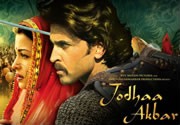
Jodhaa Akbar
Synopsis:
Hrithik Roshan’s nostrils flare with such relentless frequency in the first forty minutes of Ashutosh Gowariker's historical epic that you start mentally counting them just to stay awake through the armor-fitting montages. It is a small thing, but it bugged me throughout a runtime that demands considerable patience from anyone who didn't grow up memorizing Amar Chitra Katha comics. Hindi movies have long possessed an appetite for monumental scale, yet few modern directors approach that canvas with the agonizing, slow-drip deliberation that Gowariker brings to the sixteenth-century union of Mughal Emperor Jalaluddin Muhammad Akbar and Rajput princess Jodhaa. This is a picture that refuses to hurry, lingering on the friction of hot coals and the exact weight of a gold-plated breastplate long after any other filmmaker would have cut to the battle scene.
The screenplay by Haider Ali and Gowariker functions less like a standard dramatic narrative and more like a series of heavily upholstered tableaux that happen to move. Instead of relying on fast-paced political intrigue, the script lets entire scenes breathe through silence, mutual suspicion, and the careful clink of heavy jewelry. You watch Akbar try to navigate a court full of scheming uncles and suspicious advisors while simultaneously attempting to figure out how to speak to his new wife without starting a war, and the domestic comedy of manners overlaps strangely with bloody imperial expansion. It isn't a tight narrative by any stretch, often bloating in the middle act with secondary plots involving rebellious brothers-in-law and disgruntled courtiers who exist purely to give the emperor someone to glare at from atop a warhorse.
Yet the physical production carries a staggering amount of weight, largely because cinematographer Kiran Deohans frames every courtyard and tent drape as though natural sunlight were paying rent to be there. The color palette abandons the garish neon primaries that so frequently sink contemporary Bollywood into a visual swamp, favoring dust-choked golds, deep crimsons, and the cool slate blues of stone fortresses at dawn. Even when the editing stumbles—cutting away from reaction shots a beat too late, leaving actors blinking in mid-air—the sheer tactility of the frame rescues the scene. You can almost smell the horse sweat, the heavy attar of roses, and the charcoal smoke wafting through the imperial camp kitchens.
Aishwarya Rai enters this world with the calm poise of a marble statue that has suddenly decided to talk back, playing Jodhaa not as a victim of political marriage but as a woman who treats her new husband like an unexploded bomb in her living room. Her chemistry with Roshan avoids the usual breathy romantic clichés, relying instead on locked jaws, sharp sideways glances, and an ongoing, silent negotiation over who actually holds the moral authority in the tent. When they finally share a sword-fighting sequence, the metal clangs with genuine competitive annoyance rather than choreographed passion. Rai manages to make royal duty look physically exhausting, a rare feat in a genre where princesses usually glide through palaces as if floating on invisible wheels.
Across from her, Roshan anchors the historical framework with a performance that grows on you precisely because it avoids the booming, theatrical bombast of traditional period villains and heroes alike. He plays Akbar as an insecure giant, a man who conquered half of India before his twentieth birthday yet clearly has no idea how to ask his wife to pass the salt without causing an international incident. There's a particular scene where he stands alone in a dim prayer hall, whispering Arabic verses to a God he isn't sure is listening, and Roshan lets his voice crack just enough to puncture the imperial myth-making. It recalls Kamal Haasan’s meticulous, physical character work in *Hey Ram*, where grand historical movements are constantly undercut by the petty, sweaty panic of the men caught inside them.
A.R. Rahman’s score does something strange to the pacing, stretching time out until three hours feel like five while making the journey strangely addictive. The recurring motifs drift through the palace corridors like woodsmoke, never overpowering the dialogue but swelling just enough to tell you when a political alliance is about to curdle into betrayal. Sure, the title track gets recycled a few too many times during random walking sequences, but the sheer melodic warmth of the instrumentation keeps the machinery humming through the duller stretches of land reform debates.
The film commits hard to a secular ideology that feels increasingly archaic in modern public life, presenting an India where religious tolerance is forged through stubborn compromise and literal marital bed negotiations. Akbar’s abolition of the jizya tax on non-Muslims isn't treated as a dry historical footnote, but as a hard-won domestic argument that spilled over into statecraft. This is where the epic loses some of its momentum, trading sword fights for long, earnest discussions about pluralism that occasionally sound like they were pulled straight from a high school civics textbook. You can see the message coming a mile away, and yet the actors commit to the sincerity of the argument with such unblinking conviction that you forgive the heavy-handedness.
By the time the elephant stampedes and massive siege engines finally arrive in the third act, the sheer scale of the production starts to feel less like a boast and more like an endurance test for both the characters and the audience. Gowariker directs the battles with a wide lens that lets you track individual soldiers getting trampled underfoot, avoiding the shaky-cam chaos that turns modern action into gray sludge. It's a messy, gorgeous, overstuffed piece of commercial cinema that demands you surrender your afternoon to its slow, rhythmic breathing. You leave the theater thinking less about the grand sweep of the Mughal empire and more about the way a simple look across a dinner table can change the map of a continent.