

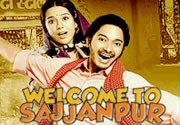
Welcome to Sajjanpur
Synopsis:
Halfway through Welcome to Sajjanpur, Shreyas Talpade is sitting at his little wooden desk under a dusty banyan tree looking completely stressed out while people scream at him about goats and government paperwork, and honestly it's just such a chaotic vibe. But to understand why this poor guy is sweating through his kurta in the middle of a village square, you have to look at how this whole mess started in the first place, which brings us back to the fact that he plays Mahadev, an aspiring writer who can't get his actual creative novels published and instead makes a living writing letters for illiterate villagers who mostly just want to fight with their relatives or confess secret crushes. The funny thing is, a lot of hindi movies usually focus on city drama or rich people falling in love, but this one plants itself firmly in rural chaos where the biggest drama involves cows and local elections. Mahadev is hopelessly in love with his childhood friend Kamla, played by Amrita Rao, but she gets married off to some brute who immediately goes missing or gets sent away, leaving her stranded as a young bride back in the village. So then Mahadev spends all his time pining after her while she stands by a well looking tragic in her red and yellow sari, and I have to mention this specific scene where she's scrubbing a very dirty brass pot with ash and mud for what feels like ten straight minutes, really aggressively scouring the bottom while complaining about her mother-in-law's cooking, and it's just so mundane yet weirdly hypnotic to watch on screen. Right after that hyper-specific domestic chore, Mahadev gets roped into local politics because Ravi Kishan shows up playing Bansi, a loud, obnoxious, muscle-headed politician who wants to win the upcoming election by any means necessary, and he's wearing these ridiculously bright printed shirts and chewing paan the whole time. Bansi doesn't know how to read or write either, obviously, so he uses Mahadev's letter-writing service to dictate aggressive campaign speeches and love notes, and the power dynamic shifts completely.
Anyway, the entire village is completely obsessed with literacy rates and government schemes and sending letters to distant spouses, so Mahadev's little desk becomes the epicenter of every single scandal in town, including this one hilarious subplot where an older man wants to divorce his goat, or rather, write a legal petition about a goat dispute, and everyone just gathers around shouting opinions. The government announces a reservation for a female candidate for the local leadership seat, and Bansi decides he's going to run his own illiterate wife for the position so he can rule through her, but things get messy because other factions have the same idea. The women of the village start waking up and realizing they don't want to just be puppets for their husbands, and Kamla gets drawn into the political madness too, because she actually starts learning things and speaking up at town meetings, which completely ruins Mahadev's quiet fantasies of her just sitting by the well waiting for him to write her a poem. People start dictating petitions to the district collector about dry wells, broken roads, and corrupt local officials, and Mahadev writes all these fiery complaints that end up shaking up the whole district bureaucracy, and bollywood movies don't usually spend this much time on bureaucratic paperwork grievances, but it works. Bansi tries to bribe everyone with cheap liquor and unfulfilled promises of electricity, but the villagers are getting smarter because Mahadev is accidentally educating them through all the complaint letters he drafts every afternoon. There's this huge public shouting match near the village pond where accusations fly about stolen grain and fake marriage certificates, and everybody is sweating and waving their arms around while stray dogs bark in the background. Mahadev tries to stay neutral because he just wants to finish his manuscript and marry Kamla, but he's too deeply entangled in everyone's personal business now, and he can't even walk to the tea stall without three people handing him crumpled pieces of paper with grievances scribbled on them. It is total madness.
Things reach a boiling point on election day when all the shady tricks come out, ballot boxes almost get stolen, and Ravi Kishan's character goes completely wild trying to intimidate voters while wearing a massive marigold garland that keeps slipping down his neck. The votes get counted in the town hall under the flickering light of a single weak bulb surrounded by dozens of buzzing insects, and the entire village holds its breath while the local official reads out the names. Mahadev finally stops hiding behind his shy writer persona and stands up in front of the whole angry crowd to deliver a speech about how everyone deserves to have their own voice heard without needing a middleman to translate their feelings into officialese. Kamla looks right at him with a mix of respect and realization, finally seeing him as an actual man instead of just the neighborhood scribe who used to share roasted corn with her when they were kids. The election results are announced, old rivalries shatter into a million pieces, and the power structure in the village is completely rearranged by people who couldn't even sign their own names six months ago. Mahadev packs up his wooden desk, tucks his unfinished novel manuscript under his arm, and walks away from the banyan tree as the sun sets over the dusty fields of Sajjanpur while Kamla walks beside him. He drops his pen in the dirt and leaves it there.
The blue ink keeps leaking on Shreyas Talpade’s fingers, right around the second knuckle, and if I am honest that messy little detail bothered me more than the resolution of the third act. We are supposed to be watching a satire about literacy and bureaucratic idiocy in the heartland, yet I found myself staring at a smudge of dye that hadn't been continuity-checked between shots of letter-writing. Shyam Benegal made Welcome to Sajjanpur when he was well past the age where directors usually bother with comedies about rural electoral politics, leaning instead into a kind of dusty, sun-bleached patience that doesn't care if you're keeping up with the subplots.
It shares a certain shaggy-dog DNA with Jaane Bhi Do Yaaro, though without the hysterical momentum that leaves you gasping for air by the credits. Here, everything moves at the speed of a bullock cart slogging through unpaved mud after an erratic monsoon, which works for stretches before threatening to stall out entirely. The screenplay by Ashok Mishra treats illiteracy not as a grand societal tragedy requiring a speech from the front of a jeep, but as a tedious daily inconvenience solved one dictated postcard at a time. Mahadev Prasad, the aspiring novelist turned professional letter-writer sitting under the banyan tree outside the post office, doesn't want to save his village from feudal corruption; he just wants his government job application to clear and maybe a glimpse of Amrita Rao walking past with an empty pitcher.
Talpade plays Mahadev with a permanent, slightly damp look of grievance, the kind of guy who thinks he is the smartest person in the district simply because he owns a dictionary and a spare white shirt. He lacks the manic energy he brought to Iqbal, opting for a softer, slightly cowardly posture that makes his occasional bursts of moral cowardice sting a bit more. He writes love letters for illiterate housewives and threatening notes for local thugs with the exact same deadpan neutrality, turning the public square into an open-air confessional where nobody actually confesses anything important. It is a performance built out of small, hesitant pauses—the way he licks the nib of his fountain pen before committing someone else's secret to cheap government stationery, or how he averts his eyes when a bribe is slipped under the blotter.
Amrita Rao plays Kamla, the childhood sweetheart who has been married off to a minor currently serving time in a distant jail, with a straightforwardness that borders on plain. She doesn't get many flashy emotional beats, mostly because her character spends the first hour of the film as a silent symbol of rural endurance before suddenly developing opinions about local government. The chemistry between them relies entirely on stolen glances across dusty courtyards, backed by a background score that occasionally remembers it needs to sound folksy and ramps up the dholak loops with zero subtlety. Ravi Kishan steals practically every scene he wanders into as Banshidhar Pandey, a local politician whose campaign strategy involves promising goats to voters who already know he's going to steal the panchayat funds. He plays the part with a greasy, wide-grinned confidence that makes you wish the movie had just abandoned the romantic entanglements and followed him around the backroads instead.
The cinematography by Rajan Palit refuses to romanticize the dust. This is not the glossy, postcard-ready rural interior you find in a lot of contemporary Hindi movies, where every cow looks like it was brushed ten minutes before the director called action. The light is harsh, flattening out the mud-brick walls and bleaching the saris until the colors look baked out by noon. Shantanu Moitra’s music sits lightly on top of these images without trying to push the emotion down your throat, though there is a recurring flute motif that plays during the romantic close-ups which feels like it wandered in from a different, more expensive production. It is a small thing, but the sound mixing on the crowd scenes occasionally drops the ambient chatter so abruptly that you can tell the dialogue was looped in an air-conditioned studio in Bandra three months after the cameras stopped rolling.
Satire in mainstream Hindi cinema usually relies on a sledgehammer, but Benegal prefers a dull butter knife, sawing away at caste hierarchies and electoral hypocrisy with an exhausted shrug. The village of Sajjanpur is populated by grotesque caricatures who somehow manage to feel entirely authentic to anyone who has ever spent a weekend dealing with a local patwari over land revenue records. There is a transgender candidate running for the local election whose campaign arc feels rushed and tokenistic, shoehorned in to check off a box about inclusive democracy before the script hurries back to Mahadev’s romantic troubles. Yet the film gets away with its structural looseness because it understands that small-town life isn't driven by dramatic turning points but by gossip, petty revenge, and waiting around for the afternoon bus that never arrives on time.
We have seen this territory covered better by lesser-known indie releases that didn't have the backing of major studios, yet there is a steady, workmanlike competence to how Benegal frames a conversation between two elders sitting on a charpoy. He doesn't need to tilt the camera to show you who holds the power in a scene. He just lets the frame stay wide enough to include the guy standing in the background holding a pair of shoes. That attention to the social background keeps the movie grounded even when the plotting gets a bit silly, like when Mahadev gets roped into writing anonymous poison pen letters that accidentally start a communal riot over a goat. It is not great, not bad, just there, idling in the heat with its characters while the ink dries on another batch of lies.
When the election finally arrives, the film avoids the temptation to deliver a neat moral lesson about the triumph of grassroots democracy over feudal power. The corrupt politician wins some seats, the minor characters go back to their fields, and Mahadev is still sitting under his tree waiting for a postal clerk position that isn't coming. The fade-out is abrupt, almost careless, leaving you with the image of a dusty square where nobody learned anything of permanent value. That feels about right for a story set in a place called Sajjanpur, where the only thing guaranteed to survive the changing of the guard is the smudge of blue ink on a cheap white shirt.