

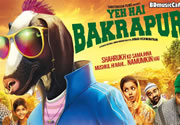
Yeh Hai Bakrapur
vcdSynopsis:
Shahid wakes up in a cold sweat because his beloved pet goat has just been stolen right from under his nose, and honestly the sheer panic on his face is something you only get in very specific low-budget hindi movies where the stakes are somehow both insanely low and the absolute center of the universe.
So then, to understand why a grown man is crying over a missing ruminant in rural India, we gotta go back to the start of Yeh Hai Bakrapur, which is a wild little satire that doesn't care about your polite sensibilities and just dives headfirst into village politics.
The Qureshi family is drowning in debt, and Qureshi, played wonderfully by Asif Basra, is just trying to survive while his wife Begum, brought to life by Suruchi Aulakh, worries about paying off the local butcher and keeping the household afloat.
They own this gorgeous little black goat named Shahrukh, and everybody in the neighborhood treats this animal like a minor celebrity, especially after young Shahid, played by Anshuman Jha with maximum earnestness, starts treating the creature like his actual brother.
Shahid has this one specific grey vest he wears in like four different scenes that is somehow both dirty and totally iconic, complete with a frayed collar that probably smelled like goat feed and bad decisions.
The funny thing is that Qureshi realizes they can make some serious cash off this animal because a local cleric drops a rumor that the goat has Arabic markings on its side that spell out a holy word, and suddenly every single person in the village loses their absolute minds.
Politicians get involved, greedy businessmen start circling, and the whole town turns into a circus where everyone wants a piece of this magical beast, making you wonder what kind of weird parallel universe you wandered into while watching modern bollywood.
Right after that madness kicks into high gear, the movie drops this random song sequence where people are dancing around in a dusty yard, which is classic for bollywood movies that love to throw a musical number right when the plot is getting tense just to make sure you didn't forget you were watching a commercial masala product.
Then we slam right into the interval block where the goat gets auctioned off for a ridiculous sum of money, and everyone is screaming at each other over pen fences while the camera zooms in on the goat chewing grass like it hasn't a single care in the world.
Anyway, things escalate so fast that the police have to get involved, and the local MLA tries to hijack the animal for his own election campaign because nothing says winning votes quite like exploiting a religious superstition over a farm animal.
Shahid is running through the dirt lanes trying to get his buddy back, dodging corrupt cops and local goons who want to sacrifice the goat or sell it to the highest bidder for political mileage.
The chaos reaches a boiling point when a massive mob gathers outside the house, reporters are shoving microphones in Qureshi's face, and the poor family is trapped inside wondering how a simple pet turned into a literal riot.
They try to smuggle the goat out through the back alley under a burlap sack, but somebody spots them, and a full-on foot chase erupts through the crowded market stalls where cabbages are flying everywhere and bicycles get crushed under angry feet.
Yaushika Varma shows up in the middle of this mess trying to voice some sense into the screaming crowd, but nobody is listening to reason because the entire village has completely lost its collective grip on reality over this stupid animal.
The madness peaks when rival factions start fighting over who actually owns the rights to the holy markings, turning a peaceful afternoon into a slapstick warzone straight out of the wildest independent hindi films ever made.
Shahid finally manages to grab the tether rope from a distracted guard, leaps over a wooden barricade, and drags the confused goat into a waiting truck just as the local police sirens start wailing in the distance.
The truck grinds its gears, belches a huge cloud of black diesel smoke into the faces of the angry mob, and barrels down the dusty highway out of town.
Shah Rukh Khan's oversized poster outside a fading storefront in rural Bihar looks less like a star endorsement and more like a faded deity keeping watch over an absurd comedy that refuses to play by the usual rules of commercial Hindi movies. Right from the opening minutes, Janaki Vishwanathan’s film makes you acutely aware of the dust settling on small-town aspirations, even if the sound design occasionally muddies the dialogue so badly you miss half the jokes because someone decided to mix the background goats a bit too loud.
The plot hangs on Shahru, a pampered goat with a star painted on his side who accidentally becomes a political symbol and local messapiah. It is a premise that could easily have collapsed into broad, exhausting farce, but the screenplay manages to sidestep the worst clichés by keeping its focus small and grimy, dealing in real economic desperation rather than glossy countryside aestheticism. If I'm honest, the first half hour drags quite a bit while it sets up the various factions trying to cash in on the animal's sudden fame, lingering on reaction shots of local politicians that outstay their welcome by at least two beats.
Anshuman Jha plays the opportunistic young man trying to monetize the beast with a kind of desperate, frantic energy that saves the character from being purely despicable, grounding the satire in genuine lower-middle-class panic. He has this specific way of widening his eyes when a bribe fails or a crowd turns that reminds me of Rajat Kapoor in "Ankhon Dekhi"—that same weary recognition that the world is spinning past him while he is stuck calculating pennies. Opposite him, Asif Basra brings a lived-in, tobacco-stained weariness to the local politician who sees the goat not as a religious icon but as a polling booth strategy, playing every scene with a casual ruthlessness that feels entirely earned.
Suruchi Aulakh and Yaushika Varma fill out the domestic spaces with a quiet friction that keeps the satire from floating away into pure cartoon logic, though there is a supporting uncle in the second act whose post-dubbed dialogue sounds so detached from his mouth movements it takes you right out of the movie every time he opens his jaw. The cinematography embraces a bleached, unfiltered look at dusty lanes and cramped concrete rooms, refusing to romanticize the poverty while still finding moments of genuine visual wit in the way humans crowd around an animal who clearly has no idea what is happening. The music stays mostly out of the way, which is a mercy, save for a recurring acoustic motif that pops up whenever the goat does something slightly unusual.
What saves the picture from becoming a one-note joke about gullible villagers is the way it maps out the terrifying speed at which collective hysteria curdles into bigotry and opportunistic capitalism. Bollywood movies love to treat rural settings as either pastoral dreamscapes or moral vacuums, but Vishwanathan treats this dusty corner like a complex ecosystem where media manipulation and ancient superstitions merge seamlessly into a terrifying new marketplace. The satire bites hard when it targets the news media and the local netas who will weaponize literally anything—even a stray ruminant with an accidental star on its flank—to secure a few votes or minutes of airtime.
It is not a polished piece of cinema by any stretch, often looking closer to a television pilot than a feature meant for theatrical distribution, but its rough edges give it a texture that slicker productions usually polish away. When the credits finally roll, you are left thinking less about the grand social commentary and more about the sheer exhaustion of trying to get by in a system that turns everything, from faith to farm animals, into a commodity to be traded and discarded.