

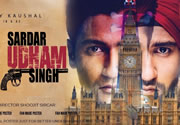
Sadar Udham
Synopsis:
Vicky Kaushal is staring blankly at a cold stone wall while wearing a horribly itchy-looking brown wool coat that honestly looks like it was fished out of a muddy puddle behind a pub and never washed, and he's just sitting there in total silence in a bleak British prison cell while an investigator annoys him with questions.
Let's back up because Sardar Udham is not your average run-of-the-mill entry into the usual loud catalog of bollywood movies where everyone bursts into synchronized dance routines every five minutes, though trust me, this historical drama hits way harder than most standard hindi films you'll watch on a lazy Sunday.
The whole story kicks off with Vicky Kaushal playing Udham Singh, a guy who's deeply traumatized, quiet, and hiding in plain sight in London after surviving the absolute nightmare of the Jallianwala Bagh massacre back in 1919.
God, the massacre scenes are brutal and chaotic and messy, showing kids running for cover and blood pooling everywhere while British troops just fire endlessly into a trapped crowd.
Udham is running around pulling bodies out of piles and wrapping wounds, and this horrifying afternoon alters his entire brain chemistry forever because he spends the next two decades plotting a very specific revenge mission against Sir Michael O'Dwyer, played by Stephen Hogan with the most punchable aristocratic sneer ever captured on film.
He wanders through various European cities, works odd jobs, and connects with other revolutionaries like Bhagat Singh, who is this fiery, inspiring icon that Udham practically worships like a god.
And then boom, we hit the interval block right in the middle of a tense conversation about weapons smuggling, which always feels so delightfully old-school for bollywood where the projectionist literally stops the reel so you can go buy an overpriced tub of popcorn and complain about your friend's terrible taste in snacks.
After the break, the movie slows down into this deeply hypnotic, snail-paced character study where Udham adopts the alias Ram Mohammad Singh Azad, blending three major Indian religions into one single name to prove a point about unity, which is honestly a great subtle flex.
He spends months blending into the foggy London dampness, wearing that exact same ugly brown coat, buying a revolver off shady black-market dealers, and stalking O'Dwyer through high-society events where posh British folks sip tea and chat about golf.
Stuff happens so fast during the actual assassination sequence that you almost miss it—Udham just walks into Caxton Hall, fires a couple of shots into O'Dwyer's back, and doesn't even try to run away because his life's work is finally complete.
Sam Redford pops up as one of the interrogators trying to break Udham down in custody, but our boy just sits there refusing to give them the satisfaction of a panicked confession.
They yell at him, they wave documents in his face, and they demand to know why a humble working-class guy would travel halfway across the globe just to make a bloody political statement.
Udham looks straight across the table at his captors, delivers a chilling monologue about the thousands of innocent people who died in Amritsar, and makes it clear that imperialism is an absolute disease that deserves to be eradicated.
They march him down a damp stone hallway toward the gallows, his feet shuffling against the concrete while the heavy prison door swings open to reveal the rope hanging silently in the dim morning light.
Vicky Kaushal breathes heavily through a fog of damp wool and stale prison tea about twenty minutes into Shoojit Sircar's historical biography, and if I'm honest, that single rasp tells you more about the British Raj than three hours of standard prestige television. We get endless period dramas about men shouting noble declarations from horses, but rarely do we sit in the actual grease of the thing. This is a film that refuses to hurry its steps, moving with the sluggish, heavy deliberation of damp coal shifting in a basement grate. It takes its time. Sometimes too much time, as when the camera lingers on a muddy boot or a peeling wallpaper strip for an extra three beats after the dialogue has finished, turning narrative momentum into a war of attrition against the viewer's patience.
Shoojit Sircar has always worked best when he strips away the shiny gloss typically associated with Bollywood productions, finding grit in domestic corners and bureaucratic hallways. Here he abandons conventional three-act architecture entirely, preferring instead to fracture time into splintered shards that bleed into each other without warning. You are in 1919 Punjab one second, smelling the dust and the cordite, and then abruptly stranded in 1930s London where the rain hits the pavement with a flat, greasy sound. The screenplay by Shubendu Bhattacharya and Ritesh Shah is structurally audacious because it denies us the comfort of a rising narrative curve. It circles the same traumatic event like a dog chained to a post, biting at the dirt until nothing is left except exposed roots. Dialogue is sparse, delivered in flat, exhausted murmurs that sound less like movie lines and more like what people actually say when they are too tired to argue anymore.
Then there is Stephen Hogan as Michael O'Dwyer, who avoids every single trap of the mustache-twirling colonial villain we usually tolerate in Hindi films. Hogan plays the former Lieutenant Governor with a terrifying, banality-of-evil casualness, reading his morning correspondence while men bleed three thousand miles away, treating the subcontinent as a ledger entry that occasionally needs auditing. He isn't loud. He doesn't bellow racist insults from a balcony. He simply exists in his tweed suits with an absolute, calcified certainty that his God gave him the right to manage other people's lungs, which makes the eventual reckoning feel less like cinematic justice and more like a messy, unfortunate administrative error.
And yet the film rests entirely on Kaushal’s shoulders, a lead performance that requires him to age twenty years through posture alone rather than prosthetics that distract from the brow. He plays Udham Singh as a ghost who forgot to die, moving through boarding houses and industrial yards with his shoulders permanently hitched toward his ears as if bracing for a blow that never quite lands. When he speaks, his voice has the dry rattle of gravel sliding down a chute. There's a scene in a London pub where he simply sits across from Sam Redford's detective character, not saying a word, just watching a pint of stout settle with an intensity that makes you want to check your own pockets for weapons. Redford holds his own against that steady, unnerving stare, though the sound mixing in their interrogation room scenes occasionally makes the dialogue bounce off the back wall with a hollow ring that sounds distinctly like a loop recorded in a Mumbai studio three months after the shoot wrapped.
Avik Mukhopadhyay’s cinematography deserves its own separate credit, though not because it's pretty in the postcard sense. It is aggressively drab. The color palette looks like it was scraped off the bottom of a zinc bucket, full of slate grays and wet-brick browns that drain the romance out of anti-colonial resistance. Even the sunlight feels bruised, filtering through greasy London windowpanes or dusty Punjab haze without ever offering any real warmth. Shantanu Moitra’s score avoids the bombastic brass sections that usually accompany historical epics, relying instead on low cello groans and the occasional dry scrape of a cello bow that sounds suspiciously like a rusty gate hinge. It underscores the psychological rot of occupation rather than the soaring triumph of freedom fighters, treating history as a series of open wounds that refuse to scab over.
Historical biopics about anti-colonial martyrs usually fall into the trap of hagiography, turning complicated human beings into bronze statues before the opening credits even finish rolling. Sircar and Kaushal actively resist this impulse by making Singh boring, petty, and exhausted, a man who spends months of his life planning an assassination while worrying about his laundry and whether his boots have soles thick enough for the English drizzle. We see the dull mechanics of revolution, which mostly involve sitting on benches in the damp cold and eating cold porridge out of tin bowls while waiting for someone important to walk through a specific doorway. It brings to mind Steven Spielberg's *Munich*, another long film about the tedious, soul-corroding weight of targeted vengeance, though this picture lacks the propulsive genre thrills of that thriller. It is slower, flatter, and infinitely more interested in the silence that follows a gunshot than the flash of the barrel.
The Jallianwala Bagh sequence itself is handled with a devastating lack of cinematic punctuation, refusing to give us the slow-motion aestheticized violence we have been trained to expect from modern blockbusters. People fall, they scramble, they hide behind brick walls that offer no cover, and the sound design drops all musical accompaniment to leave only the wet thud of boots in mud and the high, thin screaming of children. It is not an easy sequence to watch, not because of gore, but because of its terrifying ordinariness. When you look at the wider landscape of Hindi movies dealing with the freedom struggle, most prefer the safe comfort of flag-waving melodrama and rousing speeches delivered against painted backdrops. This film looks at the same history and finds only ash and paperwork, leaving you with the distinct impression that history is something that happens to people who are simply too tired to get out of the way.
By the time the judicial proceedings roll around in the final reel, the narrative momentum has slowed to a complete crawl, testing the audience's endurance with long, unedited stretches of legal wrangling that feel genuinely arduous. Some viewers will check their watches here, wishing for a brisk montage or an emotional final monologue that ties the ideological stakes into a neat little bow. But the film denies you that release valve, ending instead on a quiet, lingering note that suggests nothing has really been resolved except that one old bureaucrat has been replaced by another.