

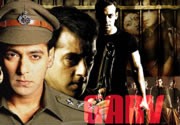
Garv
Synopsis:
So anyway, about halfway through Garv, Salman Khan is sitting on a bench somewhere looking deeply exhausted while wearing this terribly faded brown leather jacket that looks like it's been through three washing machines and survived to tell the tale, and he's just staring off into space while a bunch of really dramatic background music plays to make sure we know he's brooding about the state of the justice system. But to understand why he's looking so rough and why everything's gone completely off the rails, you have to look at how this whole mess started in the first place, way back at the beginning of the movie when he's introduced as ACP Arjun Ranawat, this honest cop who doesn't play by the rules because the rules are too slow and annoying. He's joined by Arbaaz Khan who plays his younger brother or partner or whatever, and they're both running around trying to clean up the city like typical heroes in old-school bollywood movies where the police department is basically just a backdrop for dudes in sunglasses punching bad guys through wooden tables. Right after that, Salman meets Shilpa Shetty, and she's playing this loud, bubbly character who sings a few songs and dances around in neon outfits that honestly hurt my eyes a little bit, but she brings some much-needed colour to a film that is otherwise practically drowning in shades of grey and dark blue.
They fall in love super fast because that's just how things work in hindi films, and before you even have time to process their first proper conversation, they're already doing a romantic number in some scenic location with lots of wind machines blowing her hair everywhere. The funny thing is, Shilpa Shetty doesn't even get to do all that much in the second half except look worried whenever Salman leaves the house with his gun, which is a real shame because she's totally charming and deserves way more screen time than just being the worried girlfriend waiting by the landline phone. Anyway, crime happens, politicians get involved, and everything falls apart. The local mafia boss is this slimy guy who wears silk shirts and has a very weird laugh, and he keeps paying off judges and politicians to make sure his criminal empire stays safe from the long arm of the law, which drives Salman absolutely crazy. He tries doing things the legal way for about five minutes, but the system fails him over and over again, so he just decides to take matters into his own hands and starts executing bad guys in broad daylight like a total vigilante. You can't just do that. But he does.
So then the government suspends him and brands him a rogue cop, and his family gets dragged into the crossfire because apparently bad guys in hindi movies never fight fair and always go after the innocent relatives to get back at the hero. Arbaaz Khan tries to talk some sense into him during this one scene where they're eating dal in a dimly lit kitchen, but Salman isn't having any of it and just stares into his bowl of lentils and says, law is blind, but I am not, which is peak nineties melodrama at its finest. Then there's this massive climax where Salman raids the villain's underground fortress or warehouse or whatever it is, and he's shirtless for half of it because classic Salman Khan action scenes apparently require a strict no-shirt policy once the final boss battle begins. He fights off like fifty guys with sticks and swords and guns, taking hits left and right, and he finally corners the main villain in a muddy courtyard and beats him up until the guy confesses to all his crimes on a cassette recorder or something equally dated. The police arrive right after the bad guy is already dead, and Salman just drops his weapon, walks over to a waiting police van, and climbs inside without saying a single word.
Arbaaz Khan wears this particular shade of tinted aviator glasses in the second half of Garv that I still cannot entirely place. They are not quite blue and not quite grey, sitting on the bridge of his nose through scenes of intense domestic strife like an accessory picked out in a rush during a lunch break on a hot Tuesday. Hindi movies from the early two-thousands possess a very specific kind of visual clutter, full of overexposed daylight bouncing off shiny leather jackets and car hoods painted in colors that look like they were mixed by someone who had only ever heard descriptions of sports cars second-hand. Puneet Issar stepped behind the camera for this one after a long career playing heavies who got punched through wooden tables by Sunny Deol, and you can feel his desperation to make something that isn't just about men yelling at each other in gravel pits. He wanted a statement on corruption and judicial paralysis, which is perhaps why the script feels like three different screenplays stapled together with rusty staples and covered in blood from a prop closet that was running low on corn syrup. Salman Khan plays ACP Arjun Ranavat, a man whose posture never relaxes even when he is sitting on a wicker chair in his family's modest courtyard talking to his mother about lentils. His jaw is locked so hard throughout the first forty minutes that you start wondering if his dentist is going to send an invoice to the production office. The film opens not with an explosion or a chase but with an internal tribunal where superiors with bad mustaches lecture our boy about his loose cannon ways, setting up a template that Bollywood movies had already worn completely smooth by the time the millennium turned. It is a slow grind of bureaucratic frustration and setup.
Shilpa Shetty plays Kashish, a character whose primary narrative function is to exist in soft focus whenever Arjun needs to remember why he shouldn't shoot five men in a municipal parking lot. She gets about four scenes that actually matter to the plot, and in two of them, she is wearing a cream-colored salwar kameez that seems to have been starched to within an inch of its life. If I'm honest, the romance between them moves at the speed of a rusted tractor being pushed up a muddy incline by two tired bullocks. They meet, they share a lingering look near a fruit stall, and suddenly they are dancing on a soundstage that looks suspiciously like a hotel lobby in Juhu with some plastic ferns taped to the pillars. It's a small thing, but it bugged me how the editor kept cutting back to the same four extra dancers in blue vests every time the chorus hit. Salman doesn't really know what to do with romantic scenes where he isn't pulling someone by the wrist or glaring at a prospective suitor, so he just stands there with his hands in his pockets, occasionally shifting his weight from one boot to the other while Shilpa delivers her lines with the earnest commitment of a high schooler performing Arthur Miller. The chemistry is non-existent, but the film simply refuses to slow down and let them breathe because there is a commissioner waiting in the next scene to slam a file down on a mahogany desk and talk about political pressure.
The action direction by Vijayan has this heavy, bone-crunching sound design that feels like someone dropping frozen turkeys onto a concrete floor. When Arjun beats up a roomful of henchmen in a textile warehouse, the blows land with a dull thud that lacks the acrobatic grace of something like Ghajini or the slick choreography you see in more recent stuff. It is ugly, brutal work, and Salman throws his whole weight into the punches without caring whether his hair looks right. That dedication saves the movie from being completely unwatchable during its bloated middle section where the narrative gets bogged down by subplots involving corrupt politicians who wear silk kurtas and laugh in dark rooms while drinking lukewarm scotch. Arbaaz plays Arjun's younger brother, a law student whose trajectory is so obvious from his very first scene that you want to tap the screen and tell the characters to read the script ahead. He brings a slightly softer energy to the frame, though he spends most of his screen time looking like he just remembered he left the gas on at home. The brothers share a kitchen scene where they eat dal out of steel bowls while arguing about ethics that actually works better than the big dramatic confrontations because it feels small, almost accidental, like the director forgot to yell cut and they just kept improvising until the tea got cold.
Cinematographer Johny Lal uses a lot of green and blue gels on night scenes, bathing police stations in an aquatic gloom that makes everyone look like they have mild jaundice. The soundtrack by Anu Malik is full of brassy horns and heavy percussion that drops out abruptly whenever someone starts shouting a monologue about duty and honor. There's a particular song midway through that features Salman wearing a red leather jacket that looks like it was cut from the interior of a secondhand taxi, and he dances with an aggressive boredom that tells you he was probably thinking about his workout schedule. Hindi films of this vintage often treated songs as contractual obligations rather than narrative tools, and Garv follows that rule with religious devotion. The plot grinds to a complete halt, the lighting shifts to a simulated desert sunset, and everyone starts moving their hips while a hundred extras in matching turbans wave sticks around. Yet, despite the mechanical predictability of these musical breaks, they provide a strange kind of relief from the endless parade of dirty politicians and weeping mothers.
The script borrows heavily from every cop drama ever made in Bombay, lifting dialogue beats from Shool and dialogue-heavy confrontations from Zanjeer without ever capturing the specific, ragged fury of those older pictures. The villains are cardboard cutouts who exist purely to be hurled through glass doors or shot in slow motion while dramatic violin stings play on the soundtrack. Amrish Puri is missed here; the actors playing the chief antagonists lack that operatic thunder that made older films feel larger than life. They just mumble their threats while playing with expensive fountain pens or stroking stubble that looks glued on. The moral universe of the film is aggressively simple, dividing the world into honest men who sleep on cots and corrupt ministers who eat grapes out of crystal bowls while ordering hits on journalists. There is no middle ground, no nuance, no hesitation. Arjun operates with a kind of moral certainty that feels exhausting after two hours, never once pausing to wonder if his methods are actually solving anything or just creating more paperwork for the junior officers who have to clean up the blood.
The climax takes place in a courtroom, which is a choice that immediately invites unfavorable comparisons to Aitraaz or any number of better-paced courtroom thrillers where the dialogue actually snaps. Instead of a sharp verbal duel, we get twenty minutes of Salman screaming at the judge about the failures of the constitution while the bad guys sit in the gallery looking mildly inconvenienced. The sound mixing during this sequence gets weirdly muddy, with the background score drowning out half of Salman's lines just when he's reaching the emotional peak of his rant. It is sloppy in a way that feels distinctly local, the kind of post-production rush job where nobody had the time or budget to loop the dialogue properly so they just let the room echo ring out. When the verdict finally drops and the courtyard outside the courthouse erupts into chaos with police vans ramming into barricades, you feel a strange sense of exhaustion rather than satisfaction. The film doesn't earn its grand finale because it spent too much time wandering through subplots about local elections and brotherly loyalty that went nowhere interesting. It stays in your head less for its grand themes about justice and more for the weird way Salman holds his tea glass in the background of family scenes while everyone else is yelling about murder.