
logo
[Login]   [Register]   [Contact Us]   [Watch on TV]
Home
Movies
Contact Us
FAQ
Watch on TV
[Login]   [Register]
  • All Movies
  • Newly Added
  • Blue-Ray Releases
  • Subtitled Releases
  • Coming soon
  • New Releases
  • Mid Releases
  • Old Releases


  • Action
  • Adult
  • Adventure
  • Animation
  • Awards & shows
  • Biography
  • Classic
  • Comedy
  • Crime
  • Documentary
  • Drama
  • Family
  • Fantasy
  • Fiction
  • Foreign Movies
  • historical
  • Horror
  • Kids
  • Music Video
  • Musical
  • Mystery
  • Punjabi
  • Religious
  • Romantic
  • Short Film
  • Social
  • South Indian
  • Sports
  • Suspense
  • Thriller
  • TV Series
  • War


  • Prices / Rates
  • Free Movies
  • Blogs
Action, Drama

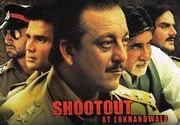
Shoot Out At Lokhandwala


Cast: Amitabh Bachchan, Sanjay Dutt, Sanjay Dutt, Viveik Anand Oberoi, Tusshar Kapoor, Arbaaz Khan, Rohit Roy, Sammir Dattani, Shabbir Aluwalia
Director: Apoorva Lakhia
Genre: Action, Drama
Play time: 02:01:55
release Year: 2007

Synopsis:

From director Apoorva Lakhia comes Shootout At Lokhandwala, a shocking, hypnotic look at a real-life disaster. On a calm summer day in 1991, in the bustling Lokhandwala Complex, five criminals including Maya and Dilip were counting 70 lakhs in flat no. 32 B, when 286 policemen, headed by ACP Khan, took strategic positions around their building. A gunfire ensued and the entire nation witnessed the most talked about daylight encounter lasting 6 hours that transformed suburban Mumbai into a virtual war zone. Shootout At Lokhandwala is the story of a seasoned cop, Khan, who chased Khalistani extremists, handpicked cops like Inspector Kaviraj Patil and Constable Javed Shaikh, and dared to engage trigger-happy gangsters in a residential locality of Mumbai. Khan''s fight went beyond the encounter as he faced inquisition from his own department and legal charges of human rights violations. Shootout At Lokhandwala is the story of an upcoming underworld gangster, Maya, and his highly skilled partner, Dilip. The two made extortion the buzzword in the early 90s and dared to disobey the big bhai of the underworld, drawing the attention of Khan and his newly formed ATS squad. Both Khan and Maya were men obsessed, so devoted to their professions that their personal lives were a disaster. Shootout At Lokhandwala explores the personal obsessions and sacrifices of the two protagonists with absorbing insight, with some of the most riveting action sequences to be ever filmed.

Movie Review:

The landscape of Indian cinema underwent a significant transformation in the mid-2000s, shifting away from the glossy, escapist romances that had dominated the previous decade toward a grittier, more visceral exploration of urban crime and police procedural narratives. Among the films that defined this transition, Shootout at Lokhandwala stands out as a quintessential example of high-octane storytelling. Directed by Apoorva Lakhia and produced by Sanjay Gupta, the film is a dramatized account of the 1991 Lokhandwala Complex shootout, a real-life encounter between the Mumbai police and a gang of notorious gangsters. With a sprawling ensemble cast featuring heavyweights like Amitabh Bachchan, Sanjay Dutt, and Viveik Anand Oberoi, alongside actors like Tusshar Kapoor, Arbaaz Khan, Rohit Roy, Sammir Dattani, and Shabbir Aluwalia, the film remains a landmark in the genre of Bollywood crime thrillers, offering a window into the volatile relationship between law enforcement and the underworld during a time when Mumbai was synonymous with the rise of organized crime.

The screenplay, co-written by Suresh Nair and Apoorva Lakhia, adopts a nonlinear structure that effectively balances the intensity of the final standoff with the procedural buildup that leads to it. The film is framed through the lens of a judicial inquiry, with Amitabh Bachchan playing the role of Dhingra, a stoic and principled lawyer tasked with investigating the encounter. This framing device allows the narrative to oscillate between the cold, sterile environment of the courtroom and the chaotic, sun-drenched streets of Mumbai where the gangsters operate. Lakhia’s direction is marked by a frantic energy, utilizing handheld cameras and rapid-fire editing to immerse the viewer in the claustrophobic tension of the Lokhandwala apartment complex. While the film occasionally leans into the stylized tropes common in Bollywood action cinema, it manages to maintain a sense of urgency that keeps the audience anchored throughout its runtime.

The performances are the backbone of this sprawling narrative, and the casting choices prove to be both ambitious and largely successful. Sanjay Dutt, portraying ACP A.A. Khan, brings a seasoned, world-weary gravitas to the role of the lead investigator. He embodies the archetype of the tough, uncompromising police officer who is willing to bend the rules to maintain order. However, the film truly belongs to Viveik Anand Oberoi, who delivers a career-defining performance as Maya Dolas. Oberoi captures the chilling unpredictability and sociopathic arrogance of a gangster who believes he is untouchable. His portrayal of Dolas is not merely a caricature of a villain but a complex study in ego and violence, making his character the gravitational center of the movie. The chemistry between the gang members, played by Tusshar Kapoor, Rohit Roy, Sammir Dattani, and Shabbir Aluwalia, provides the necessary human element to the criminal side of the story. Tusshar Kapoor, in particular, surprises with a nuanced turn as Buwa, showing a level of emotional depth that contrasts sharply with the mindless violence displayed by his cohorts. Arbaaz Khan rounds out the ensemble with a steady performance that adds weight to the police side of the conflict.

Technically, Shootout at Lokhandwala is a masterclass in atmospheric world-building. The cinematography by Gururaj R. creates a distinct visual language for the film, utilizing a desaturated color palette that underscores the grim reality of the underworld. The sequence of the final shootout is a technical achievement, stretching over a significant portion of the film’s climax and employing intricate choreography that captures the sheer scale of the confrontation. The soundtrack, composed by Anand Raj Anand, Mika Singh, and Biddu, serves as a rhythmic punctuation to the chaos. While some of the songs feel like forced inclusions typical of the commercial constraints of the era, the background score effectively builds tension, particularly during the high-stakes sequences where the narrative shifts from tactical maneuvers to all-out warfare.

Thematically, the film explores the blurred lines between justice and vengeance. By utilizing the courtroom inquiry, the movie forces the audience to question the morality of the police encounter. Is it justifiable to bypass the legal system when faced with an existential threat to public safety? This tension between the rule of law and the necessity of force is a recurring motif in Indian crime cinema, and Shootout at Lokhandwala handles it with a degree of intellectual honesty. It does not shy away from the brutality of the police force, nor does it romanticize the criminal lifestyle of Maya Dolas and his gang. Instead, it presents a portrait of a city held hostage by its own internal contradictions, where the line between the hunter and the hunted is perpetually shifting.

Despite its strengths, the film is not without its flaws. The pacing in the middle act can feel somewhat repetitive, as the narrative occasionally gets bogged down in the minutiae of police bureaucracy. Furthermore, the sheer number of characters involved means that some of the supporting members of the gang are given little to do beyond providing cannon fodder for the final act. Yet, these are minor grievances in what is otherwise a tightly wound and compelling piece of cinema. The film succeeds because it understands the pulse of its audience, delivering the requisite thrills while maintaining a serious tone that respects the gravity of the events it depicts. It stands as a testament to the evolution of the crime genre in India, paving the way for more realistic and gritty portrayals of police work in subsequent years.

In conclusion, Shootout at Lokhandwala is a visceral, gripping, and deeply influential film that captures a pivotal moment in the history of Mumbai’s underworld. Through a combination of strong performances, particularly from Viveik Anand Oberoi and Sanjay Dutt, and a director who understands how to orchestrate large-scale action sequences, the film delivers an experience that is both entertaining and thought-provoking. It serves as a reminder of the power of the crime thriller to reflect the anxieties of a society grappling with lawlessness and the often-uncomfortable methods used to curb it. For those who enjoy films that are unafraid to dive into the darker corners of urban life, this remains a must-watch entry in the pantheon of modern Indian cinema. It manages to balance the demands of a commercial blockbuster with a narrative that feels grounded in a genuine sense of dread and realism. The film is a solid, albeit sometimes flawed, achievement that earns its place in any discussion about the best action-oriented dramas produced in the last two decades. Final Verdict: 8 out of 10.

Home
Movies
Contact Us
FAQ
terms and conditions
privacy policy
x
  • All Movies
  • Newly Added
  • Blue-Ray Releases
  • Subtitled Releases
  • Coming soon
  • New Releases
  • Mid Releases
  • Old Releases


  • Action
  • Adult
  • Adventure
  • Animation
  • Awards & shows
  • Biography
  • Classic
  • Comedy
  • Crime
  • Documentary
  • Drama
  • Family
  • Fantasy
  • Fiction
  • Foreign Movies
  • historical
  • Horror
  • Kids
  • Music Video
  • Musical
  • Mystery
  • Punjabi
  • Religious
  • Romantic
  • Short Film
  • Social
  • South Indian
  • Sports
  • Suspense
  • Thriller
  • TV Series
  • War


  • Prices / Rates
  • Free Movies
  • Blogs