

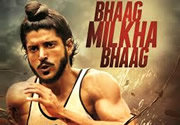
Bhaag Milkha Bhaag
Synopsis:
The film starts in the 1960 Olympic Games in Rome, where a coach says "It!", and the story is taken back to the memories of the childhood days of a young boy which haunted him, resulted in him dropping to fourth. Shiva is partition caused chaos which resulted in war with the locals of Punjab in Pakistan, killing the parents of Milkha Singh (Farhan Akhtar). He reaches Delhi and later meets his sister there. Milkha soon makes friends and survives by stealing with his friends. He falls in love with Biro (Sonam Kapoor) but she asks him to live a life of honesty. Milkha finally finds himself in the army where he gets noticed by a Havaldar (Sergeant) after he wins a race in which top 10 runners will get milk, two eggs and excuse from exercise. He gets selected for service commission where he gets miffed and also gets beaten up by senior players whom he had defeated earlier, on the day before selection of Indian team for Olympics. In spite of being injured he still participates in the race, overcomes his pain and wins the race. His coach tells him that he has broken the national record.
In the Melbourne Olympics he gets attracted to the granddaughter of his Australian technical coach, and after a night in a bar he sleeps with her. He loses the race, beats himself up and on the way back to India asks his coach to tell him what the world record for the 400m race is. He trains hard with a firm determination and wins in several places. Then Jawaharlal Nehru convinces him to lead the Indian team to Pakistan for friendly races. In Pakistan he misses the press conference and goes to his village where in a flashback it is shown how his parents were murdered and the last words of his father were "It!" He starts crying and is comforted by a boy who turns out to be his childhood friend''s son. In the games, the Pakistani favorite is winning, when Milkha comes, overtaking opponents one by one,taking a convincing lead and winning the race and respect of both nation''s people. The Pakistani commander then gives him the title "The Flying Sikh".
The sound design during the track workouts in Bhaag Milkha Bhaag features a shoe squeak on gravel that repeats too often, a tiny Foley quirk that starts to grate by the second act because someone in post-production clearly fell in love with that specific crunch and decided to paste it over every single running montage. Rakeysh Omprakash Mehra directs with a heavy hand that sometimes suffocates the air right out of the frame, preferring massive crane shots and churning dust storms over letting characters just breathe for a second. Prasoon Joshi’s screenplay relies on a framing device of a train ride where Milkha Singh flashes back to his past while refusing to travel to Pakistan, which is a structural crutch that keeps pulling us out of the historical momentum just when the narrative engine starts humming. Farhan Akhtar committed his entire physical existence to playing the Flying Sikh, shedding fat and gaining tendon until his torso looked like a relief map of the Himalayas, and that sort of radical body transformation usually eats a movie alive from the inside out, but here it anchors the sprawling chaos.
Akhtar has this way of running with his eyes fixed on some invisible horizon past the camera lens that makes you forget you are watching a Bollywood star playing dress-up, selling the agony of partition trauma and athletic glory without chewing the scenery into dust. Pavan Malhotra brings a quiet, bruised authority as the coach who recognizes raw, untamed speed before anyone else in uniform, whereas Yograj Singh plays the military disciplinarian with a booming bark that feels less like acting and more like a force of nature. Prakash Raj and Sonam Kapoor show up in smaller, sketchier roles that mostly serve to anchor Milkha's emotional geography, though Kapoor’s character gets shortchanged by a script that treats her as a fleeting memory rather than a fully realized person. If I'm honest, the supporting cast gets shoved aside whenever Akhtar needs to sprint across another sandy track or scream at the sky, turning what could have been an ensemble period piece into a one-man endurance test.
Cinematographer Binod Pradhan shoots the early village sequences during the partition with a terrifying, chaotic handheld urgency that echoes the best parts of Paul Greengrass without feeling entirely derivative, capturing mass violence through mud, blood, and screaming limbs. Then the movie shifts gears into Technicolor stadium grandeur once Milkha joins the Indian army, swapping gritty realism for golden-hour lens flares and slow-motion sweat droplets that fly off shoulders like diamond dust. Shankar-Ehsaan-Loy deliver a thumping, percussion-heavy score that drives the running sequences forward with relentless energy, even if the mixing occasionally pushes the vocals so high that the lyrics drown out the ambient sound of the crowds roaring in the background. It is an exhausting audiovisual experience, designed to overwhelm the senses so completely that you do not notice the three-hour runtime until your lower back starts aching against the theater seat.
Hindi films have traditionally struggled with sports biographies because they tend to turn complex human beings into saintly martyrs who can do no wrong on or off the field, and while this movie flirts with hagiography, it occasionally lets Milkha be petty, arrogant, and broken. The trauma of losing his entire family during the partition isn't just a convenient backstory used to explain why he runs fast; it functions as a psychological cage that he can only escape by physically outpacing his own memories. When he freezes on the track during the Melbourne Olympics because he looks up into the stands and remembers the slaughter at Gobindpura, the film touches on a raw, unvarnished truth about PTSD that transcends the standard inspirational sports genre. It is a messy, overstuffed exploration of survival guilt where the athletic victories feel less important than the moments Milkha manages to stop running away from his childhood ghosts.
There is a scene midway through where Milkha visits a Lahore brothel out of sheer disorientation and grief, and the movie handles the sequence with an awkward, prudish distance that betrays its mainstream commercial instincts. That kind of narrative hesitation keeps the picture from reaching the raw, abrasive heights of something like Anurag Kashyap's Gangs of Wasseypur, preferring instead to sand down the jagged edges so family audiences can digest the tragedy without choking on the details. Yet despite the occasional dip into melodrama and the relentless, exhausting pacing that never gives the viewer a moment of quiet reflection, the sheer visceral impact of Akhtar crossing finish lines keeps the whole enterprise upright. You walk out of the theater humming the title track and rubbing your own calves, half-convinced you could run a marathon, which is probably the exact reaction the producers paid millions of rupees to manufacture.