

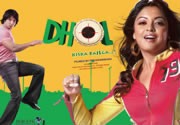
Dhol
Synopsis:
There is a specific kind of panicked gesticulating that Rajpal Yadav brings to mid-2000s Bollywood movies which defies all laws of physics and acting school, and I spent the first twenty minutes of Priyadarshan’s Dhol watching him sweat through a pale blue button-down while wondering if his character’s shirt was actually shrinking in real-time or if it was just special effects.
Priyadarshan was coming off the enormous success of Hulchul when he took on this remake of a Malayalam hit, and if I'm honest, the wheels look slightly loose from the jump. The plotting is frantic, the kind of breathless farce where four broke slackers hatch a half-baked scheme to marry a wealthy woman, only to stumble into a mafia-adjacent extortion plot that involves a dead body and a remarkably unconvincing prosthetic hand.
Sharman Joshi, Tusshar Kapoor, Kunal Khemu, and Rajpal Yadav form the quartet of hopeless roommates at the center of the chaos, and their chemistry is the only thing keeping the enterprise from sliding entirely off the rails. Joshi plays the exasperated straight man with a weary, wide-eyed exhaustion that makes you feel every rupee of his character's debt, while Kapoor leans into a soft-spoken goofiness that feels entirely distinct from his usual persona.
The comedy relies heavily on door-slamming misunderstandings and frantic double-takes, a directorial style that worked wonderfully in Hungama but feels a bit more breathless and frayed around the edges here, mostly because the screenplay by Akshat Verma and Neeraj Vora refuses to let the actors pause for breath. Every single line is delivered at a volume that suggests someone is standing just off-camera with a cattle prod, which gets exhausting by the time the second reel rolls around.
Tanushree Datta and Payal Rohatgi pop up as objects of affection and suspicion, though the script gives them precious little to do besides look glamorous while the male leads scream at each other in cramped, brightly painted living rooms. Arbaaz Khan arrives later as the menacing antagonist, and it's a small thing but it bugged me how his sunglasses never once reflect the studio lights, making him look less like a terrifying mobster and more like a guy waiting for an Uber outside a suburban multiplex.
The cinematography by Sameer Arya is aggressively sunny, washing every frame in an over-saturated primary palette that screams 2007 comedy, though it does match the manic energy of the editing. Speaking of the editing, Arun Kumar's cuts during the frantic chase sequences sometimes linger a fraction of a second too long on a background extra laughing before the punchline has even landed, which kills the comedic rhythm dead in its tracks.
Pritam’s soundtrack is loud and ubiquitous, though the title track pops up as a background cue at least three times too many during the first hour alone, hammering the viewer over the head with percussion whenever a character opens a door or drops a vase.
Beneath the surface-level shouting and slapstick, the film operates as a cynical fable about male desperation and greed in modern Hindi cinema, where none of the protagonists have any moral compass to speak of and are entirely motivated by laziness and the desperate need to avoid getting a real job. Om Puri anchors these lunatic proceedings with a brief, grumpy cameo that reminds everyone on set how to land a deadpan delivery without looking like you're trying to win a marathon.
Dhol is not a subtle picture, nor is it particularly concerned with narrative logic once the third act descends into a full-scale riot involving mistaken identities, flying paint cans, and a runaway goat. It is messy, loud, and frequently repetitive, yet there is an undeniable, low-brow charm to the way Joshi and Khemu bounce off each other when the script finally gets out of their way. You forget about the plot holes and the clunky sound mixing the moment Yadav launches himself across a coffee table to tackle a nonexistent threat, which is probably the exact reaction the director was banking on.