

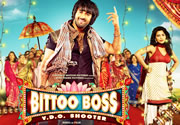
Bittoo Boss
Synopsis:
''It'' is a young charming, ingenious and a fun filled wedding cameraman who takes pride in calling himself a "Sesky Video Shooter". He is the star of all wedding celebrations of Anandpur Sahib, a small town in Punjab.
Bittoo believes in spreading happiness through the beautiful moments he captures, moments which you can rewind and keep watching for years and smile looking at them thus making them heartfelt experiences which last forever. He falls in love with an educated and strong-headed girl who makes him realize the importance of financial stability and monetary gains in order to gain respect and recognition. Smitten in love and bitten by the one he loves, the smart and righteous cameraman is lured to take a shortcut in order to earn a quick buck and get his life back on track. What follows is a madcap ride.
The sound design during the wedding procession sequences in Bittoo Boss carries an abrasive, low-end hum that suggests someone left the compressor on the master bus during the mix and simply walked away for lunch.
Supavitra Babul wants to capture the hustle of a tier-two Punjabi town where every wedding videographer fancies himself a budding auteur with a crane shot and a dream, but the screenplay by Sumit Arora keeps getting bogged down by its own eagerness to please a multiplex audience that probably wouldn't know a rented Sony FX1 if it bit them on the ankle. The protagonist, a small-town fixer of memories who specializes in catching weeping aunts and nervous grooms on magnetic tape, spends the first forty minutes establishing his hustle with a relentless energy that feels less like character motivation and more like a caffeine crash waiting to happen, bouncing from one venue to the next while the background score hits every comic beat with the subtlety of a falling anvil. There is a curious lack of texture in the way the town is rendered, smoothing out the grit of local commerce until everything looks like it was shot on a closed set in Film City during a particularly overcast Tuesday, which drains the proceedings of whatever documentary realism they might have initially possessed.
Pulkit Samrat arrives on screen with the bright-eyed, teeth-flashing confidence of someone who has spent hours studying Shah Rukh Khan in Baazigar but forgot to internalize the actual menace, playing Bittoo with a perpetual smirk that eventually wears out its welcome long before the intermission song hits the speakers. He has this tic of adjusting his collar whenever the dramatic stakes get slightly elevated, if I'm honest, and it starts to feel less like a choice for the character and more like a nervous habit from an actor who knows the scene isn't quite working. Opposite him, Amita Pathak plays a headstrong girl from a slightly higher tax bracket with a pinched severity that makes her romantic sparring with Samrat look less like genuine attraction and more like a contractual obligation fulfilled under duress, though she manages to salvage a few throwaway lines in the second half simply by refusing to overplay them. They lack any real chemistry, bouncing off each other like billiard balls on a table with uneven felt, which makes their sudden realization of eternal devotion feel entirely unearned.
The cinematography relies on a hazy, over-saturated golden hour filter that makes every single outdoor location look like a commercial for refined cooking oil, drowning out whatever natural colors might have existed in the Punjab dust. Then there is the soundtrack by Jeet Ganguly, which recycles the same three accordion-heavy melodies across every emotional register until you begin to feel personally victimized by the mere concept of a Punjabi wedding, dragging down scenes that might have otherwise breathed on their own. It's a small thing, but it bugged me how the boom mic dips into the upper corner of the frame during the middle of a rather crucial emotional confrontation between Bittoo and his uncle, lingering there for a solid four seconds while the actors just keep crying right beneath it.
Underneath the wedding bells and the low-budget gloss, the film attempts to grapple with the transactional nature of modern Indian romance, positioning the video camera as both a witness to genuine emotion and a commercial tool designed to manufacture a happiness that does not exist in the bank accounts of the people paying for it. This tension between the artifice of the big fat wedding and the stark financial reality of the families footing the bill is genuinely interesting, but the narrative keeps abandoning its own social critique to indulge in yet another musical number where background dancers in matching neon turbans wave sparklers at the lens. Hindi movies have long struggled to balance populist comedy with social observation, and this one falls squarely into the trap of winking at the audience while simultaneously asking them to take the emotional fallout seriously.
Bittoo Boss is not the worst thing to ever emerge from the machinery of commercial cinema, but it drifts by without leaving much of a footprint on your memory, fading away like the cheap confetti swept off a banquet hall floor once the guests have gone home and the lights are turned off.