

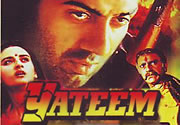
Yateem
Synopsis:
Halfway through Yateem, Sunny Deol is standing in this weirdly lit desert shack wearing a violently striped shirt that looks like it came from a discount bin in 1988, and he's just screaming at the top of his lungs while holding a rusty car part for some reason, which is hilarious because the movie hasn't even explained how he got out of the previous mess yet. But to understand why he's losing his mind in this dusty wasteland, you have to look at how this whole thing started with an orphanage and a terribly mean gang leader. Years earlier, this quiet guy named Krishna shows up, and he's just trying to live a normal life in the chaotic ecosystem of 80s hindi movies where everyone's either a saint or an absolute psychopath. Danny Denzongpa plays this main villain named Jacob, and he wears these sunglasses indoors that are just ridiculous, and he runs this criminal syndicate with an iron fist and zero regard for labor laws. Farha Naaz plays Chanda, and she's got this one specific pink ribbon in her hair during the first half-hour that completely disappears for forty minutes and then suddenly comes back during a dramatic confrontation by a water pump, which drove me crazy trying to figure out if it was a continuity error or intentional symbolism. Anyway, Krishna falls in love with Chanda because that's what happens in bollywood movies when the hero and heroine lock eyes across a crowded wedding or a dusty market square, but Jacob has other plans because he's a control freak who doesn't want anyone having a happy family life.
So then Amrish Puri shows up playing another heavy, and honestly, watching Amrish Puri and Danny Denzongpa in the same scene is like watching two giant volcanoes try to out-yell each other, and it's glorious. They're arguing over some smuggled goods or a ransom, and Amrish is wearing this bulky leather jacket that makes him look like a football pad, and he keeps tapping this silver cigarette case against his palm over and over again for like three whole minutes without opening it once. Right after that argument, Krishna gets framed for a murder he didn't commit, and he's running through these narrow alleyways while the police shoot fifty rounds of ammo and somehow miss every single time, which is a classic trope in older bollywood. The funny thing is, Kulbhushan Kharbanda pops up as this well-meaning mentor figure who tries to give Krishna legal advice, but his office is filled with towering stacks of dusty ledgers that literally never get opened, and he spends half his screen time eating peanuts out of a greasy brown paper bag. Sujata Mehta enters the picture as well, and she brings this intense chaotic energy that completely flips the narrative upside down, and she has this iconic line where she just looks at Danny and says, your time is up, before walking out of the room in slow motion.
So Krishna gets thrown into this brutal prison where the warden has a personal vendetta and makes him dig ditches in the blazing sun, but he escapes by hiding in a laundry cart full of dirty bedsheets, and nobody even notices until he's already halfway to the highway. The escape happened. Then he tracks down Jacob's men one by one in a series of extremely loud fistfights that destroy an entire outdoor market filled with clay pots and baskets of tomatoes, and honestly, the sheer amount of wasted produce in this sequence is staggering. Chanda gets kidnapped because villains in hindi films always use the girlfriend as bait, and she's tied to a wooden chair in an abandoned warehouse that somehow has neon strobe lights flickering for no narrative reason whatsoever. Krishna bursts through the double doors on a stolen motorcycle, revs the engine right inside the building, crashes it straight into a pile of wooden crates, and leaps through the air to tackle Danny Denzongpa right into a stack of empty cardboard boxes.
They roll around in the dirt for a long time, trading punches that sound like wet thuds, and then Amrish Puri's character betrays Danny at the very last second just out of pure corporate greed, and they start fighting each other instead. Krishna grabs Chanda's hand, they run out of the burning warehouse as explosions go off behind them in that glorious, physics-defying 80s action style, and they jump into the back of a passing pickup truck loaded with hay bales. The truck drives off into the dusty horizon as the credits start rolling on the screen.
There is a specific kind of gravelly, slightly over-dubbed throat-clearing that only happens in late-eighties Hindi movies, right before a character launches into a monologue about destiny, and it happens about four times too often in J.P. Dutta’s Yateem. If I'm honest, the sound mixing on the punches is what actually stayed with me longer than any of the thematic heavy lifting. You hear this wet, hollow thud that sounds less like human bone hitting flesh and more like someone dropping a frozen turkey onto linoleum, and it keeps pulling you right out of the melodrama.
Dutta was never a filmmaker interested in subtlety anyway, having already established his sweaty, sun-bleached visual grammar in earlier work like Ghulaami, and here he just leans entirely into the dust and the sweat. The screenplay treats geography like an emotional mood ring. Characters wander through barren, unforgiving quarries and crumbling brick kilns that look like they were abandoned fifteen minutes before the cameras rolled. There’s no breathing room in the framing. Every conversation is shot in tight, slightly uncomfortably close medium-ups where the actors are always glistening from either heat or trauma, usually both. The camera tracks through these spaces with a restless energy that makes even a simple hallway chat feel like a setup for a shootout. It's a loud, unsubtle way to direct, but it keeps the momentum from sagging during the slower stretches of the plot.
Sunny Deol arrives on screen looking like he’s perpetually about to tear a heavy wooden door off its hinges, even when he’s just sitting quietly at a table. He plays Vijay, an orphan pulled into a complicated web of crime and misplaced loyalty, and he brings this coiled, trembling intensity to every single frame. When he’s angry, his neck veins bulge to almost cartoonish proportions, but you buy it because his eyes sell the hurt underneath. He has this way of dropping his chin and looking up through his eyebrows that signals immediate trouble for whoever is standing across from him. Farha Naaz matches his heavy-lidded intensity with a quieter, more defensive posture, though her character gets sidelined by the script whenever the boys start shouting at each other over barrels of contraband.
The real gravitational pull of the picture comes from the older men snarling at the edges. Danny Denzongpa plays the antagonist with a chilling, soft-spoken menace that relies entirely on how he casually cleans his fingernails while someone is begging for their life. He doesn't need to chew the scenery because he speaks in this low, raspy register that forces everyone else in the room to lean in. Then you have Amrish Puri showing up to anchor the proceedings with his usual thunderous authority, treating even minor expository dialogue like a pronouncement from Mount Sinai. Sujata Mehta brings a sharp, dangerous edge to the supporting cast that cuts through a lot of the standard testosterone poisoning, though the editing occasionally cuts away from her reactions a fraction of a second too late, leaving her standing there blinking in a way that feels awkward.
The cinematography by Ishwar Bidri relies heavily on ochre filters and harsh, naturalistic sunlight that makes the actors look like they’ve been rubbed in turmeric and left to dry in a desert wind. It is an aggressively brown movie. Even the interiors look like they were lit by a single dusty bulb hanging over a poker table in an abandoned warehouse. This visual monotony works for the first hour to establish a mood of relentless oppression, but after a while, you start craving a splash of blue or green just to reset your eyes. The background score by Laxmikant-Pyarelal doesn't help matters, recycling the same three brass stings every time Deol flexes his biceps or Denzongpa narrows his eyes.
Beneath the surface noise, the narrative is chewing on ideas about institutional corruption and the way blood ties become a trap from which nobody escapes clean. Vijay isn't just fighting bad guys; he’s fighting the very concept of inherited duty, trying to figure out how to be an honest man when the only father figures available to him are murderers and thieves. The movie suggests that breaking the cycle requires a kind of violence that eventually consumes the person doing the breaking. It’s a cynical worldview, baked right into the dialogue and the geography, refusing to offer any easy redemptive arcs for characters who have spent decades swimming in filth.
Yet for all its grand ambitions about existential orphanhood and societal rot, the film gets tripped up by small mechanical oversights that any decent continuity editor should have caught. There’s a running gag with a broken wristwatch that appears on the wrong wrist in alternating shots during the second-act climax. It’s a tiny, meaningless error, but once you spot it, you spend the next ten minutes staring at Deol’s cuffs instead of listening to his dialogue about loyalty and betrayal. Hindi films of this vintage often suffer from this kind of rushed post-production fatigue, where the big emotional moments land with tremendous force while the basic continuity gets dropped on the cutting room floor.
The climax itself is a protracted, mud-soaked demolition derby that refuses to end when it logically should, stretching out across multiple locations that all look suspiciously like the same gravel pit outside Bombay. By the time the final confrontation resolves, nobody is standing tall, and the camera lingers on the empty dirt rather than the surviving faces. It leaves you with a dull ringing in your ears and a faint grit between your teeth, which was probably the point all along.