

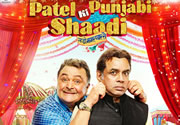
Patel Ki Punjabi Shaadi
Synopsis:
Honestly, Patel Ki Punjabi Shaadi is a wild ride of a movie that throws you right into the absolute mess of two clashing cultures in a way only certain bollywood movies can really pull off, because we’ve got Gujjus and Punjabis living right next door to each other and absolutely hating every single second of it.
It’s loud.
It’s chaotic.
And Rishi Kapoor is just chewing the scenery as this angry Punjabi guy named Guggi Tandon who cannot stand his Gujarati neighbors, especially the patriarch of that household, Hasmukh Patel, played by Paresh Rawal, who is equally stubborn and petty and spends half his day plotting ways to annoy the Tandons just because he hates their loud music and their general vibe.
You can't even focus on the background because there is this one random extra wearing a neon yellow sweater with weird green polka dots in every single neighborhood scene and it's so distracting you'll spend ten minutes rewinding just to figure out why he's always standing near the garbage cans holding an empty tea glass.
Anyway, Jinal Belani is in this thing too, and she's trying to navigate life while her family is at constant war with the next-door neighbors, but stuff happens and kids always ruin everything for feuding parents by falling in love.
Vir Das plays Monty, and Payal Ghosh plays Pooja, and naturally, because this is how Hindi films work, these two fall head over heels for each other despite knowing that their fathers would literally rather explode than let a Gujarati marry a Punjabi.
They try to keep it a secret, obviously, sneaking around, whispering on phones, and dodging their parents' angry glares, but secrets in movie neighborhoods never stay hidden for long, especially when everyone has giant balconies and nothing better to do than spy on each other with binoculars.
And then boom, the big secret gets dropped right in the middle of a family gathering where everyone is screaming and throwing things and someone’s uncle gets hit in the face with a flying samosa.
Right at the interval point, which hits you out of nowhere while characters are still mid-argument about wedding traditions, a random song starts playing where everyone is suddenly wearing matching bright pink outfits and dancing in a courtyard that wasn't even there five minutes ago.
God, the song placements in these older hindi movies are always so jarring because characters will be crying about broken hearts and then suddenly they're doing backup choreography with fifty professional dancers holding umbrellas.
So the second half kicks off and the parents are losing their minds even more because the kids announce they aren't just dating, they're actually getting married, and they expect their racist, stubborn dads to just hug it out and plan a reception together.
Bharti Achrekar is trying to keep the peace and yelling at the men to stop acting like toddlers, but Hasmukh and Guggi just double down on their petty rivalry, refusing to enter each other's houses without wearing full body armor and carrying measuring tapes to make sure no Punjabi furniture crosses the property line into Gujarati territory.
They stage fake heart attacks, they bribe wedding planners, they try to sabotage the catering, and honestly, you're sitting there wondering how anyone in this family has the energy for this level of sustained hatred over cultural differences about how to cook lentils.
There's a massive wedding planning sequence where both sides try to outspend and out-decorate each other, leading to a hilarious disaster of a venue where half the room smells like dhokla and the other half smells like butter chicken and everyone is glaring across the buffet table.
Right near the end, after all the shouting matches and dramatic speeches about love and family unity and how traditional bollywood movies always have to end with a massive group hug, the dads finally realize they've been total idiots and that their stubbornness is just ruining their kids' happiness.
They look at each other across the crowded, chaotic wedding hall, tears welling up in their eyes because they secretly missed their daily fights, and they walk slowly toward each other through a shower of falling marigold petals while the entire cast claps and cheers and the credits roll right over their awkward, tearful, tightly gripped embrace.
The sound design during the opening confrontation of Patel Ki Punjabi Shaadi involves a squeaking door hinge that never quite gets resolved for the rest of the scene, which is the kind of tiny technical annoyance that sets the tone for an afternoon spent staring at a screen and wondering why nobody in the editing suite thought to pull down the fader just a fraction. Sanjay Chhel directs his cast with an enthusiasm that borders on frantic, rushing through dramatic beats as though the negative of the film was actively on fire behind the camera and everyone needed to sprint to the exit before the heat got to them. It is loud, it is broad, and if I'm honest, it exhausts you long before the interval hits its stride, piling up misunderstanding upon cultural cliché until the narrative collapses under its own inflated weight. The screenplay operates on a logic where shouting louder equals being funnier, trading any sense of genuine observation about the friction between Gujarati and Punjabi households for cheap gags that have been recycled through Hindi films since the late eighties with remarkably little variation in the punchlines. Characters enter rooms with a level of decibel output that suggests they are trying to reach the back row of a drive-in theater rather than a standard multiplex auditorium, and the dialogue rarely misses an opportunity to spell out the emotional subtext with all the subtlety of a falling grand piano. You can see the structural scaffolding of the jokes from miles away, telegraphing every punchline with reaction shots that linger a beat too long on actors who look just as confused by the spatial continuity of the scene as the audience sitting in the dark.
Bharti Achrekar does what she can with a maternal role that requires her to look perpetually disapproving while holding a tray of snacks, managing to inject a sliver of genuine warmth into moments of absolute tonal chaos despite the script giving her nothing resembling a distinct interior life. Beside her, Prem Chopra hams it up with an infectious, slightly bewildered energy that calls to mind his more unhinged supporting turns in forgotten nineties dramas, leaning heavily into his iconic screen persona while simultaneously looking like he would rather be taking a nap in his trailer. Jinal Belani navigates the romantic tracks with a straight-faced commitment that borders on heroic, though she is routinely undercut by framing choices that seem determined to capture her from the least flattering angle available in the room. The supporting players bounce around the frame with the frantic desperation of dinner theater actors trying to keep a restless crowd from walking out before dessert, over-pronouncing every punchline and gesturing wildly toward props that frequently appear to have no logical reason for being placed on the set. There is a distinct lack of rhythm in how these performances bounce off one another, resulting in dialogue exchanges that feel less like conversations and more like two people taking turns shouting lines they memorized ten minutes before the director called action. When the dramatic temperature rises, the actors resort to the oldest tricks in the commercial playbook, clutching their chests and widening their eyes with an earnestness that feels misplaced in a production this aggressively synthetic.
Visually, the movie looks like it was lit by someone who discovered a box of colored gels at the back of a warehouse and decided to use all of them simultaneously before lunch, bathing every interior in an artificial blue and orange glow that makes even the most mundane living room look like a discotheque in the middle of a power surge. The camera moves with a restless, jittery energy, zooming in and out of conversations as if the operator was suffering from an inner ear infection, refusing to let a single master shot breathe for more than four seconds before cutting to a medium close-up of someone looking astonished. The soundtrack, meanwhile, leans on percussion loops that pound away at your skull long after the musical numbers have mercifully ground to a halt, recycling traditional bhangra beats through tinny digital synthesizers that sound like a cheap keyboard plugged into a blown speaker. It's a small thing, but the constant reuse of the exact same upbeat flute riff every time a character smiles at a relative started driving me up the wall by the end of the first reel. Songs appear without narrative justification, dragging the already sluggish pace down to an absolute crawl while the chorus repeats lyrics about cultural harmony that feel utterly divorced from the petty squabbling depicted in the scenes immediately preceding them.
The underlying cultural clash between the titular families is handled with the kind of blunt instrument approach that makes you yearn for the relative nuance of something like Namastey London, a film that at least understood how to balance broad comedy with moments of genuine geographical observation. Here, every Gujarati is defined entirely by their frugality and love of dhokla, while every Punjabi is reduced to a caricature of loud brashness who breaks into spontaneous dance whenever a drum is struck within a three-mile radius, flattening diverse communities into walking greeting card clichés. The script attempts to bridge these divides through a romance that lacks any discernible chemistry, asking us to root for two people who spend ninety percent of their shared screen time yelling at each other about wedding venues and catering arrangements. This lack of genuine emotional stakes makes the eventual reconciliation feel entirely unearned, a mere contractual obligation the narrative must fulfill before the credits are allowed to roll across the screen. You search in vain for a single scene where the characters feel like actual human beings rather than walking mouthpieces for regional stereotypes, but the production is far too busy rushing toward its next loud set piece to bother with psychological realism or narrative coherence.
Hindi movies have a long and occasionally glorious tradition of chaotic family comedies that manage to transcend their predictable formulas through sheer performance energy or directorial flair, but this particular entry misses the mark by a considerable margin on almost every conceivable level. The jokes fall flat with a dull thud that echoes through the room, the romance evaporates the moment the characters stop arguing, and the technical execution remains consistently subpar from the first frame to the last. It is difficult to muster much genuine anger toward a project this harmlessly inept, yet the sheer persistence of its loud, unimaginative plotting wears you down until you are simply staring at the screen waiting for the end to arrive. There is no grand artistic failure here to dissect, only a series of poorly edited scenes and exhausted tropes dragging themselves across a brightly colored canvas with nowhere particular to go. When the final frame arrives, it brings with it nothing more profound than a profound sense of relief that the noise has finally stopped and you can go check if your car is still parked legally on the street outside.