

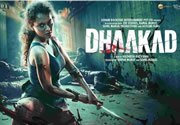
Dhaakad
Synopsis:
There is a specific kind of digital color grading in modern Hindi movies that smells vaguely of lukewarm tap water, and Dhaakad coats its first twenty minutes in that exact shade of slate blue. It’s an aesthetic choice that wants to evoke the neon-bleeding grime of Luc Besson’s early work or perhaps the cold concrete of a South Korean revenge thriller, but instead it just makes everyone look like they are standing inside an unvented server room while someone occasionally shines a blue Maglite into the lens. Agni is a super-agent, or something equally vague with a badge and a licence to kill people in various exotic locations, and Kangana Ranaut plays her with her jaw set so tight you can almost hear the enamel grinding down to pulp. She doesn't walk into rooms so much as she arrives with an audible thud, carrying the weight of four different acting schools and a very expensive fitness regimen. The film wants us to take her seriously as a physical threat from the very first frame, dropping her into hand-to-hand combat against nameless henchmen who exist purely to have their elbows bent backward at unpleasant angles by a woman in a leather duster.
Razneesh Ghai directs with the enthusiasm of someone who has watched a lot of action clips on YouTube at two times speed and decided he could edit them together with even more cuts. He can’t, as it turns out. Action choreography requires a spatial logic that gets completely lost here in a flurry of close-ups and motion blur, leaving you squinting at the screen trying to figure out if the knife went into the ribcage or just past the shoulder. It’s a small thing but it bugged me how every time a character fires a pistol, the muzzle flash is clearly slapped on in post-production with a digital brush that doesn't quite match the focal length of the lens. The screenplay by Ghai, Chintan Gandhi, and Rinesh Joshi feels less like a narrative and more like a series of moody music videos stitched together with scenes of people whispering grave exposition in dimly lit rooms. Characters explain their motivations to each other while standing on windy helipads or inside industrial kitchens, ensuring that every line of dialogue has to compete with the sound of a roaring wind machine or a heavy bass drone on the soundtrack.
Kangana is undeniably committed, throwing her entire body into sequences that would have lesser stars reaching for a double before the first punch was thrown, yet there's a stiffness to the proceedings that keeps her from achieving the fluid lethality Charlize Theron brought to Atomic Blonde. She is snarling when she should be cold, and loud when a simple glare would do the heavy lifting. Arjun Rampal plays the villain, Rudraveer, who runs a coal-smuggling syndicate out of a cavernous underground fortress that looks less like a criminal enterprise and more like an upscale brutalist hotel where nobody ever orders room service. He wears long fur coats and heavy rings and has this voice that sounds like he gargles with gravel and stale Scotch every morning before call time. He’s having fun, chewing the dark wood of the set pieces with broad, theatrical strokes, but his menace is entirely theoretical because the script never gives him a single moment of genuine cruelty that isn't immediately undercut by another lingering shot of his tattoos. Divya Dutta shows up as Rohini, his ruthless partner in crime who operates a child-trafficking ring with the bored efficiency of a middle-management bureaucrat processing insurance claims. She has two distinct gears in this movie: whispering threats through clenched teeth, and laughing maniacally while standing next to a burning stack of shipping containers. It is not subtle acting, but then nothing in this production has any use for subtlety or shade, preferring instead to hit every dramatic beat with a sledgehammer wrapped in velvet.
Saswata Chatterjee appears as a handler whose sole function is to look worried while staring at a computer screen that displays random graphs and blinking red dots, a trope that feels about twenty years past its expiration date in modern genre cinema. Sharib Hashmi gets roughly three minutes of screen time as a terrified informant, delivering his lines with a desperate realism that momentarily makes you forget you are watching a comic book adaptation written by a committee of screenwriters who have never met a real human being. The cinematography by Tetsuo Nagata leans heavily on high-contrast lighting that turns actors into silhouettes whenever the budget starts running low, which happens with alarming frequency during the second act. Dhruv Ghanekar’s score pulses underneath every scene like an untreated migraine, swelling to deafening crescends during conversations about mundane logistical details and dropping out entirely during moments of actual violence where you might actually want some sonic anchoring. It’s loud, it’s muddy, and it refuses to let the audience breathe for a single second without reminding us that we are watching a very expensive entertainment product.
Somewhere beneath the layers of digital blood and leather jackets, there is a thematic exploration of trauma and female autonomy trying to claw its way out of the mud, but the movie is simply too impatient to deal with nuance. Agni’s backstory involves childhood abuse and a lost sister, tropes pulled straight from the standard-issue action hero playbook without any real attempt to ground them in psychological reality. Bollywood movies have historically struggled with the female-led action genre, often leaning too hard into either hyper-sexualized camp or humorless grimness, and Dhaakad firmly plants its flag in the latter camp with a solemnity that borders on the comical. There is no joy in the violence here, which is fine, but there is also no style to offset the grimness, leaving the viewer trapped in a three-hour slog of grey corridors and shouted dialogue. When the climax finally arrives in a labyrinthine underground lair that resembles an abandoned car park, you are too exhausted by the editing to care who lives, who dies, and who gets thrown into the industrial shredder. It’s an ambitious swing at a notoriously difficult genre, but the bat hits nothing at all except empty air and a lot of expensive smoke machines.