

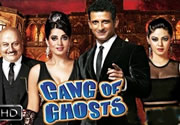
Gang of Ghosts
Synopsis:
The funny thing is that Raju isn't alone in this massive crumbling heap of concrete and peeling wallpaper because the place is totally infested with restless spirits from different eras of Indian history. There is a flamboyant theatre actor ghost played by Saurabh Shukla who loves chewing the scenery even in death, an item-girl spirit named Manorama played by Mahie Gill who died during a stage performance, a freedom fighter, a stereotypical Bengali poet, and a menacing British general who still thinks he rules the Empire. Chunkey Pandey shows up as this weird, eccentric character named Grewal who provides random comic relief, and honestly, the styling of all these ghosts is just a trip with way too much white face powder and dusty velvet.
Anyway, Raju tries to make peace with the supernatural residents and they actually form a quirky little family unit because they all share a mutual hatred of the living world, which brings us right up to the interval block where a completely random item song drops out of nowhere and interrupts a dramatic conversation about heritage and eviction notices. Seriously, bollywood movies love throwing a dance number at you when the plot is literally hanging by a thread, and this one features Meera Chopra looking bewildered while ghosts and humans shake a leg together in a dusty courtyard.
Right after that chaotic musical break, the real conflict kicks in because a slimy builder and politician duo want to demolish the haunted mansion to build a glitzy modern shopping mall, which is a classic trope in hindi films where greedy developers have zero respect for heritage or the paranormal. The builder sends in goons, but the ghosts use their spooky powers to scare the living daylights out of the thugs with flying furniture and flickering lights, and Yashpal Sharma’s character gets thoroughly terrorized in a sequence that lasts way too long and features a ridiculous amount of green-screen fog.
Parambrata Chatterjee and Jackie Shroff pop up too, adding to the overcrowded ensemble cast where half the actors barely get any lines, but they all look like they are having a blast shooting on sets that smell like old dust and fake cobwebs. The tension peaks when the demolition crew arrives with heavy machinery and riot gear, ready to flatten the palace once and for all, and the ghosts realize they have to team up with Raju and his theatre troupe to stage one massive, terrifying illusion to protect their home. They orchestrate a massive coordinated haunting, putting on a theatrical display of historical battles, ghostly groans, and flying objects that convince the corrupt politicians and the greedy builders that the land is cursed by actual demons.
The politicians flee in absolute terror, dropping their blueprints and running down the dirt road in slow motion while the entire ensemble of ghosts and humans cheer wildly in the courtyard. The property gets declared a protected historical monument, saving the spirits from homelessness and giving Raju a permanent place to stage his plays without paying rent. The final scene shows the ghosts and humans sitting together on the mansion's grand veranda sharing cups of tea as the credits roll and everybody laughs awkwardly at a final cheesy punchline.
That one specific screech on the soundtrack right before the second reel starts is going to live in my head for at least a week, and honestly, I am not thrilled about it. Satish Kaushik had a particular kind of loud, broad-strokes comedy in him that could sometimes cross from exhausting into something oddly watchable, though Gang of Ghosts tests that boundary with a crowbar. It is a remake of a Bengali film called Bhooter Bhabishyat, which I only mention because people who have seen that earlier version seem constitutionally unable to stop talking about it, treating the original text like sacred scripture that has been dragged through the dust of a typical Mumbai studio lot. That comparison is tedious, so let us just look at the mess in front of us, starting with the way Anupam Kher enters the frame like he wandered off the set of a completely different period drama and just decided to stay. Kher plays an old-school theater artist whose spirit now haunts a dilapidated colonial mansion slated for demolition, delivering his lines with a theatrical cadence that makes everyone else on screen look like they are acting in an insurance commercial. If I am honest, the sheer weight of his past filmography does half the work for him here, because you remember better days while watching him squint at a modern lighting rig. The premise itself is built on ghosts from different eras—a freedom fighter, an item girl, a British officer, a Punjabi migrant—all squabbling over real estate like eccentric tenants in a rent-controlled South Bombay building, which gives the art department plenty of excuses to pile on vintage props until the edges of the screen blur.
Mahie Gill drifts through the middle of this chaos as a glamorous starlet from the fifties whose death involved some melodramatic poison, giving her every scene a heavy-lidded, slow-motion treatment that wears out its welcome about ten minutes in. It is a small thing but it bugged me how the makeup department gave her the exact same winged eyeliner in flashbacks that spanned twenty years of supposed cinematic history. Around her, Sharman Joshi plays a struggling young filmmaker trying to shoot a documentary in the haunted house, providing the mandatory straight-man reactions while looking increasingly bewildered by the paycheck he must have cashed to be there. Joshi has a very specific, nervous kind of screen presence that worked wonders in a tighter ensemble like 3 Idiots, but here he is just cannon fodder for punchlines that arrive three seconds too early. Saurabh Shukla shows up as a corrupt politician with grease in his hair and money in his socks, chewing on the scenery with a gusto that suggests he read the script, threw it away, and just decided to wing every single take. When Shukla and Chunkey Pandey share a frame, the movie lurches into a strange, frantic rhythm where timing doesn't matter as much as who can yell the loudest without bursting a blood vessel. Pandey plays a 1970s villain who still talks like he is auditioning for sub-standard action thrillers, complete with white shoes and an unearned swagger that feels weirdly authentic to the seedier corners of older Hindi films. The supporting players—Yashpal Sharma as a communist ghost who refuses to check his ideology at the door, and Asrani as a relic of silent-era slapstick—drift in and out of scenes with the blank efficiency of extras waiting for their lunch coupons. Jackie Shroff pops in for a cameo that consists mostly of leather jackets and gravelly one-liners, looking like he was passing by the studio on his motorcycle and agreed to do a shift for old time's sake.
The direction by Kaushik lacks the nimble, fast-twitch dexterity required for a multi-character farce, choosing instead to let scenes breathe long after the joke has expired and the actors have run out of gas. A comedy about displaced spirits living in a doomed building should theoretically carry a faint undercurrent of melancholy about urban decay, but this movie would rather cut to a broad visual gag about a ghost dropping a teacup or tripping over a rug. The camera setup in the main drawing-room sequences feels static, relying on master shots that trap the actors in semicircles and force them to shout their dialogue across the room just to maintain some semblance of energy. Cinematographer Kabir Lal lights the haunted mansion with a sickly blue filter that screams low-budget horror, even though the tone is supposed to be lighthearted caper territory with musical numbers thrown in to pad out the runtime. Those musical numbers, by the way, arrive with the structural necessity of a root canal, halting the narrative momentum dead in its tracks just so the ghost of an item girl can gyrate in front of a green screen that looks like it was rendered on a Pentium 3. It is hard to judge Bollywood movies by the standards of traditional ghost stories when the supernatural elements are used primarily as an excuse to comment on modern real estate mafia and the loss of heritage, but the social commentary is hammered home with the subtlety of a falling anvil. Every time the script tries to say something genuine about how we treat our old buildings and our forgotten artists, a character immediately makes a fart joke or pulls a funny face to ensure nobody in the back row gets confused.
There is a recurring editorial choice to hold on reaction shots for three or four beats longer than necessary, creating a dead air that drains whatever comic momentum the previous line managed to build up. You can practically hear the editor in the bay wondering if they should have cut to a wide shot, deciding against it, and just letting Meera Chopra blink at the camera until the next cue drops. That kind of mechanical sluggishness is what keeps the movie from ever achieving the breezy, chaotic charm it so clearly wants to project. The script borrows its structural backbone from older supernatural comedies like Paheli, but trades out any lingering sense of folklore or magic for stale punchlines about bureaucratic corruption and greedy builders. Parambrata Chatterjee tries to bring some grounded authority to his role, but he is stranded in a sub-plot about local elections that feels like it was grafted on from an entirely different screenplay about municipal politics in western Uttar Pradesh. By the time the climax rolls around—featuring a massive confrontation between the spirits and the demolition crew involving flying furniture and poorly composited CGI dust—you are mostly just watching actors sweat under heavy wool costumes while waiting to hear director's cut.
It is not a disaster on the scale of some of the more infamous trainwrecks in recent popular cinema, but it suffers from a terminal lack of imagination that makes the ninety-minute runtime feel twice as long. You appreciate the occasional flash of wit from Kher or a particularly committed sneer from Shukla, yet these small pleasures are routinely buried under layers of indifferent execution and flat lighting. Some films manage to survive their own clumsiness through sheer enthusiasm, but this one feels exhausted from the very first reel, dragging its spectral cast through one predictable confrontation after another until the house finally falls down. We are left with a collection of half-formed ideas about ghosts, gentrification, and old Bollywood tropes, none of which are explored with enough rigor to make an impression once the screen goes black.