

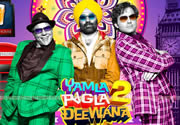
Yamla Pagla Deewana-2
Synopsis:
In Varanasi, Dharam Dhillon (Dharmendra) is conning people along with his son Gajodhar (Bobby Deol) by pretending to be Gurus. When Sir Yograj Khanna (Annu Kapoor) from England comes to meet Dharam thinking he is a Guru, Dharam’s eyes twinkle and settle on his diamond rings. Dharam & Gajodhar pretend to be the owners Oberoi of Oberoi & Oberoi Company, in order to fool Yograj. Yograj gets impressed, and mentions his daughter. Dharam tells Gajodhar to go make his daughter Suman Khanna (Neha Sharma) fall in love with him, which he does and soon marriage is fixed. However, Dharam''s elder son Paramveer (Sunny Deol), a loan recovery agent for a bank, by chance meets Yograj Khanna.
Paramveer lands up at Khanna''s club just as Joginder Armstrong (Anupam Kher) arrived to take over the club. Joginder is mostly called “Dude” and has the hair and gall to reference one of cinema’s most curious and cherished characters (Jeff “The Dude” from The Big Lebowski). Joginder brings his two main flunkies (played by Johnny Lever and Sucheta Khanna) along with a group of goons, who are then all bashed up by Paramveer. Yograj hugs him and makes him his manager. Then, Paramveer encounters Dharam and Gajodhar trying to become part of Yograj''s wealth. Paramveer has the power to stop his father and brother, but will he? Or will he yet again become a part of their con?
Bobby Deol's hair in the first twenty minutes of Yamla Pagla Deewana-2 has this strange, lacquered stiffness that refuses to move even when he is being thrown through a tea stall, and if I am honest, that was the exact moment I knew the afternoon was going to be a long one. Sequels to successful comedies usually operate on a sliding scale of desperation, but Sangeeth Sivan’s follow-up to the 2011 hit feels less like a continuation and more like an extended hostage video where the hostages keep forgetting their lines and staring off-camera at the prompt cards. You sit there in the dark, watching Dharmendra attempt to charm a snake or a woman with the same weary twinkle in his eye, wondering how a franchise that traded entirely on the genuine familial warmth of its three leads managed to drain every ounce of organic joy out of their screen presence. Hindi films have a long, storied tradition of milking a successful premise until the cow is dry, yet this particular enterprise doesn't even bother with the milking, preferring instead to beat the carcass with a plastic cricket bat and hope the audience laughs at the hollow thud.
The plotting, credited to a writers' room that apparently worked entirely in separate dark rooms without ever speaking to each other, concerns a convoluted scam involving fake art, real gangsters in the UK, and a dog that barks on cue. Dharam Singh and his dimwitted sons, played with varying degrees of exhaustion by Sunny and Bobby, relocate to England because apparently British tax laws are friendlier to con artists who wear matching leather jackets. Sangeeth Sivan directs with the frantic energy of a man trying to defuse a bomb while blindfolded and slightly drunk on lukewarm tea, cutting away from reaction shots a fraction of a second too late so you can see the actors blinking and waiting for the cue to look surprised. There is a running gag involving Annu Kapoor as a sleazy art dealer whose dubbed dialogue is so out of sync with his mouth movements that you could read a novel between the syllable hitting the soundtrack and his lips actually closing, a small technical glitch that somehow manages to distract from the broader narrative chaos unfolding around him.
Sunny Deol spends ninety percent of his screen time looking like he would rather be doing literally anything else, perhaps auditing a tax form or cleaning a very large garage, which is actually a shame because his deadpan delivery in comedies has occasionally yielded accidental gold in past bollywood movies. Here, the legendary anger that once tore through Ghajini and Damini is reduced to a mild, bewildered annoyance whenever Bobby's character gets them into another scrape involving giant papier-mâché bananas or mistaken identity. Bobby himself is caught in a perpetual loop of playing the handsome loser who gets hit on the head with various heavy objects, a bit he has been running since the late nineties with diminishing returns that bottom out completely here. Dharmendra remains the only person on screen who seems to understand the assignment, leaning heavily into his vintage star persona with a wink and a shrug, though even his considerable charm cannot save scenes where he has to dance alongside background artists who look like they were pulled off Oxford Street ten minutes before the cameras rolled.
The cinematography looks smeared in Vaseline and primary school poster paint, giving Birmingham the aesthetic look of a slightly damp budget hotel lobby during an off-season convention for regional insurance salesmen. Whenever the narrative threatens to stall completely, which happens roughly every six minutes, the soundtrack drops a frantic, synthesized bhangra track that loops the same four-bar hook until your teeth ache from the repetition. Neha Sharma and Kristina Akheeva wander through the frame with fixed smiles and nothing to do, serving mostly as human coat racks for sequined outfits that probably cost more than the catering budget for the entire crew. It is an exhausting kind of loud, aggressively unfunny cinema that mistakes noise for momentum, leaning on the audience's nostalgia for the senior Deol's past glories like a panhandler rattling a cup outside a tube station. You watch these seasoned performers stumble through crude double entendres and slapstick routines that feel leftover from a bad 1980s VHS tape, and the general feeling is not anger at the waste of time, just a heavy, persistent numbness.
Somewhere in the middle of all this sound and fury, an entire subgenre of Hindi movies based entirely on family dynamics and generational friction got lost, replaced by hollow product extensions designed to sell satellite rights to exhausted television programmers. Anupam Kher pops up in a dual role that requires him to wear a series of unconvincing wigs and shout a lot of dialogue, proving once again that a great character actor can survive almost any script if he just collects his check and hits his marks with professional detachment. By the time the climax arrives on a yacht that is clearly a soundstage with some blue muslin taped to the windows, the film has long since abandoned any pretense of storytelling in favor of unearned happy endings and aggressively cheerful group dances. It is not a disaster on the scale of true cinematic infamy, nor is it a misunderstood camp classic waiting for rediscovery by ironic twenty-somethings on late-night streaming services. It is just a movie that exists because someone had a budget, a few famous names on retainer, and a complete unwillingness to check if the cameras were actually in focus before shouting action.