

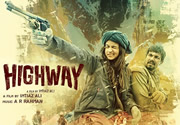
Highway
Synopsis:
Story begins on the eve of the wedding of Veera Tripathi (Alia Bhatt), daughter of a rich business tycoon. She is on the It at night with her fiance when she gets abducted. The gang who kidnaps her panics when they find out about her father who has links in the government. However, Mahabir Bhati (Randeep Hooda), her abductor, is adamant, and is willing to do whatever it takes to see this through. They are continuously on move into different cities, to avoid being tracked by police. At one point, Veera tries to flee, but fails. As the days go by Veera finds peace in her bondage to the point that she confides in him of her troubled childhood. Fear of abduction is taken over by a sense of freedom.
At one point while crossing a check post police forcefully search the truck, but Veera, surprisingly even to herself, hides. Veera confesses to Mahabir that she loves the journey and doesn''t want to go back to her life. Mahabir couldn''t help but care for Veera and his anger fades away, though slowly, he decides to let her go. Veera refuses and persist on staying with Mahabir. They both take shelter on a hilltop house. Next morning a sudden shootout starts, as police has tracked them down. Mahabir is shot dead on the spot, while shocked Veera is sent back to her parents. Disturbed by the incident Veera tells her family the truth about abusing by her uncle and her desire of not living with them anymore. Movie ends with Veera shown working and living on a hill station on her own, with memories of days she spent with Mahabir.
Randeep Hooda has this way of blinking right before he delivers a line in Highway that makes you forget you are watching a movie someone spent money on, which is good because the rest of the sound design in the first twenty minutes sounds like it was mixed in a tin shed during a thunderstorm. Look, if I am being completely honest, the opening highway sequence moves so fast through the toll plaza that I had to rewind twice just to figure out whose car they were actually in, but once the vehicle gets moving the whole thing settles into a strange kind of rhythm that stays with you long after the screen goes black.
Imtiaz Ali isn't really interested in the logistics of a kidnapping, and frankly neither should you be, preferring instead to shove his characters into the back of a truck and let Anil Mehta's camera figure out how to capture the terrifying vastness of northern India without making it look like a tourist brochure. That camera is restless, moving from the suffocating neon haze of a Delhi shopping mall right into the blinding white salt flats of Sambhar with a suddenness that leaves you a bit carsick. The screenplay takes its sweet time getting where it's going, occasionally losing the plot entirely in favor of an extended sequence where Alia Bhatt just stares out a window while the background hums with ambient traffic noise. There's a scene near the middle where Mahabir stops the truck simply because the engine sounds weird, and the camera lingers on Hooda's grease-stained hands for an uncomfortably long duration while Hindi films usually panic and cut to a close-up of a worried face, but here it just sits in the dirt and lets the silence do the work.
Alia Bhatt was basically a kid when they shot this, and you can see the exact moment she stops acting and starts reacting to the cold wind blowing through the canvas of the truck, which separates her work here from the polished stiffness of Student of the Year without needing any grand declarations about range. She plays Veera with a twitchy, upper-class restlessness that could easily have become grating if she didn't occasionally let slip a quiet, terrifying vulnerability that makes you understand why she doesn't actually want to go back to her impending wedding. Hooda plays Mahabir with a jagged-edged tiredness that reminds me of how Manoj Bajpayee used to carry himself in Ram Gopal Varma's early crime dramas, though with less outward menace and a lot more internal rot. Their dynamic doesn't follow the usual Stockholm syndrome beats where the captive falls for the captor because he shared a piece of dry bread; instead, it develops through exhaustion, long stretches of shared silence, and the mutual realization that neither of them has anywhere else on earth to go.
AR Rahman's soundtrack does something weird here where it doesn't just score the emotional beats so much as it provides an alternate narrative track entirely, sometimes drowning out the dialogue with a wall of folk-infused percussion that makes the landscape feel almost predatory. Patakha Guddi works well enough on the radio, but when it plays over the sweeping mountain vistas while Veera screams into the wind, it avoids feeling like a standard music video break because the editing keeps cutting back to the dirt under their fingernails. There's a persistent hum in the audio mix during the interior truck scenes that sounds suspiciously like a stray air conditioner somewhere on the mixing stage, and once you notice it, you can't unhear it whenever the dialogue drops below a normal conversational whisper.
The themes of freedom and captivity get tossed around quite a bit in reviews of this picture, but what actually lingers is the way the narrative treats trauma not as a sudden lightning strike to be overcome with a dramatic speech, but as a chronic ache that just changes shape depending on the altitude. Veera's realization that her golden-cage upbringing was just a more expensive version of the actual cage she's currently sitting in isn't treated as a profound philosophical breakthrough, but rather as a depressing math equation she solves while staring at a goat tied to a fence. They keep moving because stopping means talking, and talking means admitting that the houses they came from were never really homes to begin with. It's a small thing, but it bugged me how the police department is portrayed as this utterly toothless entity that only exists when the plot needs an artificial surge of panic, vanishing for days at a time while our couple casually camps out in abandoned brick kilns.
Hindi movies rarely know how to end a road trip without resorting to either a shootout or a sermon, and while this one flirts dangerously with the latter during the mountain monologue, it pulls back just enough to let the ambiguity of the situation settle into the dust. You don't get neat resolutions for characters who have been broken this badly by the world, and the film refuses to pretend that a couple of weeks in the mountains can erase twenty years of domestic suffocation. The final twenty minutes are shot with a washed-out, overexposed light that hurts the eyes, perfectly matching the mental state of a girl who has looked at the sun for too long and forgot what the shade felt like.