

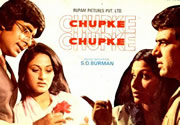
Chupke Chupke
Synopsis:
Professor Parimal Tripathi (Dharmendra) is a botany professor who falls in love with Sulekha Chaturvedi (Sharmila Tagore) during a women''s college botany excursion. Prof. Parimal Tripathi helps the bungalow watchman to get to his village downhill to enable him to see his grandson who''s fallen ill. Meanwhile he disguises himself as the bungalow watchman to protect the old man''s job. Sulekha finds out one day about the cover-up and is charmed on seeing Parimal''s real personality. They both get married. Parimal loves playing pranks and is the antithesis of regular professors. Sulekha, on the other hand is in awe of her jijaji (brother-in-law) Raghavendra (Om Prakash). She considers her jijaji to be highly intellectual and looks upon him as her idol. Parimal develops an inferiority complex thanks to Sulekha''s excessive praise of her jijaji and decides to prove that he is in no way a lesser mortal. Jijaji, meanwhile, has written a letter to Haripad bhaiyya (David Abraham Cheulkar) asking him to send a driver who can speak good Hindi because his present driver James D''costa (Keshto Mukherjee) uses improper grammar. This provides the perfect opportunity for Parimal to get to see and interact with jijaji. Parimal becomes Pyaremohan Ilahabadi, a motor-mouth driver who pretends to hate the English language and so speaks only Hindi. So begins the comedy of errors, as Parimal and Sulekha play prank after prank on the unsuspecting jijaji.
First they pretend that Sulekha is not happy with her new marriage, then they put across the impression that Sulekha is having an affair with Pyaremohan, and if that was not enough, they get Parimal’s long-time friend Sukumar Sinha (Amitabh Bachchan), a Professor of English literature, to temporarily act as Parimal and portray him as a serious and boring lecturer, the complete opposite of Parimal''s character. Pyaremohan''s excessively refined Hindi, his habit of correcting jijaji''s usage of the language and his persistence in getting jijaji to teach him English all serve to irk jijaji to no end and provide for many laughs. Parimal''s long-time friend P K Srivastava (Asrani) is also party to the prank. His sister-in-law Vasudha (Jaya Bachchan) suspects fake ''Parimal'' - Sukumar Sinha - of infidelity to his wife ''Sulekha'' when he tries to get close to her. Sukumar falls in love with Vasudha who at first believed he was Parimal, but Sukumar reveals to her the real drama behind all this mix-up of situations. Lata Srivastava (Lily Chakravarty), P K Srivastava''s wife, is also angered over the latest ''extra marital'' love affair. But toward the end, Sukumar and Vasudha end up marrying in a temple where Haripat bhaiyya coerces Pyaremohan to ''kill'' himself so that Parimal could surface. Thus jijaji comes to comprehend the whole enactment, finally admitting that he was truly fooled. The film revolves around the resolution of these funny mishaps.
That specific tilt of Dharmendra’s head right before he launches into another absurdly convoluted grammatical explanation is something I keep rewinding. It is a small thing, sure, but it bugged me how the print on the streaming version I watched made his teeth look entirely too yellow during that botanical monologue. Hrishikesh Mukherjee never needed much budget to make a comedy work, relying instead on the kind of gentle domestic chaos that feels distinctly miles away from the current state of Hindi films where everything has to be amplified by four subwoofers. This 1975 classic keeps its footing without leaning on slapstick crutches or shouting at the audience. Yet we still get a few clunky transition cuts where the audio dubbing on Asit Sen’s lines drifts half a second out of sync with his jaw movement, a sloppy bit of post-production that always pulls me right out of the illusion.
The script, adapted from a Bengali story by Upendranath Ganguly, trades in identity confusion and verbal gymnastics with a lightness that Hrishikesh Mukherjee managed better than anyone else working in Bollywood during that decade. Parimal Tripathi is a botany professor who decides to masquerade as a chauffeur named Pyarelal to rattle the ego of his new brother-in-law, a man so obsessed with his own command of pure Hindi and his ability to see through human pretense that he practically begs to be taken down a peg. Dharmendra plays this dual persona with a physical looseness that feels completely improvisational, slouching into the driver’s seat with tobacco-chewed confidence while dropping high-register Sanskrit words into casual conversation just to watch Om Prakash’s character sputter in sheer bureaucratic outrage. The setup is ridiculous on its face, requiring an entire household to suspend disbelief regarding uniforms and accents, but the screenplay lets the momentum build through dialogue rather than frantic chases, letting characters talk themselves into corners.
Then there is Sharmila Tagore as Sulekha, who spends the first half of the narrative trying to suppress giggles behind the corner of a floral sari whenever Dharmendra adopts his stiff, rustic persona. Her chemistry with Dharmendra feels lived-in, miles away from the calculated star-pairings you see in glossy contemporary Hindi movies, possessing the casual friction of people who share bathroom routines and breakfast grievances. When she attempts to act cold and haughty around the disguised professor, her sideways glances betray a giddy thrill that makes the elaborate deception look less like cruelty and more like an elaborate private joke played on the entire extended family.
Down the hall, Amitabh Bachchan and Jaya Bachchan are doing something entirely different as Sukumar and Prasad, the scholarly friend and the eager wife dragged into the conspiracy. Amitabh plays the philosophy professor with a permanent, hangdog expression of intellectual exhaustion, looking perpetually as though he would rather be grading term papers in an empty library than pretending to know how to fix a carburetor. His deadpan delivery of absurd lines about existential botany provides a dry counterweight to Dharmendra’s physical exuberance, showing an aptitude for deadpan comedy that a lot of directors ignored after *Zanjeer* cemented him as an angry action hero. Jaya matches his energy with wide-eyed exasperation, her dialogue timing sharp enough to cut glass, especially during the dinner table scenes where everyone is desperately trying to maintain polite conversation while hiding massive lies beneath their napkins.
The supporting cast features Om Prakash playing Raghav Prasad, the pompous brother-in-law whose obsession with correct Hindi speech forms the entire logistical architecture of the plot. Om Prakash does not play him as a mustache-twirling villain, but rather as an annoying middle-aged bureaucrat who genuinely believes his opinions on language are a matter of national security, making his eventual humiliation feel earned instead of mean-spirited. Keshto Mukherjee shows up as the perpetually drunk gardener who ends up sober at the most inconvenient possible moments, stumbling through flowerbeds with a look of mild grievance that never fails to land. There is a recurring gag with Keshto’s character and a bottle of rum that starts to wear thin by the third repetition, an editorial misstep where the film lingers on his slurred speech four seconds too long after the joke has already finished making its point.
S.D. Burman’s score remains understated, sliding into scenes with acoustic guitars and light flute trills that never telegraph the jokes or cue the audience when to laugh. "Ek Ladki Bheegi Bhaagi Si" from *Chalti Ka Naam Gaadi* had more immediate rhythmic punch, but the musical numbers here—particularly "Keh Do Na Keh Do Na" sung by Kishore Kumar and Lata Mangeshkar—drift through the background like pleasant afternoon breeze rather than demanding total attention. The cinematography by Jaywant Pathare stays largely out of the way, framing the living rooms and porches with a flat, naturalistic lighting that makes the chaos look like something happening in your own uncle's house rather than a pristine studio set.
Underneath the mistaken identities and linguistic wordplay, the film is really an extended argument against the absurdity of intellectual snobbery and domestic rigidity. Raghav Prasad’s insistence on linguistic purity is treated as a symptom of a broader stiffness that prevents people from simply enjoying their lives, and the entire elaborate hoax cooked up by Parimal is essentially a massive, expensive therapy session designed to teach an old relative how to laugh at himself. Nobody learns a profound moral lesson by the end, nobody reforms their entire worldview, and the household simply goes back to its normal routine once the masks come off, which feels far more honest than any grand cinematic resolution.
Watching it now, long after the era of clean middle-class comedies in Indian cinema has faded into the background, the film holds up through sheer pacing and the relaxed authority of its lead actors. The framing devices are creaky, the audio mixing occasionally sounds like it was recorded inside a tin bucket, and the central premise makes almost no logistical sense if you spend more than ten seconds thinking about it. Yet the comedic timing between Dharmendra and Om Prakash during the final confrontation over a bowl of kheer remains as crisp as anything in *Padosan*, proving that professional execution of a silly premise will always outlast whatever trend is currently dominating the box office.