

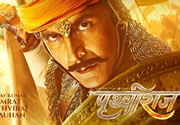
Samrat Prithviraj
Synopsis:
That fake grey mustache glued to Akshay Kumar’s upper lip does half the heavy lifting in Samrat Prithviraj, which is a problem when the other half is supposed to be dramatic tension. Every time he turns his head to gaze across a sun-bleached courtyard with a look of fierce, unyielding nobility, the edge of the prosthetic lifts just a millimeter. You cannot unsee it once you catch it. You spend twenty minutes watching the adhesive rather than the Chauhan empire falling to pieces.
Director Chandrapraksh Dwivedi spent nearly two decades trying to get this script off the ground, and if I'm honest, the extra time didn't do the pacing any favors. Scenes start and end with the abruptness of a PowerPoint presentation. Characters walk into a room, state their historical grievances with the exhaustion of people reading regional transit announcements, and then someone starts swinging a broadsword. The screenplay treats history less like a living sequence of human choices and more like a series of Wikipedia infoboxes that need to be cleared before the intermission. It is all setup and declaration, rarely letting a moment breathe without a booming orchestral cue reminding us that we are currently witnessing something epic and grand.
Akshay Kumar plays the titular ruler with a placid, smiling serenity that suggests he has already checked his investment portfolio for the afternoon, refusing to break a sweat even during the siege sequences. He lacks the erratic, animal ferocity that made Ranveer Singh so compelling in Padmaavat, opting instead for a monotonous, uncle-like benevolence that makes you wonder how he ever conquered a territory. Manushi Chhillar, as Princess Sanyogita, looks stunning in heavy brocade and enormous nose rings while delivering her sparse dialogue with the careful cadence of a schoolgirl reading from a primer. They share about as much romantic chemistry as two strangers waiting for an elevator in Noida, exchanging loaded glances that feel entirely procedural.
Sanjay Dutt shows up as Kaka Bhairava with a voice so heavily compressed and raspy it sounds like he is speaking into a metal bucket from the bottom of a well, though at least he brings a physical weight that the rest of the principal cast ignores. Sonu Sood fares better as Chand Vardai, lending the proceedings a weary, poetic gravity that almost tricks you into caring about the fate of Delhi. The supporting players drift in and out of the narrative like extras who wandered off a television soap opera set, complete with obvious dubbing that drifts half a second out of sync during close-ups. It’s a small thing but it bugged me every single time.
The cinematography relies on a hazy, digital golden-hour wash that flattens every texture until the silk costumes and the stone pillars look like they were rendered by the same mid-tier graphics card. Action coordinator Franz Spilhaus stages the battles with a dizzying reliance on speed ramps and excessive digital blood splatters that obscure the geography of the fight. You rarely know who is hitting whom or why the camera is shaking so violently, turning what should have been brutal hand-to-hand skirmishes into a messy blur of brown tunics. Shankar-Ehsaan-Loy’s soundtrack tries to rescue the proceedings with sweeping folk motifs and thunderous percussion, yet the tracks arrive with such mechanical predictability that you can practically hear the audio track fading out five seconds before the dialogue kicks back in.
Beneath the bluster, the film wants to be a moral anchor for national identity, leaning heavily into notions of duty, sacrifice, and the eternal righteousness of the motherland. Hindi cinema has trodden this path so many times that the ideological messaging feels shopworn and weary. Instead of exploring the complicated geopolitical realities of twelfth-century India, the script collapses into a simplistic binary where our side is noble to a fault and the opposing forces are cartoonishly villainous without a single redeeming contradiction. The women exist to be protected, rescued, or mourned, rarely getting a chance to drive the plot through their own agency.
When the credits finally roll, you are left with the distinct sensation of having sat through a history textbook that caught on fire and was then hastily beaten out with a damp rug. Bollywood movies have always had a complicated relationship with the past, often preferring mythmaking over archival accuracy, but this production lacks even the pulpy joy of a good costume drama. It sits there on the screen, heavy and earnest and remarkably dull, proving that good intentions alone cannot build a kingdom or hold a three-act structure together.