

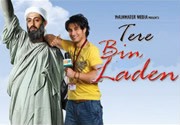
Tere Bin Laden
Synopsis:
About halfway through Tere Bin Laden, Ali Zafar is sitting in a tiny, sweltering room in Karachi sweating profusely while wearing this ridiculously oversized, stiffly tailored brown faux-leather jacket that honestly looks like it smells heavily of stale mothballs and cheap laundry detergent, and he is trying to glue a piece of fake cotton beard onto the face of a terrified, bewildered young guy named Pradhuman Singh who isn't even sure what country he is in anymore, and it is just a deeply chaotic disaster of a scene. But to understand why any of this is happening, you have to look at how Ali's character, an ambitious and endlessly frustrated television reporter named Ali Hassan, is just completely desperate to pack his bags and move to America because he is so entirely sick of getting rejected for his US visa by miserable embassy officials who treat him like absolute garbage every single time he walks through their sliding glass doors. He works for a second-rate local TV station and he cannot catch a break, and it is honestly amazing how anyone survives that kind of daily career humiliation. So then one day he stumbles across this goofy chicken farmer from a remote village who looks just enough like the world's most wanted terrorist to give Ali a really terrible, brilliant, and completely unhinged idea. Right after that, Ali teams up with a shady local cable operator played brilliantly by Piyush Mishra and a quirky photographer girl, and they decide to shoot a fake hostage video featuring the chicken farmer pretending to be the infamous mastermind just to mess with the CIA and force the American government to pay attention to them, which completely balloons out of control because the video actually gets leaked on the internet and instantly becomes the biggest news story on the planet. The CIA panics and sends a twitchy agent running all over the place, and the local Pakistani intelligence agency gets involved too, and honestly, the whole middle section of the movie is just a relentless blur of guys in bad disguises hiding in closets and running down narrow alleyways while yelling at each other in Urdu and Hindi movies style panic. Sugandha Garg's character is running around trying to keep everyone focused, and Barry John shows up as this intense American official who is sweating through his crisp suit because his career is totally on the line over a fake video of a guy who just wants to go back to his chickens. The plot gets so thick with ridiculous double-crosses and botched ransom drops that you completely forget who is working for whom, but nobody really cares because it is just one funny mishap after another. The fake Osama keeps breaking character to ask for lunch or complain about the weather, and Ali is constantly having to duct-tape his mouth shut or bribe him with sweets just to get him to look menacing into the webcam lens, and it's a miracle they don't get arrested in the first ten minutes. They go on the run across the desert in a beat-up station wagon that rattles like a bag of loose nuts and bolts, and they are dodging federal agents and local thugs who all want a piece of the bounty, and the comedy just hits this peak level of absurdism that you rarely see in typical Bollywood stuff. They end up cornered in this abandoned warehouse filled with dusty crates and hanging plastic sheets, and Ali has to talk his way out of a literal firing squad using nothing but his smooth-talking anchor voice and a broken microphone. He convinces everyone that the United States government is about to drop a missile on the exact coordinates they are standing on, and a massive, chaotic free-for-all breaks out involving smoke bombs, flying chairs, and a frantic chase through the back alleys. Ali grabs the chicken farmer by the collar, they sprint toward the docks, and they shove each other onto a cargo boat heading out to sea while shouting curses at the horizon.
The rooster puppet in the opening montage is slightly too bright, the kind of cheap plastic prop you buy off a folding table in a dusty corner of Crawford Market, and every time it cut back to Ali Zafar holding the damn thing while attempting to look like a desperate Pakistani broadcast journalist whose visa application has just been rejected for the fourth consecutive time, I kept thinking about how close this whole enterprise came to falling completely apart before the crew even wrapped day three.
Director Abhishek Sharma clearly watched a lot of Armando Iannucci before sitting down to write this script, but instead of translating political satire into the plush carpeted hallways of Whitehall, he dragged the whole cynical apparatus down into the sweaty, power-outage-plagued alleys of Karachi where nobody cares about geopolitical strategy if the local generator is sputtering out again.
The pacing has this breathless, manic energy that makes you forget for long stretches that half the jokes are landing with a dull, echoing thud, mostly because the camera is moving so fast across cramped living rooms and chaotic newsrooms that you barely have time to register a dropped punchline before somebody else is shouting about goat hair.
Ali Zafar plays Ali Hassan with the kind of slick, untrustworthy charm that belongs on a morning talk show sponsored by a questionable brand of laundry detergent, and he manages to hold the center of the frame even when the screenplay forces him to share scenes with a terrifyingly convincing lookalike of the world's most wanted terrorist who mostly communicates through a series of disgruntled grunts and alarming facial twitches.
Pradhuman Singh has the impossible job of playing the Osama bin Laden double, and his silent performance relies entirely on posture and heavy-lidded expressions of profound boredom, which turns out to be much funnier than any dialogue they could have written for him.
Then you have Piyush Mishra showing up as an eccentric American CIA agent who looks like he wandered off the set of a low-budget Vietnam War drama and decided to stay for the catering, chewing on his lines with a grizzled intensity that feels completely out of place in a movie where people are constantly running away from angry local grocers.
The supporting players fill out the edges with frantic, sweaty desperation, especially Nikhil Ratnaparkhi and Chirag Vohra, who spend most of their runtime looking like two guys who realized halfway through a bad business investment that they forgot to read the fine print.
It's a small thing, but it bugged me throughout the second act: the audio mixing on the crowd noise during the exterior street scenes sounds like it was lifted straight from a stock library recorded in 1994, with the exact same indistinct shout of a man complaining about bus fares repeating four times in the background whenever the camera pans across a marketplace.
Bollywood movies rarely touch this specific brand of low-stakes geopolitical farce, preferring instead to wrap their political commentary in three-hour chunks of soaring emotional melodrama and slow-motion flag-waving, which makes this lean ninety-minute prank feel genuinely refreshing even when the jokes are stretching thin.
The cinematography by Chirantan Das relies heavily on a jaundiced, sun-baked color palette that makes every interior look like it's lit by a single forty-watt bulb covered in decades of dust, capturing that particular Karachi aesthetic where nothing ever looks quite clean no matter how many times the tile floor gets mopped.
There is a distinct lack of fat on the bones of this narrative, which separates it immediately from something like "Peepli Live," a picture released around the exact same moment that got completely bogged down in its own self-importance and spent twenty extra minutes telling you that poverty and media circus make for an unhappy marriage.
Sharma keeps the engine revving by refusing to let any single sequence breathe for more than thirty seconds, jumping from Ali's disastrous attempts at filming a fake confession video to the CIA's bumbling surveillance operations with the manic concentration of an insomniac channel-surfing at three in the morning.
The background score hits you over the head with jaunty accordion loops and frantic percussion tracks that signal every joke five seconds before it arrives, which is annoying if you prefer your satire dry and understated, though let's be honest, subtlety was never on the agenda here.
Seema Bhargava gets about three lines total as a disgruntled landlady, and she delivers every single one of them with a look of such concentrated disgust that you half-expect her to reach out of the screen and slap the boom mic operator for standing too close to her geraniums.
Hindi films have a long and glorious tradition of the mistaken-identity caper, stretching all the way back to the black-and-white era of mistaken twins and stolen necklaces, but dragging that theatrical machinery into the post-9/11 security theater age gives the old tropes a weird, jittery pulse that keeps you off balance.
The thematic undercurrents about the absurdity of the global war on terror and the way modern media manufactures reality out of thin air are painted with such broad, greasepaint strokes that they barely qualify as critique, functioning more like a series of cartoon sketches pinned to a bulletin board in a high school common room.
Nobody in this movie has an arc, least of all the protagonist, who starts the story as a selfish opportunist desperate for a US work visa and ends the story as a slightly more exhausted selfish opportunist who has learned nothing from his brief flirtation with international terrorism.
That lack of moral redemption feels almost radical in a cinematic climate that demands every rogue character hug their mother by the third reel and repent for their comedic transgressions against good taste.
The editing by Aarti Bajaj keeps the rhythm so choppy that you occasionally lose track of who is chasing whom down which alleyway, but that disorientation works in favor of the material, mirroring the chaotic panic of a newsroom trying to break a story before the power cuts out again.
Sugandha Garg brings a sharp, no-nonsense fatigue to her role as the lone voice of reason in a room full of idiots, though her character mostly exists to roll her eyes at Ali's latest harebrained scheme while handing him a clipboard with more paperwork.
Hindi movies of this scale usually drown in their own desperate need to be loved by the urban multiplex crowd, but this one has a greasy, opportunistic charm that makes you forgive the occasional dud joke about bearded men hiding in caves.
Rahul Singh plays a menacing intelligence officer with a permanently furrowed brow, bringing a stiff, humorless gravity to the proceedings that provides a necessary counterweight to the frantic buffoonery happening everywhere else in the frame.
The climax involves a runaway chicken, a remarkably unconvincing disguise involving a fake beard made from rug remnants, and a television broadcast that goes horribly wrong in front of millions of confused viewers, wrapping up the chaos without offering a single neat resolution.
It refuses to pat itself on the back for being daring, mostly because it's too busy running away from the consequences of its own terrible decisions.
The final shot lingers just a second too long on a blinking neon sign outside a dilapidated Pakistani bakery, humming with that low-frequency electrical buzz that makes your teeth itch.