

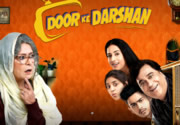
Door Ke Darshan
Synopsis:
Honestly, Door Ke Darshan is one of those totally wild bollywood movies that just throws you headfirst into a nostalgic fever dream, and the whole premise revolves around this hilarious and chaotic household trying to restore an antique Doordarshan-era TV set so that their elderly, deeply senile matriarch—played brilliantly by Dolly Ahluwalia—can watch her favorite old shows without having a total meltdown.
Mahie Gill is running around the house playing the harried daughter-in-law trying to hold everything together while dealing with her wildly dysfunctional family members, and Manoj Bakshi is right there too, adding to the complete madness of this household where nobody can ever agree on anything.
The matriarch has been in a coma or suffering from severe memory issues for ages, and the doctors say that waking her up or keeping her calm entirely depends on showing her this one specific retro television broadcast from her past, which sounds like an absolute logistical nightmare, but hey, it's one of those classic hindi movies where logic doesn't exist and emotions rule everything.
They have to scramble to find old repairmen who even know how to fix a massive CRT television from the nineties, and you get these weird, random background scenes where the local neighborhood guys are wearing the ugliest, most neon-colored striped sweaters you've ever seen in your life, just sweating profusely in the Delhi heat while hitting the back of the TV with a wrench like that's going to magically summon a satellite signal.
And then out of nowhere, right as the family is arguing about money and the broken antenna on the roof, a totally random song and dance number breaks out for no reason whatsoever, completely halting the narrative momentum just so everyone can bust some awkward moves in the middle of the living room before getting right back to yelling about the TV repair bill.
Stuff happens.
We hit the interval point right when the television finally flickers to life with a loud buzzing sound, and everyone freezes in absolute terror because the screen starts showing the wrong channel entirely.
Coming back from the intermission, the plot gets even crazier because the family realizes they have to recreate an entire historical broadcast from decades ago just to trick the grandmother into believing time never passed, which involves dressing up in horribly outdated vintage outfits and staging fake news segments in the living room.
Manoj Bakshi is sweating through a terrible fake mustache while holding a cardboard microphone, reading news off a crumpled piece of paper, and Mahie Gill is literally hiding behind the sofa cueing up a cassette tape of vintage sound effects.
The grandmother sits in her rocking chair, staring blankly at the glowing box with her eyes wide open, muttering old catchphrases from classic hindi films while the family holds their collective breath, praying she doesn't notice the terrible makeup or the obvious cardboard props.
The deception somehow actually works for a little bit, but then the local nosy neighbors start barging into the house to complain about the noise, nearly ruining the whole elaborate scheme and causing a massive shouting match right in front of the senile matriarch.
She suddenly stands up, looks right through the fake TV setup, and starts laughing hysterically because she knew it was a joke the entire time, leaving the rest of the family standing there completely stunned and exhausted by the sheer ridiculousness of the past few days.
Dolly Ahluwalia walks over to the antique television, turns the power knob firmly to the off position, and sits back down in her chair as the screen fades completely to black.
The sound design in the opening ten minutes of Door Ke Darshan relies so heavily on that specific, grating buzz of a vacuum tube television warming up that I found myself reaching for a remote that wasn't there on my desk. It is a minor audio choice, sure, but when a director decides to amplify the electrical hum of a vintage Murphy radio until it drowns out the dialogue twice in the first reel, you start wondering if the mixing board lost its midrange. Let's be real about how nostalgia works in modern hindi movies these days because half the time it feels like directors are just weaponizing our childhoods against us while we sit there eating popcorn that costs as much as a gas bill. Gagan Puri takes this whole retro conceit—a dysfunctional family trying to keep their bedridden matriarch believing it is still 1990 so her heart doesn't give out from the shock of the present—and builds a contraption that rattles every time it hits a narrative bump. The plot mechanism is thin enough to read through, requiring an entire household of Delhi eccentricities to freeze their lives whenever grandmother opens her eyes, yet the sheer logistical madness of turning a living room into a Doordarshan studio keeps the thing moving even when the jokes flatline.
Mahie Gill plays the harried mother with the kind of tired, pinched grace that suggests she spent the morning dealing with three different plumbers and a school fee deadline, abandoning the glamour that usually sticks to her in streaming crime dramas. She doesn't get enough credit for playing exasperation without turning it into comedy, letting her shoulders drop two inches lower in every scene until she practically melts into the sofa cushions. Opposite her, Dolly Ahluwalia chews scenery like she hasn't eaten in a week, and honestly, the film belongs to her whenever she squints at the fake television screen and complains about the news anchor's haircut. It is an enormous physical performance that requires her to spend eighty percent of her screen time horizontal while still dominating the frame through sheer volume of eyebrow movement. We have seen this brand of chaotic domesticity before in various mid-tier comedies, but the actors actually seem to know each other, shouting over one another with the practiced rhythm of people who have shared a cramped kitchen and a single bathroom for twenty years. There's a supporting uncle played by Manoj Bakshi whose background reactions are consistently funnier than the lines the script hands him, though I could have done without the three separate scenes where he drops his dentures into a glass of water because that bit was old when Basu Chatterjee was making comedies. Sometimes the framing is so claustrophobic that you feel like you are trapped in a Delhi DDA flat in August with the cooler broken, which might be an intentional choice to match the characters' desperation, but it also makes the visual field look muddy and cramped.
The screenplay wants to be a satirical look at how technology rewires our brains, but it keeps getting distracted by slapstick routines involving faulty antennas and neighbors who won't mind their own business. The period details shift wildly from 1990 to random bits of modern slang that slipped past the continuity supervisor, which happens constantly in bollywood productions that don't have infinite budgets to vet every background prop. You spot a plastic water bottle from a brand that didn't exist until 2015 sitting on a sideboard during what is supposed to be a tense emotional confrontation about the family's financial ruin. It's a small thing, but it bugged me, just as the soundtrack's habit of cueing a sweeping sentimental violin line every time someone looks at an old photograph bugged me. Gagan Puri directs with a heavy hand, pressing down on the emotional pedals until the squeak drives you slightly mad, refusing to let a quiet moment just sit there without a gag or a tear to validate it. The cinematography by Rakesh Parmar relies on washed-out pastel tones that make every interior look like it was filmed inside an old biscuit tin left out in the sun, capturing that specific, unattractive glare of tube lighting that plagued Indian living rooms before CFLs took over. Yet within this visual swamp, there are moments of genuine sweetness, like the way the family members coordinate their fake news broadcasts using old newspapers and a megaphone as if they were running a pirate radio station in a war zone.
If you compare this to Khosla Ka Ghosla, which handled the middle-class Delhi real estate panic with a scalpel, Puri's film is more like a blunt instrument used to whack you over the head with nostalgia until you agree to smile. The comparison isn't entirely fair because Dibakar Banerjee's film had sharper teeth and a budget that allowed for exterior locations that didn't look like they were built on a soundstage behind a warehouse in Noida. Still, both movies understand that the Indian family unit is essentially a pressure cooker with a loose lid, where love and mutual irritation occupy the exact same emotional frequency. The theme of keeping up appearances for the sake of the elderly isn't new—we have seen it in countless regional dramas and even in Hollywood farces—but here it gets tangled up in a broader critique of how fast the city changed while everyone was busy paying their electricity bills. The neighborhood itself becomes a character, full of gossiping aunties and shopkeepers who treat private family crises as public entertainment. This collective gaze is what makes the central lie so difficult to maintain, turning every trip to the local vegetable vendor into a high-stakes counter-intelligence operation. The humor often lands because it's rooted in the pettiness of urban survival, where a good Wi-Fi connection or a working television antenna can mean the difference between social death and standing upright in front of the local committee.
There is no grand revelation at the end, no sudden moral about the importance of total honesty, which actually comes as a relief given how moralistic hindi films usually get when they tackle family values. They just fix the antenna, or they don't, and the grandmother goes back to sleep while someone changes the channel to a cricket match that isn't actually happening on the screen. The editing in the final reel gets a bit choppy, jumping between the fake broadcast studio in the bedroom and the panicked conference happening in the kitchen over a burnt pressure cooker. You can feel the production running out of money and time in those last ten minutes, rushing through resolutions that should have taken an extra beat to breathe. It doesn't redefine anything about how we look at comedy, and it won't be remembered as a classic of its decade, but it manages to stay afloat through the sheer willpower of its cast. Mahie Gill and Dolly Ahluwalia keep the engine turning over long after the script runs out of gas, proving that good actors can drag a mediocre premise across the finish line if they push hard enough against the dead weight of the dialogue.