

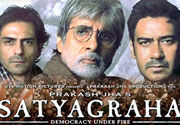
Satyagraha
Synopsis:
Halfway through the movie, Ajay Devgn is standing in the middle of a dusty government office shouting at some low-level clerk who is slowly eating a samosa and ignoring him completely, and honestly that moment captures the whole vibe of the film because it's just so frustrating to watch. But to understand why he's losing his mind over this paperwork, you have to look at how this started, which was with Amitabh Bachchan playing this retired school principal named Dwarka Prasad who loses his son in a shady bridge construction accident. That son was supposed to get a government compensation payout, but the local politicians are completely corrupt and they keep giving the old man the runaround, demanding bribes and making him walk up and down these endless concrete staircases until his knees are practically buckling under him. Amitabh wears this very specific faded grey kurta throughout all these early scenes that looks like it hasn't seen a proper iron in three decades, and you can just tell the wardrobe department wanted him to look as exhausted and worn down as humanly possible, right down to the little yellow stains around the collar. So then Ajay Devgn, who plays this high-flying corporate fixer and family friend named Manav, shows up and decides to turn this personal grief into a massive social media campaign because he's got all these slick presentation skills and modern tricks up his sleeve. Right after that, the whole thing snowballs out of control and they take over the town square. Arjun Rampal enters the picture as this brooding, alcoholic former student leader who's got a permanent stubble and a lot of pent-up anger, and he joins forces with them because he's got nothing better to do with his life. The movie fits right into that tradition of modern bollywood where regular people fight back against the system, you know. The funny thing is Kareena Kapoor shows up as this fierce broadcast journalist who's constantly adjusting her microphone and glaring at camera operators while reporting live from the protest site, and she gets pulled right into the chaos instead of just staying neutral. Manoj Bajpayee is also in this, playing the slimy, slick-haired politician who wears crisp white clothes and smiles through his teeth while plotting how to crush the movement using every dirty trick in the book. They all end up occupying this abandoned industrial yard and staging a massive hunger strike. Things get violent. People throw stones. The police start swinging batons and breaking up tents in the middle of a torrential downpour that makes everybody look miserable. The plot just kind of speeds through the next forty minutes of court battles, media spin, and backroom deals where Manoj Bajpayee tries to buy everyone off or frame them for crimes they didn't commit, but nobody backs down because they are too stubborn for their own good. Amitabh gives these long, booming speeches about truth and justice that echo across the dirt fields while the crowd holds up their cell phones and plastic signs. Then there's a standoff at the main highway where a truck plows through the barricade and someone important gets hurt badly, which changes the mood from hopeful activism to outright tragedy in a split second. The supporters riot and smash windows. The authorities lock everybody up in the local jail, but the movement doesn't die because the whole country is watching the news broadcasts. Kareena keeps interviewing people through prison bars and posting videos online that go viral overnight. A tense courtroom scene happens where nobody listens to the judge because everyone is shouting slogans and waving pamphlets at the ceiling fans. Amitabh walks out of the courthouse steps into the bright afternoon sun, raises his hand to wave at the cheering mob, and a lone figure in the crowd pulls out a hidden pistol and fires two quick shots right into his chest.
He collapses onto the dusty concrete while the crowd screams and scatters in every direction.
Arjun Rampal's hair in the first thirty minutes of Prakash Jha’s Satyagraha looks like it survived a mild gale inside an SUV, which honestly distracts from the gravity of the whole governance-is-broken speech he is giving to a bunch of sweating villagers in central India. It's a small thing, but it bugged me every time the camera caught him from the side.
Prakash Jha operates on a frequency of loud urgency that usually flattens whatever grey matter a political script starts with. Here, we get Ajay Devgan as a ruthless corporate strategist who drops dead-eyed platitudes about infrastructure before his moral compass gets shocked back to life by a tragedy involving his son. That son's death is staged with the kind of blunt-force editing that makes you wonder if the cutting room floor was lined with broken anvils. Devgan doesn't do grief so much as he does jaw-clenching permanence. He stands there in sharply tailored shirts that never seem to pick up dust despite all the street protests, anchoring a narrative that desperately wants to be Rajkumar Santoshi’s Khakee but keeps getting bogged down in its own editorializing.
Amitabh Bachchan looms over the proceedings as Dwarka Prasad Suman, an aging Gandhian schoolteacher whose moral authority is supposed to be the magnetic north of the movie. Bachchan has played this exact sort of righteous thunderbolt before, notably in Sarkar, but here he leans harder into the weary, cracked-voice routine. When he speaks, people stop to listen, even when the dialogue sounds like it was copied out of an editorial page from a second-rate English daily. He occupies space with that familiar, terrifying bulk. The problem is that the script surrounds him with characters who exist only to agree with him or to embody cartoonish corruption so he has someone to glare at. Manoj Bajpayee plays the politician who replaced idealism with social media strategy, and he is magnetic in the dirtiest way possible. Bajpayee chews the scenery with a toothy, terrifying grin that suggests he actually reads the polls before he sleeps, bringing a sleazy modern verve to hindi cinema villains that usually just shout a lot.
Kareena Kapoor shows up as a hard-nosed broadcast journalist who wears smart blazers and looks exceedingly concerned by satellite feeds, though her function in the story is mostly to narrate the social media revolution through various urgent phone calls. She doesn't get much to do besides look exasperated while standing in front of a green screen or a crowd of extras waving placards that were clearly painted ten minutes before the shot. It feels like an afterthought, this media angle, grafted on because every modern political drama needs to nod at Twitter mobs and twenty-four-hour news cycles. The cinematography by Sachin Krishn tries to give the dust-choked towns a gritty, washed-out realism, but the lighting keeps betraying the studio floor. Every time the sun hits Amitabh Bachchan’s forehead just right, you can see the meticulous care of a makeup crew working overtime to maintain his icon status.
Then there is the soundtrack, scored by various hands, which drops bombastic choral chants into scenes where people are just walking across a dusty courtyard. It's exhausting. You cannot have a slow-motion shot of a crowd carrying candles without the music swelling to a deafening roar that tells you precisely how to feel about democracy. Bollywood movies have always loved a good anthem, but Satyagraha treats its musical cues like moral instructions. If I'm honest, the background score is so intrusive it practically elbows you in the ribs every time a character makes a facial expression.
The film wants to talk about middle-class rage, corporate land grabs, and the sudden, terrifying power of hashtag activism, yet it treats these ideas with the subtlety of a falling safe. It reduces complex policy debates to shouting matches in television studios where everyone talks over each other until someone drops a one-liner about the constitution. There are moments, buried under the noise, where you can see the shape of a genuinely sharp movie about how modern revolutions get co-opted by media algorithms and opportunists. But Jha refuses to let the ambiguity breathe. He needs every single viewer in the back row to understand who is good and who is bad, complete with slow-motion pans that mythologize people who are just doing basic civic duties.
Arjun Rampal’s character arc dissolves into a blur of brooding stares and heroic background lighting long before the credits roll. By the time the massive third-act rally happens, complete with thousands of extras and drone shots that make the protest look like a music festival for anti-corruption, you feel less like you’ve watched a story unfold and more like you’ve been lectured by a civics textbook that had a very large budget. It is messy, loud, and entirely too long, lingering in the middle stretches where nobody is quite sure if they are making a thriller or an election manifesto, leaving you stranded with actors who are clearly better than the lines they are forced to spit out.