

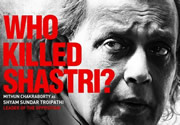
The Tashkent Files
Synopsis:
Mithun Chakraborty clears his throat in that specific, gravel-heavy way he has carried since the eighties, and suddenly you are back in a small dark theater watching some forgotten thriller from the middle of the last decade where nobody bothered to check if the props were period-accurate. The Tashkent Files starts with an air of conspiratorial urgency that manages to feel both entirely desperate and strangely casual about its own mechanics, throwing historical curiosity into a blender with the sort of low-budget political filmmaking usually reserved for midnight television broadcasts on regional networks. If I'm honest, the whole enterprise smells faintly of mothballs and cheap incense from the very first frame, dragging viewers into a cramped conference room where arguments about the death of a former Indian prime minister are shouted with the relentless volume of an afternoon news debate on a channel you only watch when the remote is out of reach.
Director Vivek Agnihotri structures the screenplay as a pressure cooker with a very loose lid, meaning the steam escapes constantly through awkward narrative vents rather than building toward any genuine dramatic detonation. Characters walk into rooms solely to deliver monologues that feel cribbed from internet message boards and hyperventilating YouTube video essays, functioning less like flesh-and-blood historians or journalists and more like mouthpieces for opposing sections of the political peanut gallery. There is an over-reliance on aggressive reaction shots where faces twist in mock disbelief while the background score works overtime to convince you that a dry archival document about a medical report is actually a tactical nuclear weapon. The dialogue rarely breathes; it sprints from one accusation to another without ever giving the audience a second to absorb the weight of the allegations being thrown across the polished mahogany table, which makes the two-plus-hour runtime feel less like an investigation and more like a protracted custody battle over a dead man's diary.
Shweta Basu Prasad shoulders the heavy lifting as a naive, ambitious young television journalist who stumbles into this labyrinth of conspiracy theory and state secrecy, trying desperately to anchor the chaos with wide-eyed sincerity. She plays Raagini Phule with a dogged determination that often outstrips the material, managing to sell moments of sudden professional epiphany even when the script asks her to pivot from skeptical reporter to fierce believer on the strength of a single fuzzy photograph. Beside her, Naseeruddin Shah drifts through the proceedings with the bored, terrifying grace of a veteran actor collecting a paycheck while still remembering how to command a room with just the tilt of his chin. His character, a cynical politician with a voice like crushed gravel, delivers lines that would sound ridiculous coming from anyone else, yet he manages to inject them with enough oily charm to make you briefly forget you are watching a dramatic reenactment of a Wikipedia rabbit hole. Yet the supporting ensemble often stumbles into cartoonish territory, particularly when the screenplay demands that they foam at the mouth or slam their fists down on desks in theatrical outrage, echoing the worst excesses of daytime television dramas rather than the nuanced political thrillers that sometimes emerge from independent Hindi cinema.
The cinematography deserves a special note simply for its relentless abuse of the digital zoom lens, which pushes in and out of actor's faces with the subtlety of a runaway freight train. Every conversation is shot through smoke or strange blue filters that seem designed to convince us we are watching a top-secret government operation, though the lighting frequently betrays the budget constraints of a project cobbled together with more passion than polish. The editing cuts on mismatched beats, leaving characters blinking awkwardly in the middle of sentences or reacting to lines that clearly weren't delivered in the same room. Then there's the soundtrack, an intrusive wall of synthetic percussion and swelling strings that cues up whenever someone so much as opens a manila folder, treating every minor narrative revelation like the storming of the Winter Palace. It is a loud, unsubtle sonic landscape that leaves no room for silence, preferring to bludgeon the audience into submission rather than letting the paranoia settle naturally into the corners of the frame. You will leave the theater with the main motif hammering behind your eyes, a persistent reminder of a movie that trusts its viewers about as much as a used car salesman trusts a guy walking the lot in bare feet.
Beneath the bluster and the clunky exposition, the film attempts to grapple with the uncomfortable idea that official history is often just a convenient narrative stitched together by the victors to keep the rabble quiet. It pokes at the scab of the Cold War era and the mysterious death of Lal Bahadur Shastri in Tashkent, asking why certain files remain locked away in government vaults long after the people who signed them have turned to dust. This is fertile ground for a gripping political drama, but the movie refuses to engage with the complexity of its own subject matter, preferring easy villains and righteous heroes who wear their ideologies like cheap armor. Bollywood movies have occasionally touched on these themes with a certain messy bravado, but very few have relied so heavily on the aesthetic of a late-night conspiracy podcast, turning what could have been a sharp inquiry into a loud shouting match. The ideological push is transparent, and while one doesn't necessarily mind a filmmaker having an axe to grind, the grinding noise tends to drown out any actual storytelling once the third act rolls around and everyone starts yelling at once.
There is a recurring visual motif involving a ticking grandfather clock that appears every time the characters hit a dead end in their research, a small, low-stakes directorial tic that bugged me more than the actual historical inaccuracies because it happens at least four times in the first twenty minutes alone. It’s the kind of lazy shorthand you expect from a student film, not a feature-length political drama starring some of the most formidable talent working in modern Indian movies. Mithun Chakraborty does what he can to salvage these moments by simply glaring at the props until they seem to shrink away in embarrassment, but even his formidable screen presence cannot entirely counteract the relentless repetition of visual clichés. By the time the final arguments are laid out and the characters make their respective peace with the ghosts of the past, the film has exhausted every narrative trick in its meager arsenal, leaving behind a trail of unanswered questions and bruised eardrums.