

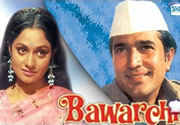
Bawarchi
Synopsis:
The film starts by introduction of Shanti Niwas & its residents by Amitabh Bachchan, who is the narrator here. He points out that Shanti Niwas is a pot of ironies: Even though its name means "Home of Peace", there is no peace here. The home, which houses the Sharma family, has members who hate each other for reasons unknown. Even a servant cannot withstand the Sharma''s for more than a month.
After every month, the search for a new servant has to start. Then, suddenly a servant named Raghu comes in. Even though nobody remembers asking for some Raghu, they hire him. But Raghu has his own surprises in store for him. Gradually, the whole home comes to know that Raghu is not only an accomplished chef, but also a singer & expert in dancing.
Raghu tells his masters that he worked for reputed veterans of given fields, who taught him something or the other. Gradually, many aces start falling out of his sleeves, causing the Sharma''s to develop an attraction to him. Even Daduji, the disgruntled patriarch of the family, develops love for Raghu. The family puts so much trust in Raghu that they even unwittingly show him the box containing the family jewels.
Krishna (Jaya Bhaduri) is the recluse daughter of Daduji''s dead son & daughter-in-law. On learning this, Raghu tutors her & brings her talents to the fore. He also helps in clearing up the misunderstandings & calling truces between the family members. Daduji cannot help but think that Raghu is actually a saviour sent by god. Meanwhile, nobody notices that Raghu is suspiciously eyeing the jewel box the whole time.
Meanwhile, Raghu learns that Krishna loves a boy, but the Sharma''s are strictly against the union of Krishna with him. The boy also loves Krishna, but is helpless before Krishna''s relatives as well. Between all the tangle, Raghu suddenly disappears. The Sharma''s are also aghast to know that the box is missing as well.
It does not take the Sharma''s to put two & two together. At the same time, Krishna''s love interest shows up. The people are already angered at the turn of events & the boys arrival, but they receive a shock when he shows them the jewelry box. He explains that he saw Raghu in a suspicious condition with the box. When he asked Raghu about the box, Raghu tried to run away. He tried to stop Raghu, even beat him up(the boy is a wrestler), but Raghu somehow managed to escape.
Stunned by this unexpected turn of events, the attitude of Sharma''s towards the boy changes & they agree to get him married with Krishna out of gratitude. Krishna, however, refuses to buy the story. When Sharma''s start abusing Raghu, Krishna''s lover cannot take it anymore and tells them what really happened.
He tells them that he met Raghu at his own wrestling ground. He had a little friendly match with Raghu, where he suffered minor injuries from Raghu. He saw the box & asked Raghu about it. Raghu said that the box was the real reason
The sound design of the kitchen scenes in Bawarchi has this weird, persistent clatter of brass vessels that stays slightly too high in the mix even when characters are whispering across the dining table. It is a small thing, but if I am honest, it bothered me for the first twenty minutes because you can practically hear the foley artist rattling thalis just off-camera while A.K. Hangal tries to deliver a line about household budgets. Nobody ever talks about the acoustic texture of old Hindi films, preferring to talk about the soul or the philosophy, but you sit there in the dark and realize how much of the atmosphere relies on the cheap, tinny echo of a studio floor designed to sound like a sprawling colonial-era bungalow in decline. This was Hrishikesh Mukherjee working fast, not making a monument, just turning out another product for a studio system that demanded a steady stream of domestic comedies to keep the marquee lights burning. He did not have the patient, breathy intervals of Anand here, preferring a brisk, almost frantic pacing that crams domestic chaos into every available inch of the frame. The screenplay, adapted by Nabendu Ghosh from a Bengali play called Chadmabeshi, sets up a premise so thin you could practically see right through it if the actors were not constantly moving furniture or shouting recipes at each other. A dysfunctional family of bickering egoists—featuring Durga Khote as the matriarch who has given up and Asrani as the petty, ledger-obsessed clerk—needs a new cook to restore order to their chaotic household.
Rajesh Khanna walks into this mess with a green towel slung over his shoulder and a smirk that suggests he has already read the script and knows exactly how the last reel is going to turn out. People forget that by 1972, Khanna was already starting to tilt into that self-parodic zone where every glance to the camera felt calculated to wring out screams from the front stalls, but here he manages to ground it by actually doing domestic chores with surprising competence. He chops onions without looking, kneads dough with an easy rhythm, and handles the comic timing alongside Paintal without chewing the scenery quite as aggressively as he did in Kati Patang. The rest of the household reacts to him with a mix of suspicion and desperate dependence, which gives the middle portion of the movie its actual drive. Jaya Bhaduri plays the quiet, perpetually sidelined granddaughter who falls for the new arrival's mysterious past, and she does this thing where she looks down at her bare feet whenever he speaks to her, conveying volume without opening her mouth. Kali Bannerjee and Usha Kiran fill out the supporting ranks as the married couple constantly at war over money and social status, screaming at each other through open doorways with a weariness that feels entirely earned. Asrani is particularly good at playing the kind of sniveling, self-important relative every joint family seems to spawn, managing to be genuinely irritating without turning into a cardboard villain.
The cinematography by Jaywant Pathare is strictly functional, lit with that flat, shadowless high-key illumination typical of mid-century studio comedies, but it captures the claustrophobia of a shared courtyard surprisingly well. Whenever the camera pulls back to show the entire family gathered around the dinner table, you feel the physical weight of too many bodies crammed into too few rooms, all of them rubbing each other raw over petty grievances and unwashed utensils. Madan Mohan's music score stays mostly in the background, offering light, playful flute melodies that punctuate the comic beats rather than overwhelming them, though the songs themselves feel like mandatory interruptions rather than organic extensions of the plot. "Babul Pyare" gives Jaya Bhaduri a chance to stand still and sing with a quiet dignity that cuts through the surrounding silliness, even if the staging of the musical numbers feels rushed and perfunctory. The film's politics are resolutely middle-of-the-road, preaching the gospel of cooperation and emotional labor while never actually questioning the patriarchal structures that make a live-in servant necessary for the family's survival in the first place. Mukherjee wants to show how love cures all social friction, which works as a comforting fable for audiences sitting in crowded cinema halls across India, but it skips past the messier realities of class servitude with a cheerful wink.
What keeps the movie from turning into a toothless sermon is the sheer volume of petty human behavior on display during the quiet moments between the big moral lessons. Characters are constantly stealing food from the pantry, eavesdropping on private conversations behind carved wooden screens, and nursing petty grudges over who got the larger share of mango pickle at lunch. That kind of observational grit saves the project from its own better instincts, preventing the household from ever becoming too angelic or too irredeemably wicked. Master Raju pops up as the youngest kid who knows everyone's secrets and uses them as leverage for sweets, adding a layer of juvenile extortion that feels much more authentic to large-family dynamics than any of the sentimental bonding sessions. You watch these people scheme against one another and you recognize the exact rhythm of a household falling apart from sheer boredom and too much proximity. That is why the ending lands with a slight thud of disappointment, because the narrative feels obligated to tie up every loose thread with a neat little bow of communal harmony, robbing the characters of their sharper edges just as things were getting interesting.
There is no grand vision here, no sweeping statement about the state of the nation, just a bunch of solid character actors sweating under studio lights while a major star plays the wise stranger who fixes everyone's emotional plumbing. If you look closely at the background extras in the market scenes, you can spot the same three people walking past the vegetable stalls in three different sequences, a reminder of the low-budget shortcuts Hindi cinema routinely took to meet production schedules. That lack of polish gives the production an unpretentious charm that glossier modern iterations of the family comedy genre completely miss out on. It remains a minor entry in Mukherjee's filmography compared to the heavier emotional terrain of Namak Haram, but it understands the comic potential of everyday irritation better than almost anything else from that decade. Khanna gets his big speech near the climax about how love is the only true spice of life, and while the dialogue is undeniably corny, he delivers it with a casual shrug that almost makes you forget how manipulative the whole setup has been from the very first frame.