

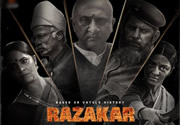
Razakar
vcdSynopsis:
Kasim Razvi is literally standing over a terrified villager and screaming at the top of his lungs while his Razakar goons burn down half the huts in the background with wild, chaotic energy and you are just sitting there holding your lukewarm coffee wondering how the movie even got to this point. Let's rewind the clock way back before we get to all that madness because Razakar isn't your typical breezy romance from standard bollywood movies where everyone sings in the snow, oh no, this thing dives headfirst into the brutal historical chaos of Hyderabad right around 1948 during the partition era when things were an absolute mess. Raj Arjun plays this terrifyingly unhinged villain Kasim Razvi who leads the private militia of the Nizam, and he is just chewing up the scenery in every single scene with his menacing glares and over-the-top monologues about absolute control and religious dominance while innocent people are just trying to live their lives without getting terrorized every five seconds. And then boom, we are introduced to the heroic resistance fighters and regular villagers who are trying to organize underground networks to smuggle weapons, food, and secret messages right under the nose of the Nizam's brutal regime. Anasuya Bharadwaj shows up as this fierce, no-nonsense woman who takes charge of the local defense efforts and she doesn't take garbage from anyone, wielding sickars and lathis with a raw intensity that honestly makes you forget you are watching a modern cinematic production. Bobby Simha is also hanging around doing heavy lifting as a crucial historical figure, bringing this intense, brooding energy to the screen that grounds all the chaotic violence happening around him. Look, the pacing in this movie is all over the place, shifting wildly from a tender family gathering where Grandma is making some flatbread to an immediate, bone-crunching mass execution scene where you literally drop your popcorn on the floor because you weren't ready for the gore.
Stuff happens so fast you can barely track who is betraying who, like there's this one random background extra wearing a neon yellow vest in 1948 rural India which makes zero historical sense and it distracts you for a solid ten minutes while monumental political shifts are happening in the foreground. Villages are getting torched left and right, women are bravely fighting back against impossible odds, and the Nizam's army is marching through the muddy streets while brass instruments blare a deeply unsettling march theme on the soundtrack. And then right when a major character is giving this deeply emotional speech about freedom and sacrifice, the movie violently slams the brakes for a completely random, oddly choreographed dance number that feels so wildly out of place you'll genuinely question if your streaming platform accidentally glitched and started playing a totally different film from the nineties. That is the classic interval block right there, folks, right in the middle of a massive village raid where you are left staring at the screen wondering how anyone thought putting a upbeat folk tune here was a good idea.
The second half kicks off with even more unhinged violence because the Indian government finally decides they've had enough of the Nizam and his crazy militia running wild, leading directly into Operation Polo. Police action starts and tanks are rolling in, and Bobby Simha's character is giving final tactical orders while bullets are flying everywhere, tearing through mud brick walls and wooden carts. Kasim Razvi is running around like a headless chicken realizing his little empire is crumbling down around him, screaming orders at guards who have already dropped their weapons and started running for the hills. The resistance fighters charge the main compound with unstoppable momentum, breaking down heavy wooden doors and engaging in brutal hand-to-hand combat in the muddy courtyards while the background score goes completely deafening with massive orchestral drums. Razvi gets cornered in his own office by the very people he spent three hours terrorizing, and after a brief, tense standoff where he tries to bluff his way out of getting arrested, he gets slapped in cuffs and dragged out into the harsh daylight. The film doesn't give you any comforting epilogue text explaining the geopolitical aftermath or a nice little moral message about peace, it just cuts abruptly to a wide shot of the Indian tricolor flag fluttering high above the liberated soil of Hyderabad as the credits roll with zero warning.
That one screeching violin note keeps coming back whenever the police enter a room, and honestly, if I heard it one more time I might have walked out before the second reel even started. Cinema is supposed to build tension through silence sometimes, not lean on a string section like a crutch every time an actor pulls out a pistol or looks sternly at a map.
Director Yata Satyanarayana approaches the bloody history of the Hyderabad State liberation with all the subtlety of a sledgehammer, though to be fair, nobody was expecting a pastoral romance out of a movie explicitly titled after the Razakars. The screenplay moves in sudden, herky-jerky jumps across a sprawling cast of historical and semi-fictional figures, struggling to maintain any narrative momentum once the focus shifts away from the immediate brutality of the villages. Scenes start in the middle of arguments and end abruptly on reaction shots that linger a beat too long, making the whole thing feel less like a cohesive epic and more like a collection of dramatic historical reenactments stitched together in a hurry. The dialogue leans heavily on declamatory speeches that sound like they were written for the back row of a massive theater, robbing the performers of any conversational rhythm.
Raj Arjun tries to anchor this chaos with sheer volume, playing the main antagonist with bulging eyes and a permanent snarl that rarely lets up. It is a one-note performance, sure, but it fits the crude caricature the script demands, even if you find yourself wishing for a bit of quiet menace instead of shouting. Bobby Simha wanders in halfway through, looking visibly exhausted by the heavy woolens and the oppressive heat of the production design, yet he manages to inject a brief flash of genuine grit into a sequence where he rallies the villagers with an improvised weapon. Anasuya Bharadwaj gets stuck playing the suffering mother figure who must weep on cue while dust blows into her eyes, though she handles the melodramatic beats with more dignity than the material strictly deserves. They all push against the constraints of a budget that clearly didn't stretch far enough for the scale of the violence being depicted on screen, leading to messy crowd scenes where extras clearly don't know whether to run left or right.
The cinematography relies on a washed-out, sepia-toned filter that makes every exterior look like it was shot through a dirty windshield, a trick we have seen a thousand times in historical dramas trying to look gritty without actually earning the mud. Bheems Ceciroleo provides a score that thunders away constantly, drowning out dialogue in crucial moments and leaving you straining to catch the plot points over the bass drum. It feels very loud, very crowded, and stubbornly resistant to any moments of genuine human quiet.
Films dealing with partition-era violence always walk a tightrope between historical reckoning and exploitation, and Razakar frequently loses its footing and tumbles straight into the latter. It is interested in atrocities only insofar as they shock the audience, rarely pausing to examine the ideological fractures among the peasantry or the complex political machinations of the Nizam's court. We are told constantly that the stakes are high, but the film treats its masses as faceless props to be beaten or rescued rather than individuals with distinct fears. It reminds one of how certain mainstream Hindi movies handle historical conflicts by reducing complex regional traumas into simple good-versus-evil binary showdowns that leave zero room for historical ambiguity or doubt. You can feel the ideological weight pressing down on every frame, flattening out the nuances of a genuinely horrific period of the Deccan plateau into cheap theatrical points. That stubborn violin cue returns during the climax, reminding you that subtlety was never the point here, and perhaps you shouldn't have expected any in the first place.