

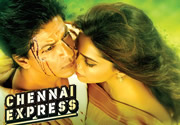
Chennai Express
Synopsis:
So anyway, about halfway through Chennai Express, Shah Rukh Khan is literally carrying Deepika Padukone up what feels like a million stone steps in the middle of a blazing hot village, and she's just shouting at him while he's huffing and puffing because he's totally out of shape and didn't sign up for any of this mountaineering nonsense. But to understand how he even ended up in rural South India sweating through his designer shirt, you have to go back to Mumbai where his character Rahul is this forty-year-old bachelor whose parents passed away when he was a kid and he's been raised by his hilarious grandparents, and he works in his late grandfather's sweet shop which is kind of a big deal in their neighborhood. Right after that, his grandfather unfortunately kicks the bucket on his hundredth birthday, and instead of mourning properly, Rahul and his goofy friends just want to scatter the old man's ashes in Goa so they can finally party on the beach for a few days without anyone nagging them about working the counter. So then Rahul has to sneakily board a train called the Chennai Express, which is where Deepika's character Meena literally falls into his life because she's running away from her massive, terrifying mob boss dad played by Sathyaraj and this giant henchman named Tangabada played by Nikitin Dheer, and she's also escaping an arranged marriage to a guy she hates. The funny thing is, Rahul just wants to mind his own business and eat his packaged snacks, but because he's got a bleeding heart and can't say no to a damsel in distress, he helps her board the train and then accidentally gets pulled off the platform himself, leaving all his luggage and his freedom behind. He doesn't even know her name yet, but suddenly he's thrust into the wildest adventure of his life, which tracks with how a lot of classic bollywood movies operate when the main guy is just trying to take a simple vacation and gets hijacked by fate.
Anyway, let's talk about that train compartment scene for a second because it's so oddly specific and funny, especially when Rahul is trying to sneak a bottle of water out of his bag and Deepika's character just stares at him with this intense expression while wearing this heavily embroidered traditional South Indian outfit with a dark green border and a matching blouse, and her hair is braided all the way down her back with these little jasmine flowers woven into it that keep bouncing every time the train hits a bump on the tracks. She doesn't talk much at first, but then she starts speaking in this rapid-fire mix of languages and Rahul just blinks at her like a confused puppy because he doesn't understand a single word, and honestly, the texture of her skirt looks so heavy and scratchy that you just feel bad for her sitting in a non-AC sleeper car for hours on end. And then things escalate super fast because some random local thugs spot her and try to drag her off the carriage, so Rahul has to channel his inner action hero even though he's totally terrified, and he ends up getting thrown off the train right along with her in the middle of nowhere. Don't underestimate the power of common sense.
So then they're stranded in a village ruled by Meena's terrifying family, and she has to pretend that Rahul is her new lover from Mumbai just to keep him from getting instantly murdered by her dad and the village elders, which leads to this whole sequence where Rahul has to hide his identity and survive in a place where everybody speaks Tamil and he's totally clueless. Deepika Padukone plays this feisty character with so much energy and she's always yelling non-stop, and Shah Rukh Khan's facial expressions are just gold every time he realizes he's in over his head, and honestly, it's pretty entertaining to watch them bounce off each other while dodging massive machetes and angry uncles. They escape that village in a stolen jeep, but then they get captured again, and then they escape again, and it's just this chaotic loop of running away through picturesque rural landscapes that remind you why people still love watching big hindi films on a Friday night with a tub of popcorn.
The funny thing is, Rahul eventually falls in love with her despite all the screaming and the constant threats of bodily harm from her giant cousins, and he even stands up to the main villain in a massive slow-motion fistfight that goes on forever on a dusty bridge. He gets beaten up pretty badly, but he refuses to back down, and he screams out this whole emotional monologue about how a woman should be allowed to choose her own life and marry whoever she actually wants instead of being treated like property. Meena's dad finally realizes he's being a jerk and respects Rahul's bravery, and the whole village stops trying to kill them. Rahul grabs Meena's hand, they run toward the sunset, and he pulls her into a massive embrace right there on the dusty road.
There is a specific kind of digital scrub on the green screen backgrounds of Chennai Express that makes every outdoor train station look like it was rendered for a mid-tier PlayStation 3 exclusive, and if I am honest, that digital smear never really leaves your eyeballs for the next two hours and twenty minutes.
Rohit Shetty has spent the better part of his directing career figuring out how to detonate a Tata Safari without anyone getting hurt, but here he tries to graft his particular brand of automotive slapstick onto a romantic comedy template that requires at least some degree of genuine interpersonal friction. Rahul is a forty-year-old bachelor mourning his grandfather while lugging an urn of ashes toward Rameshwaram, which sounds like the premise of an indie film about grief until he accidentally boards the wrong train and runs smack into Meenamma, a runaway bride whose father happens to run a small-scale village mafia in Tamil Nadu.
Shah Rukh Khan plays Rahul with the exhausted, hyper-aware resignation of a man who knows he is wearing the exact same cargo shirt he wore in three previous blockbusters, yet he still hits the comedic beats with enough physical commitment to sell the absurdity. When he gets tossed around by Sathyaraj's stoic, machete-wielding patriarch Durgeshwara Azhagar, the actor doesn't look like a romantic lead protecting his dignity; he looks like a guy who just wants to catch a flight back to Mumbai and forget the whole enterprise.
Deepika Padukone, on the other hand, is doing something entirely different with her accent, laying on a theatrical South Indian cadence that wanders wildly between different states depending on the demands of the scene. Her performance is loud, broad, and occasionally exhausting, yet she manages to anchor the film's chaotic narrative pivots by simply refusing to let Shah Rukh coast on his usual dimpled charm, matching his frantic energy with wide-eyed exasperation.
The screenplay by K. Subash feels like it was written on a napkin during a layover at the Pune airport, hurling the protagonists from one ridiculous setup to another without caring much about the connective tissue between scenes. One minute Rahul and Meenamma are hiding out in a sleepy hamlet with a suspiciously musical populace, and the next they are dodging dozens of henchmen in a village square that looks suspiciously like a studio backlot in Film City, where the extras are clearly instructed to yell loudly and fall backward over wooden crates whenever Nikitin Dheer's towering villain gives them a stern look.
Vishal-Shekhar's soundtrack leans heavily on the kind of aggressive Punjabi-meets-Tamil dhol-mixing that tends to dominate modern hindi films whenever the director wants to signal a massive celebration, though the titular track sung by Bappi Lahiri has a trashy, infectious momentum that somehow works despite itself. Vishal Dadlani's voice hits the speakers with enough volume to wake the dead, and even if the lyrics are absolute nonsense, the song arrives at precisely the right moment to rescue the movie from a sluggish stretch of exposition.
There is a recurring visual motif involving slow-motion close-ups of boots kicking up dust that repeats so often it starts to feel like a technical glitch in the editing bay. It's a small thing, but it bugged me every single time.
The broader cultural landscape of bollywood movies has always relied on this kind of regional pastiche, but Shetty rarely bothers to look beneath the surface of the tropes he is borrowing, turning every local custom into a punchline about spicy food or language barriers. When Rahul tries to communicate using movie dialogue, the meta-joke lands with a dull thud because we've seen Khan do this exact self-referential wink in half a dozen other romantic comedies since Om Shanti Om, making the gag feel less like clever commentary and more like an actor running out of fresh material.
Yet there is an undeniable kinetic rush to the way the action sequences are chopped together by editor Steven H. Bernard, who treats every fistfight like a cartoon sketch where gravity is entirely optional. Manorama appears briefly as an elderly train passenger who dispenses traditional wisdom with a deadpan glare, though her role is so underwritten she exists purely to pad out the runtime and give the leads a temporary distraction.
Kamal Haasan's classic comedy Dasavathaaram managed to juggle broad regional caricature and high-stakes farce without losing its narrative footing, whereas this film constantly stumbles over its own desire to be both a sincere romance and a brainless action cartoon. The tonal whiplash between scenes of genuine emotional vulnerability and sequences where Shah Rukh gets thrown through a bamboo fence is enough to give anyone whiplash.
Kapil Sharmaa makes a quick appearance that feels less like a real character and more like a favor called in from television executives to boost the opening weekend numbers, shouting a few quick lines before vanishing back into the crowd of extras.
The film wants to celebrate the idea of overcoming cultural divides through the magic of commercial cinema, but it frames every non-Hindi speaker as either a terrifying thug or a punchline waiting for a translation. By the time the final confrontation rolls around in that dusty village courtyard, the plot has twisted itself into such convoluted knots that nobody on screen even seems to remember why everyone is swinging bamboo sticks at each other.
Shah Rukh delivers his climactic monologue about the rights of women to choose their own partners with a level of sincerity that feels entirely unearned by the preceding two hours of screaming matches and slapstick pratfalls, transforming a messy farce into an awkward sermon on gender equality.
The cinematography by Dudley washes everything in a digital golden hour glow that strips away whatever grit might have grounded the narrative, making even a gritty village feud look like an advertisement for holiday travel. It is loud, obnoxious, and utterly devoid of subtlety, offering up a cinematic experience that works best if you turn off your brain completely and let the endless parade of primary colors wash over you.
There are worse ways to spend an afternoon than watching two massive stars yell at each other inside a poorly lit railway compartment, but there are also plenty of films that manage to balance populist comedy with actual human observation without relying on endless slow-motion reaction shots.
The background score swells at the exact moment you expect it to, the villains grunt with appropriate menace while holding outdated weaponry, and the romance resolves itself precisely because the script demands a happy ending rather than because the characters have actually learned anything about one another.
It remains a remarkably lazy piece of commercial filmmaking that coasts entirely on the historic goodwill of its lead actor, leaving the audience with little more than a headache and a catchy tune stuck in their head as the credits finally crawl up the screen.