

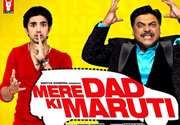
Mere Dad Ki Maruti
Synopsis:
Halfway through Mere Dad Ki Maruti, Saqib Saleem is running around a chaotic Punjabi wedding venue looking like an absolute sweaty mess while trying to avoid his terrifying father played by Ram Kapoor, but to really understand why he’s in this ridiculous predicament, you’ve got to back up and look at how this whole suburban nightmare actually started.
So then, our main guy Sameer is just a typical good-for-nothing slacker who barely scraped through his exams and can't seem to impress his dad Tej, who is this loud, booming businessman in Chandigarh who loves nothing more than yelling about how useless his son is and showing off his prized possessions.
Now let's talk about that specific car because it's not just any vehicle, it's a shiny yellow Maruti Ertiga that Tej just bought for his daughter's upcoming wedding, and honestly, the camera lingers on the chrome grille and the little plastic dashboard ornament of a nodding guru for what feels like an uncomfortable amount of time, and you can literally hear the squeak of the leather seats every time someone adjusts themselves, and Sameer spends a solid five minutes complaining about how the air conditioning smells faintly of cheap elaichi mouth freshener and old leather jackets.
Anyway, Sameer sneaks the keys out because he wants to impress this gorgeous girl Jasleen, played by Rhea Chakraborty, who looks stunning in every single frame and definitely deserves way better than a guy who’s stealing his dad’s ride to go flex outside a local college hangout.
Right after that, they go for a joyride, things get wild, and the car completely vanishes.
Gone. Stolen. Just like that.
The funny thing is that Sameer didn't even park it in a shady neighborhood, he just left it for five minutes to buy some greasy street food, and boom, it's history.
Now he's got just a couple of days to find it before Tej finds out and literally murders him, which is a pretty standard setup for a lot of wacky comedies out there, but this one leans hard into the specific chaos of north Indian family dynamics that you usually only see in the loudest hindi movies.
So Sameer and his useless buddies spend the next forty-eight hours driving around in a beat-up scooter chasing dead ends, dealing with shady auto-rickshaw drivers, shady local thugs, and running into every single relative who has descended upon the house for the wedding preparations.
There's this one random scene where Sameer has to hide inside a massive decorative wedding urn while his mother yells at him about his career choices, and it's just exhausting to watch.
The search takes them through sketchy industrial areas, noisy bazaars, and half the highways in Punjab, and somehow Rhea Chakraborty's character manages to tag along and look effortlessly cool while Sameer is hyperventilating and ruining his favorite jeans.
They track the vehicle to a shady car modifier who's already painted half of it a hideous shade of metallic purple and replaced the stereo with speakers so loud they rattle your teeth.
They have to steal it back from the thieves, which leads to a massive low-speed chase involving a tractor and a vegetable cart.
Ram Kapoor's character is pacing around the house in a terrible mood because the wedding caterer is late and the relatives are complaining about the paneer being too dry, completely oblivious to the fact that his brand new vehicle has been missing for two days and has just been subjected to the worst paint job in the history of bollywood movies.
Sameer manages to sneak the purple monstrosity back into the driveway right before dawn, and he spends hours with a bottle of nail polish remover and a stolen buffer trying to get the original yellow paint to show through under the streetlights.
Tej walks out onto the porch with his morning chai just as Sameer is collapsing against the bumper, breathing heavily and covered in purple spray paint from head to toe.
Tej looks at the car, looks at his exhausted son, realizes what happened, and instead of yelling, he just sighs deeply and hits Sameer upside the head with a rolled-up newspaper before walking back inside.
Ram Kapoor looks exhausted throughout Mere Dad Ki Maruti, which honestly makes complete sense given that he spends the entire runtime playing a man whose blood pressure is permanently hovering around the danger zone because his son has lost a brand-new vehicle. This is not a subtle picture about generational trauma or the fragile ego of the suburban middle-class patriarch, though critics who want to sound fancy will occasionally try to squint and find social commentary in the background noise of Chandigarh weddings and loud relatives. It’s a low-stakes farce that somehow manages to maintain a frantic energy without ever feeling like it's going to collapse from its own noise, which is a minor miracle for a Y-Films production from that particular era of Hindi movies when every comedy felt engineered in a lab to hit a specific demographic quadrant.
Ashima Chibber directs with a sort of breathless panic that mirrors the protagonist’s descent into absolute madness, throwing wide-angle lenses into cramped hallways and letting scenes cut off before the actors have even finished their exit lines. The screenplay by Neeraj Kabi and others relies heavily on the classic Shakespearean mechanics of mistaken identity and escalating lies, except instead of dukes and cross-dressing twins, you get a bewildered college graduate, a stolen Maruti Ertiga, and a very angry father who thinks his son is a responsible adult. It’s the kind of premise that could easily become excruciating after twenty minutes, yet the film keeps moving at such a relentless clip that you barely have time to notice how thin the secondary characters actually are, especially the various corrupt cops and local gangsters who pop up solely to complicate the hero's afternoon.
Saqib Saleem plays Sameer with a desperate, sweaty charm that recalls Imran Khan’s debut energy in Jaane Tu... Ya Jaane Na, though with slightly less polish and a lot more Punjabi swearing. He doesn't try to make the character noble or particularly smart, which saves the performance from becoming gratingly earnest; he's just a guy who messed up terribly and is now trying to lie his way out of a beating from a father who takes car maintenance as seriously as a religious sacrament. Rhea Chakraborty, in her film debut, mostly stands around looking mildly annoyed and impossibly glamorous, given very little to do besides serve as a sounding board for Sameer’s cascading failures, but she holds the screen well enough not to get completely steamrolled by the sheer volume of the male actors shouting around her.
Then there is Ram Kapoor, who anchors the whole chaotic enterprise as Tej Khullar, the kind of father who measures his self-worth in chrome polish and fuel efficiency. Kapoor has this incredible ability to look like he is one second away from a complete physical collapse, his face turning an alarming shade of crimson whenever Sameer speaks, and the movie is at its absolute funniest when it simply watches him pace back and forth in a living room while the ceiling fan turns lazily overhead. It’s a broad performance, sure, but it’s played with such total commitment that you almost forget how ridiculous the plotting is around him, particularly during the stretches involving the wedding preparations and the endless stream of uninvited guests raiding the buffet.
The visual style leans hard into a sun-bleached, oversaturated palette that makes every street in Chandigarh look like it’s radiating heat straight off the asphalt, matching the nervous perspiration dripping down the back of everyone’s necks. The soundtrack, courtesy of various artists, features a couple of bhangra-infused pop tracks that blast out of car speakers with enough low-end rumble to rattle theater seats, though one particular transition cue repeats three times during a single twenty-minute stretch and becomes genuinely distracting if you’re paying attention to the audio mixing. It's a small thing, really, but when a needle-drop is used that aggressively to cover up a continuity error in an editing room, you can practically hear the assistant director sweating behind the monitor.
Bollywood has a long, slightly embarrassing history of treating family dynamics as either an occasion for weeping strings or broad, slapstick mugging, and this film mostly avoids the weeping while leaning heavily into the mugging, though it occasionally finds a strange, quiet truth in the way fathers and sons communicate almost entirely through shouting about mechanical objects. Sameer doesn't know how to talk to his dad about his future, his career, or his girlfriend, so they communicate through the proxy of a family sedan, which is perhaps the most painfully accurate detail in a movie populated mostly by cartoonish caricatures of north Indian relatives. The script doesn't bother trying to resolve this psychological knot with a heartfelt monologue under a streetlamp, thankfully; instead, it just throws another obstacle in their path and lets them scream at each other over the sound of a sputtering engine.
The supporting cast features a rotating collection of local actors who seem genuinely thrilled to be on camera, chewing the scenery with an enthusiasm that occasionally spills over into outright overacting, particularly during the scenes set inside the local police station where everyone talks at a volume usually reserved for outdoor rock concerts. There’s a distinct lack of cynicism in how the movie views its characters, even the ones who are actively trying to blackmail the hero or steal his dad's precious car, which keeps the proceedings feeling light on their feet even when the gags start repeating themselves in the third act. You can see the narrative machinery turning from a mile away, yet the sheer physical comedy of watching grown men panic over a missing vehicle has an undeniable momentum.
Hindi films often struggle with keeping a farce airborne past the halfway mark, usually because the directors feel an irresistible urge to introduce a moral lesson or a sudden romantic melodrama that grinds the comedic momentum into dust, but this one mostly resists that particular temptation until the very end. The editing by Manan Ashwin Mehta keeps the cuts brisk and rhythmic, favoring motion over stillness, though there are moments where a reaction shot lingers for one beat too long, killing the punchline just as it's about to land. It's an uneven rhythm, but it fits a story about people who are fundamentally unequipped to handle minor crises without turning them into catastrophes of epic proportions.
Saqib Saleem’s performance works because he doesn't ask for your pity; he just expects you to laugh at his misery, which is a much harder register to hit for a newcomer carrying a feature for the first time. He runs through alleyways, climbs over fences, and begs favors from people who clearly despise him, all while maintaining a look of absolute terror that never quite tips over into genuine distress. When he finally has to face his father at the end of the day, there are no grand apologies or tearful embraces, just a mutual, exhausted acknowledgement that they are both idiots who survived a very stupid afternoon.
The cinematography captures the dust and glare of the city without trying to make it look like a tourism brochure, keeping the camera low and mobile, following characters as they sprint through crowded markets and claustrophobic hallways. It’s a functional, unpretentious visual language that serves the comedy rather than trying to draw attention to itself with fancy crane shots or distracting color grading. Even the night scenes retain a certain warmth, lit by neon signs and streetlights that cast long, messy shadows across the asphalt where half the plot takes place.
Ram Kapoor steals every single frame he occupies simply by virtue of having a physical presence that fills the entire lens, whether he's slamming a car door or glaring daggers across a crowded wedding lawn. His comedic timing relies heavily on pauses and heavy sighs, letting the silence do the work while the younger actors scramble around him trying to fill the void with frantic explanations. It's an anchor for a movie that threatens to spin off its axis every ten minutes, and without his grounding weight, the central conceit would likely have dissolved into pure annoyance.
The film ends on a note of minor domestic chaos that feels entirely appropriate for characters who have learned nothing whatsoever from their ordeal, returning to the status quo with slightly more dents in the vehicle and significantly more gray hairs on the father's head. It doesn't attempt to say anything profound about modern youth or middle-class aspirations, choosing instead to focus on the immediate, sweaty panic of a lost possession and the people who will yell at you until you find it.
There's a casual energy to the storytelling that prevents it from ever feeling heavy, even when the gags fall flat or the plot mechanics require everyone to behave like absolute morons for the sake of a quick joke. It’s a modest piece of entertainment that understands its own limitations, never reaching for greatness and therefore rarely falling flat on its face in the way more ambitious studio comedies tend to do.
The script could have used another pass to tighten up the middle section where Sameer runs in circles trying to secure ransom money from friends who are just as broke as he is, but the sheer velocity of the editing ensures that boredom is never really an option. You leave the theater or close the streaming tab with the faint taste of dust in your mouth and the sound of shouting engines ringing in your ears, which is probably about as close as a two-hour comedy can get to replicating the actual experience of driving through a crowded northern town during peak wedding season.