

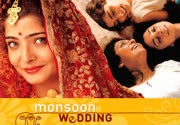
Monsoon Wedding
Synopsis:
Following up on her controversial erotic drama Kama Sutra: A Tale of Love, Mira Nair directs this charming family drama about a very chaotic Indian wedding. Lalit Verma (Naseeruddin Shah) is a wealthy father who is trying to see that his daughter Aditi''s wedding goes off without a hitch. Though familiar with Western ways, he has little patience with them and is dead set on seeing the nuptials done properly and traditionally. Disillusioned with her long time relationship with Vikram -- a man who is almost twice her age -- Aiditi (Vasundhara Das) suddenly agrees to submit to an arranged marriage with Hemant, an engineer from Houston. Yet as the ceremony nears, she gets cold feet and returns to see her former lover -- even though it could spell disaster for everyone involved. Meanwhile, Aiditi''s comely 17-year-old cousin Ayesha is coming to terms with her blossoming sexuality and has her sights set on Rahul, another relative who is a college student in Australia. Then there is Ria -- also Aiditi''s cousin -- who has a shocking revelation to make. This film was screened at the 2001 Toronto and Venice Film Festivals.
Lalit's shirt is always damp under the arms in the Delhi heat, a detail that feels too sweaty and real for a prestige international festival hit. Mira Nair directs this chaotic family gathering with a handheld camera that acts less like an observer and more like an uninvited cousin who had one too many gin and tonics before the starters even cleared the buffet. It moves with a restless, frantic energy that makes you feel the ceiling fans whirring overhead and the dust settling on the imported marigolds. If I'm honest, some of the early cross-cutting between the stressed caterer and the arriving relatives gives me a mild headache, jumping around with a sort of nervous tic that overcompensates for the stillness of the courtyard.
The screenplay by Sabrina Dhawan refuses to let anyone be entirely good or entirely terrible, which is harder to pull off than writing a clear villain. Naseeruddin Shah anchors the entire enterprise as the patriarch whose bank account is slowly bleeding out while he tries to buy enough happiness for his daughter's arranged marriage to a man she met online two months ago. He plays frustration not with thunderous monologues but with the tight, small gestures of a man calculating exchange rates in his head while smiling for a cousin's snapshot. He brings the same weary dignity to this frantic household that he brought to A Wednesday, though here he is surrounded by a dozen other people all shouting over each other in three different languages at once.
Then there is Shefali Shetty as Ria, the unmarried cousin who carries a dark secret behind her sharp, watchful eyes and her efficient management of the wedding tents. She doesn't get many big speeches, but watch the way she holds her cigarette or stands slightly apart from the dancing groups during the musical numbers. Her performance is full of heavy silences that contrast sharply with the noisy backdrop of dhols and wedding planning, giving the film its emotional gravity whenever the romantic comedy elements threaten to spin off into pure farce. It’s a performance that doesn’t ask for your sympathy right away, preferring to earn it through quiet endurance rather than tearful confessions.
The cinematography by Declan Quinn is handheld without being seasick, catching the sun glare off windshields and the deep indigo shadows of Delhi nights when the generator finally kicks out. The soundtrack leans heavily on Punjabi pop tracks that thump from tinny speakers, though there is one particular instrumental motif that repeats a beat too often during the sentimental tracking shots, sounding a bit like a stock library track bought on a budget. It's a small thing, but it bugged me every time it crept back in to tell us how to feel about a sunset over the Gurgaon highway.
Hindi cinema has spent decades treating weddings as bloated spectacles of wealth and family honor, but this picture strips away the gold leaf to show the frayed wiring underneath. Nair lets the camera linger on the servants setting up chairs and the exhausted brides adjusting their heavy lehengas in front of dusty mirrors, capturing the unglamorous mechanics behind the joy. It belongs to a specific era of transnational cinema that wanted to show the modern diaspora colliding with traditional roots, yet it avoids turning into an anthropological exhibit by focusing entirely on messy human behavior instead of cultural explanations.
There is a looseness to the supporting cast that makes the house feel genuinely lived-in, from the NRI uncle who won't stop talking about his golf handicap to the young kids sneaking rum behind the water cooler. When the darker revelations emerge about halfway through the runtime, the movie doesn't halt its momentum for a solemn, after-school-special reckoning, because real families don't pause the party just because someone's trauma has finally crashed the dinner. People argue, they cry in the laundry room, and then someone puts another cassette in the deck because the photographers are waiting outside.
Bollywood movies usually demand that you pick a side between Western modernity and conservative family values, but this script is far too messy for such simple binaries. Lalit weeps for his daughter's departure while also worrying about the catering bill, and that juxtaposition of the financial and the emotional is where the film finds its pulse. It captures how Indian families actually operate, moving between fierce affection and petty grudges in the span of a single sentence spoken over a plate of samosas.
By the time the final dance sequence rolls around, you are so deep inside the courtyard that the flashing fairy lights and the sweating dancers feel like your own memories. It doesn't solve every family trauma or fix the financial ruin hanging over the patriarch's head, because life doesn't wrap up neatly just because the band stops playing. The dancing simply continues under the smoggy Delhi sky, tired and loud and entirely unfinished.