

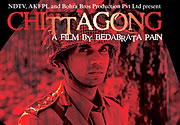
Chittagong
Synopsis:
Set against the backdrop of a little known saga in 1930s British-occupied India (now Bangladesh) - where a group of schoolboys and young women, led by a schoolteacher, Masterda Surya Sen (Manoj Bajpai) dared to take on the Empire. Chittagong is the story of a diffident 14 year old boy, Jhunku (Delzad Hiwale). Swept up into this seemingly impossible mission, the reluctant teenager battles with his own self-doubts to achieve an improbable triumph.
The story begins with Jhunku ,now a 23 yr old Youth is being chased by the Bengal police & he hides himself in a bunker along with his childhood friend Aparna(Apu/Opu),here he narrates the story of the beginning of 1930 the great chittagong uprising.Master Da surya sen(Manoj Bajpayee) is busy preparing for an armed revolution.Meanwhile 14 yr old Jhunku is a budding student and is being tutored by District Magistrate Wilkinson(Barry John) and his wife and is garnering his father''s expectation of studying in England and becoming a Barrister. However things get overturned as one day some students hit the strict police officer Maj.Johnson by spilling oil under his motorbike and happens his fall.Enraged by this Johnson makes random enquiries about the culpirit but meets with no success.However Wilkinson manages to spill beans out of Jhunku, an enranged Johnson then goes ahead shots the boy involved in the nast.This incident shocks Jhunku so much and all his faith on his tutor Sir Wilkinson, and he joins Masterda''s Army. Master Da along with his fellow comrades Nirmal Sen(Nawazuddin),Loknath Baul,Ambika Chakraborthy & Ananta Ghosh trains the 50 odd students and plans to capture the entire chittagong on April 18 1930 by disconnecting the communication.As per plan, the armoury of the police was captured by a group of revolutionaries led by Ganesh Ghosh and revolutionaries, led by Lokenath Baul took over the Auxiliary Force armoury. Unfortunately the machine guns were not located. The revolutionaries also succeeded in dislocating telephone and telegraph communications and disrupting the movement of the trains. After the successful raids, all the revolutionary groups gathered outside the police armoury where Surya Sen took a military salute, hoisted the National Flag and proclaimed a Provisional Revolutionary Government. The whole town is overjoyed at the success of Indian Republican Army and Chittagong was officialy conquered by Surya sen for one day. However reinforcements from Calcutta soon set out to capture the rebels knowing the army attack, the revolutionaries left Chittagong town before dawn and marched towards the Jalalabad hill ranges, looking for a safe place, but the British Army''s first wave had been demolished by Masterda''s Teenagers, this enraged the British and they bought machine guns and fired casualties in Masterda''s side.
Soon after Revolutionaries disperse in smaller groups, to nearby villages,however soon Ahsanullah Khan from CID comes to chittagong and cracks the rev
Alexx O'Nell looks slightly out of place in British-era Bengal, though to be fair, he always has that crisp, freshly-landed-at-Palam-airport posture that makes period pieces feel a bit like high-end cosplay. That bothered me when the credits rolled, this lingering sense that the casting directors just grabbed the nearest white guy who could say colonial lines without an accent that sounded like a surfer, but Bedford Reynolds isn't even the point of Bedabrata Pain's "Chittagong."
Bollywood movies about the freedom struggle usually want to give you flags and slow-motion marches to the gallows, shouting at your tear ducts until you feel patriotic on command. Pain, who spent years working as a NASA scientist before deciding to make a film about the 1930 armistice raid, goes the exact opposite route, treating history like an administrative nightmare where teenagers are handed rusted revolvers and told to figure it out. It is a messy, occasionally frustrating watch that refuses to smooth over the awkward corners of its own production, lurching between the grainy immediacy of a documentary and the forced constraints of a studio drama budgeted by people who definitely asked for fewer night shoots to save money.
Manoj Bajpayee as Surya Sen, known locally as Masterda, doesn't get the grand introductory speech you might expect from a lead actor anchoring a historical epic about armed rebellion. He just walks into a frame wearing a crumpled dhoti, looking tired, coughing into a gamcha, staring at ledger books with the quiet desperation of a middle-school math teacher who hasn't been paid in four months. Bajpayee plays revolutionaries by draining them of any theatrical thunder, and his performance here feels adjacent to the haunted, ground-down intensity he brought to "Gangs of Wasseypur," minus the dark humor and the leather jackets. When he talks to the boys, the young recruits who have memorized poetry and tactical manuals without ever seeing a corpse, he doesn't sound like a charismatic leader inspiring the masses. He sounds like a man running out of time and patience, terrified that these kids are going to get themselves killed because they read too many romantic pamphlets.
The cinematography by Satyajit Mohit Jena alternates between handheld chaos in the alleys and static, amber-lit interior shots that look like they were painted by someone who only had three light bulbs and a dream. Sometimes the focus pulls late, or a background extra clearly forgets they are supposed to be hiding from the police and stares directly into the lens, and honestly, I kind of love those rough edges because they keep the film from sliding into the pristine, museum-glass artificiality that ruins so many recent Hindi films. The sound design is a different story, though, especially that one recurring brass cue that hits every time someone looks pensively at a horizon, which is deployed so often you start waiting for it like a commercial break. It's a small thing, but it bugged me every single time.
Vega Tamotia and Raj Kumar occupy the shifting margins of the narrative, carrying the romantic and ideological friction that keeps the boys from becoming a monolith. Raj Kumar, long before he became the terrifying antagonist of "Newton," plays Ambika Chakraborty with a coiled, quiet intensity that suggests a man who would rather swallow glass than lose an argument about logistics. He doesn't get many flashy scenes, but watch the way his hands move when he is cleaning a breech-block or handing out leaflets; there is a mechanical precision to his performance that grounds the romanticism of the uprising. The teenagers, led by Delzad Hiwale as the young Jhunku, bear the heaviest narrative burden, and they occasionally strain under dialogue that asks them to articulate the weight of the empire before their voices have even finished breaking. It's not great, not bad, just there—the standard teenage rebellion arc, except instead of skipping school, they are planning to cut the telegraph wires and storm the armory.
Jaideep Ahlawat shows up as Anant Singh, bringing that specific bulk and menacing stillness that he later perfected in various streaming thrillers, chewing on his scenes without ever tipping over into scenery-chewing villainy. He and Bajpayee share a few quiet conversations in dim rooms where they discuss the ethics of violence, and those moments are easily the best writing in the screenplay, avoiding the usual patriotic clichés in favor of practical concerns like ammunition shortages and local police informants. Dibyendu Bhattacharya also drops in, doing that thing he does where he makes a minor bureaucrat or police officer feel like someone you desperately want to avoid at a railway station. Pain's direction is strongest when it focuses on these interpersonal frictions, the minor jealousies and ideological splits between men who know they are walking toward a firing squad.
What keeps "Chittagong" from being just another forgotten entry in the graveyard of mid-budget historical dramas is its refusal to validate the martyrdom it depicts. The kids aren't granted a glorious cinematic death where they look into the camera with tears of joy; they are hunted down in the marshes, betrayed by locals who want the reward money, or left to rot in damp cells on the Andaman Islands while the politicians in Calcutta negotiate terms that leave the actual foot soldiers out of the history books. It captures the bitter aftermath of failed resistance with an honesty that feels rare, acknowledging that most revolutions are messy, poorly organized, and eventually erased by the people who win the elections forty years later, leaving the audience to stare at the black screen and wonder what any of it was actually for.