

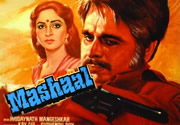
Mashaal
Synopsis:
Vinod Kumar (Dilip Kumar) is an upright and honest man, who runs a newspaper named "It". Vinod exposes the ills in the society with help of his newspaper. Vinod''s wife, Sudha (Waheeda Rehman), sees a vagabond named Raja (Anil Kapoor) and tries to instill some values and culture in him. Vinod is sceptical about this, but accepts when Raja tells them of his tragic childhood and comes to regard Sudha as a maternal figure. Finally, Vinod decides to help Raja by sending him to Bangalore to complete his education and become a journalist. During frequent meetings with Vinod and Sudha, Raja befriends Geeta (Rati Agnihotri), an aspiring journalist and an assistant in Vinod''s paper, and they fall in love.
During his investigations, Vinod finds that S.K. Vardhan (Amrish Puri), a wealthy and respected man in the society, is behind many malpractices. Vinod starts exposing S.K''s illicit business of drug-trafficking and selling hooch. Initially, S.K. tries to buy Vinod''s silence by bribing him, but when Vinod decides to stand up to S.K., the latter inflicts misery on Vinod by having him thrown out of his rented house via the landlord. That very night, Vinod''s newspaper office is burnt down by S.K.''s men. Helpless, and on the streets, tragedy strikes Vinod and Sudha further when Sudha, who is ailing, dies on the road, leaving Vinod distraught and heartbroken.
A disillusioned Vinod realizes that S.K. will always trump him, since people also support him. Instead of trying to expose S.K., Vinod now decides to follow S.K''s footsteps in order to destroy him. Vinod, in association with Kishorilal (Saeed Jaffrey), starts producing illicit hooch and doing other illegal businesses to earn lots of money - the thing, Vinod retrospectively feels, he lacked, and the shortage of which led to the tragedies in his life. In a very short time, Vinod becomes a very rich man. All this time, Raja, who is in Bangalore for his studies, is blissfully unaware of these developments. The only other person exposed to this truth is Geeta, who has grown resentful of Vinod and has started working in another newspaper.
Vinod''s business now stands as a threat to Vardhan''s empire. Soon, Raja returns after completing his education and meets Vinod and is surprised to see that the latter''s lifestyle has changed, but doesn''t know the truth.
Raja meets Munna (Gulshan Grover), an old friend, from whom he learns that a new crime lord has entered the fray and has gained a foothold in the hooch and drugs world. Raja decides to expose this criminal, who, unbeknownst to him, is Vinod himself. Vinod is disturbed to learn that Raja is trying to dismantle his empire, but does not stop him. Raja starts working for Dinesh (Alok Nath), another journalist for whom Geeta also works. A chance discussion between Raja, Dinesh and Geeta leads to the revelation that Vinod is, indeed, the new drug boss. Raja is flummoxed upon learning this, and goes to meet Vinod to confront him ab
The dialogue is so fast in the opening stretch that Amrish Puri almost sounds like he is reading a train schedule written by an angry bureaucrat. It is a small thing, honestly, but it bugged me every time he leaned into a microphone that clearly wasn't hidden well enough in the foliage. Yash Chopra usually has better spatial awareness in his sound design than what we get in those early newspaper office wrangles where the paper rustles louder than the actors breathe. You are pulled straight into the ink-stained friction of Vinod Kumar's crusading journalism without much time to catch your breath, which is mostly a good thing because it bypasses the usual table-setting nonsense that bogs down so many Hindi movies from this era. Dilip Kumar is already there, occupying the frame with a kind of heavy, gravitational exhaustion before the plot even fully decides what it wants to do with him. He plays Vinod not as a saintly crusader of the press but as a man whose stubbornness has curdled into a permanent scowl, someone who drinks too much black tea and refuses to look at his editors when they tell him circulation numbers are dropping.
Then the screenplay by Javed Akhtar takes a sharp knife to the entire apparatus and turns a crusading drama about freedom of the press into a much uglier personal vendetta. The transition from the righteous editor fighting local slum lords to the broken outcast living on the pavement happens with a brutal economy of storytelling that leaves scars. When Vinod loses his press, his house, and his standing, Chopra films the descent with a gritty, sun-bleached harshness that feels miles away from the pastel-drenched romanticism people usually associate with his name. It is messy and it sprawls across Bombay's underbelly with a genuine sweaty panic, capturing the kind of desperate daily grind where a cup of tea costs more than a man's dignity. The camera tracks Dilip Kumar through alleyways that smell of damp cardboard and cheap frying oil, far removed from the pristine drawing rooms of Shakti or Deewaar. Yet the film never quite decides whether it wants to be an epic generational tragedy about a father figure corrupted by his own past or a standard revenge melodrama featuring a punchy soundtrack by Hridaynath Mangeshkar that keeps threatening to turn every emotional beat into a folk-song lamentation.
Waheeda Rehman brings an aching, quiet dignity to Sudha, though the script mostly uses her as a moral anchor who stands on the sidelines looking worried while the men ruin everything. Her chemistry with Dilip Kumar has that lived-in, worn-edge comfort of two actors who have shared screen space across decades, communicating entire decades of unspoken disappointment with just a slight tilt of the head or a sigh that catches in the throat. When she tries to talk sense into him as he slips further into bitterness, you see the ghost of their past together, a subtle reminder of what maturity looks like when romance is stripped down to sheer survival. She doesn't get many flashy speeches, which makes her eventual breaking point land with a dull, sickening thud that echoes much longer than any of the movie's louder dramatic confrontations. It's a performance built entirely on pauses and hesitation, the kind of acting that makes most other performances in the cast look like they are shouting from the back row of a municipal theatre.
And then there is Anil Kapoor, who enters the second half as Raja, the street-smart orphan whom Vinod takes under his wing with disastrous paternal ambitions. Kapoor is playing the same hyper-energetic, fast-talking scamp he would refine across a dozen other hits, but here the sheer volume of his performance feels slightly unhinged because he has to match energy with a titan who is barely moving a muscle. When Raja gets his big journalism break and starts wearing pressed shirts, Kapoor plays the corruption of ambition with an over-eager swagger that sometimes trips over itself into melodrama. The dynamic between the older, cynical mentor and the bright-eyed protégé is supposed to be the emotional core of the film, but it often plays out like a shouting match between two different eras of acting styles sharing the same negative. Rati Agnihotri, as Raja's love interest, is mostly trapped in the narrative equivalent of a waiting room, popping in whenever the plot needs a romantic distraction from the escalating gang war.
The villains are suitably oily without ever reaching the operatic heights of Amrish Puri's best work elsewhere, though Nilu Phule brings a wonderfully slimy realism to the local politician who buys up newspapers the way other men buy cattle. Gulshan Grover pops up as a secondary thug with a twitchy menace, though his dubbing in a couple of key confrontation scenes sounds slightly out of sync with the ambient track of the street noise. It's those little technical blemishes that remind you this was a commercial product churned out during a notoriously frantic period for Bombay studios, where mixing desks were overworked and editing suites were treated like bus stations. But the sheer narrative momentum overrides the sloppy ADR work and the occasionally obvious studio sets, pushing you forward through a second act that gets darker and more suffocating by the minute. By the time the generational conflict reaches its boiling point in the rain-slicked docklands, you have forgotten about the out-of-sync dialogue entirely because the human cost of all that stubborn pride has become too heavy to ignore.
The ideological core of the movie examines how absolute righteousness can harden into a tyranny just as destructive as the corruption it fights, a theme that feels remarkably cynical for a mainstream hit of its time. Vinod starts as a man who believes the printed word can topple empires, only to realize that empires don't care about ink when they own the presses, the police, and the politicians. His descent into a gun-toting vigilante is not framed as a triumphant empowerment fantasy; it is depicted as a pathetic, tragic waste of a life spent in service of an abstract ideal that ultimately ate his family alive. The screenplay refuses to offer an easy absolution for any of its characters, leaving everyone stained by the violence they thought they were deploying for the greater good. It is a bleak view of human nature that keeps the film from settling into comfortable nostalgia, ensuring that the final confrontation leaves a bitter taste in your mouth long after the credits cut to black.