

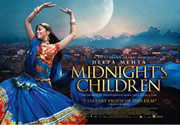
Midnight''s Children
Synopsis:
Halfway through Midnight's Children, Satya Bhabha is standing in this blindingly bright room looking completely exhausted and overwhelmed while wearing this weirdly specific striped polo shirt with a slightly frayed collar that honestly kept distracting me because it looked so itchy, and he's just staring into space and listening to all these phantom voices buzzing around his head like angry bees. But to understand why he's having a full existential breakdown in a brightly lit chamber, you have to look at how this whole crazy story started way back at the exact moment of India's independence in 1947 when two babies get swapped at birth in a hospital by a nurse who wants to give her own kid a better life among the wealthy elite. One of those babies is Saleem Sinai, and the other is Shiva, and their swapped destinies basically mirror the political chaos of the nation itself. So then, Saleem grows up with a massive nasal structure and this weird magical gift where he can host a telepathic midnight children's conference inside his mind with every single kid born in the first hour of India's freedom, and it is honestly wild to watch because the movie tries to cram decades of Salman Rushdie's massive novel into a brisk cinematic runtime by speeding through huge historical eras with dizzying voiceovers and rushed vignettes. Ronit Roy shows up as this intense patriarch figure who loses his wealth and sanity, and Shahana Goswami plays Saleem's mother with this incredible understated weariness, and they're both dealing with endless financial ruin and forced relocations and neighborhood gossips who won't mind their own business. Right after that, the family ends up moving around a ton, and Saleem's powers start acting up real bad, giving him killer migraines and isolating him from normal kids who don't have psychic connection rooms inside their brains. He's just trying to live a regular life, but he can't. Period.
Anyway, the movie speeds through the 1965 war and martial law and all sorts of heavy political turmoil in about three and a half minutes, and suddenly everyone is dealing with total devastation and bombs dropping everywhere and characters disappearing without much explanation. The funny thing is, Siddarth and Shriya Saran show up later and add a whole different energy to the second half, bringing this gorgeous, glossy star power that you usually expect to see in splashful bollywood productions rather than this kind of magical realism historical drama. The film tries to balance that big, bright bollywood movies aesthetic with a much darker, grittier political reality, which is definitely a weird tonal mix. They're running around trying to survive while historical events just crush them from all sides, and Saleem loses his memory entirely after a bomb blast, which leads to this bizarre sequence where he wanders around the jungle and forgets who he even is. He joins the Pakistani army, he fights in another war, and he essentially becomes a literal tracking dog for the military because of his sensitive nose, which is a wild career pivot that happens with zero setup. They didn't explain it well. He just sniffs out rebels and that's that. The hindi films landscape rarely tackles this specific blend of magical realism and heavy historical trauma, and even though some parts feel rushed and messy, you can't deny they swung for the fences. The dialogue shifts back and forth between English and Hindi, blending into a casual street-level patter that fits the chaotic vibe of the narrative, especially when characters are yelling at each other over street noise and cooking pots. You're just sitting there watching these actors cycle through decades of aging makeup, wondering how many more plot twists the movie can possibly squeeze in before the credits finally roll on all these sprawling generations of chaotic families.
So then, the climax brings Saleem back to Delhi where he reunites with the surviving members of the midnight children, who are all hooked up on government drugs and losing their special abilities one by one under a harsh authoritarian regime. He gets captured, he gets tortured a bit, and he realizes that his entire life has just been a punchline in a much larger cosmic joke written by history itself. The other midnight children look tired and broken, stripped of their childhood magic and forced to live ordinary, miserable lives in the slums. They're just shadows of their former selves. Shiva is there too, acting all tough and bitter with his military medals and his permanent chip on his shoulder about the hospital swap that robbed him of a rich upbringing. They have a brief, tense confrontation, but there's no grand cathartic fistfight or satisfying cinematic resolution, because real life doesn't work that way and neither does this movie. Saleem walks out into the crowded, dusty streets of Delhi, blending seamlessly into the massive, anonymous crowds of everyday citizens walking past him without a single care in the world.
Salman Rushdie’s prose has always possessed a strange, greasy kind of weight, sliding through your fingers the moment you try to pin it down with a simple plot summary, which is probably why Deepa Mehta’s screen adaptation of Midnight's Children feels so aggressively difficult to swallow. The book is famously bloated with historical accidents and magical realism, yet this film adaptation, penned by the author himself, stumbles in that specific way literary giants often do when they mistake the freedom of a novel for the permission structure of a three-act feature. You watch Satya Bhabha drag himself through the center of this frantic, overstuffed narrative and you can almost hear the pages rustling beneath the floorboards, drowning out the actors.
There is a baffling editorial choice made early on where the voiceover narration—handled by Rushdie with the weary cadence of an uncle explaining a family tree you never asked to see—steps all over the dialogue, muting the actors just as they find their footing. It is a small thing that bugged me through the entire first hour, this constant refusal to let a scene breathe without a literary safety net explaining what the audience is supposed to be feeling.
Mehta directs with a heavy hand, piling period detail upon period detail until the screen looks like a dusty antique shop that caught fire, lacking the loose, improvisational energy that usually keeps historical epics from turning into museums. The screenplay tries to chop a massive generational saga down to manageable chunks, jumping from post-partition Bombay to the emerald valleys of Kashmir and onward to the emergency-era slums, but the transitions are jarring, relying on stock footage and rushed montage work that feels closer to a television miniseries than a major cinematic release. Still, the visual palette occasionally lands on something striking, particularly when Gilles Nuttgens’ cinematography cuts through the clutter to capture the harsh, blinding glare of a Bombay afternoon reflecting off a tin roof. The colors are saturated until they bleed, heavy on ochre and rust, though the score by Nitin Sawhney tends to lean on the dramatic strings too hard, reminding me uncomfortably of the bombastic orchestrations that sank Mira Nair's Vanity Fair a decade prior.
Satya Bhabha as Saleem Sinai carries the burden of this sprawling mess with a kind of exhausted determination, his wide-eyed bewilderment serving as our proxy through decades of political upheaval, though he rarely gets a moment of quiet reflection to make the character feel like a real person rather than a narrative device. Opposite him, Siddharth plays Shiva with a snarling, physical intensity that cuts through the polite literary tone of the production, bringing a raw, street-level anger to the screen that the film could have used a lot more of. The supporting cast is packed with heavyweights like Ronit Roy and Shahana Goswami playing the parents with a desperate, middle-class anxiety, while Shriya Saran floats through her scenes as the enigmatic Parvati-the-witch, never quite given enough screen time to anchor the magical elements she is supposed to embody. Some of the minor players look like they were pulled from a touring theatre troupe and clearly dubbed in a rush after principal photography wrapped, adding an awkward, hollow echo to their emotional confrontations.
The central conceit—that children born at the exact stroke of midnight during India's independence possess telepathic links to one another and to the fate of the nation itself—is handled with surprising literalness, stripping away some of the metaphoric ambiguity that made the book so slippery. Hindi cinema has often wrestled with national identity through melodrama and song, but this international co-production tries to distance itself from those traditions while occasionally leaning on the same broad emotional beats when the plot starts to drag. Mehta attempts to map the political fractures of Indira Gandhi's regime directly onto the minds of these psychic kids, turning a sprawling historical reckoning into a literal battle between the rich kid and the poor kid swapped at birth, which is a tired trope even when it is dressed up in the grand language of post-colonial trauma.
When the story finally grinds to a halt in the authoritarian gloom of the 1970s emergency, the film has rushed through so many historical pivots that the political terror feels more like a bullet point on a history syllabus than an immediate threat to the characters we are watching. Bhabha’s narration fades out, the crowds disperse, and you are left wondering if a book this dense was ever meant to be squeezed into a standard runtime at all, or if it should have just been left alone on the shelf.