

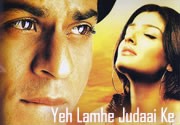
Yeh Lamhe Judaai Ke
Synopsis:
The ADR work on Mohnish Behl is so out of sync during the second reel that you can practically watch his mouth finish a sentence a full second before the sound comes out of the speakers, and if I'm honest, that kind of lazy post-production instantly pulls you out of even the most earnest cinematic universe. We are talking about Yeh Lamhe Judaai Ke, a picture that limped onto screens long after its principal photography had apparently wrapped somewhere around the middle of the nineties, breathing that strange, stale air of a project left too long in a dark drawer. It stars Shah Rukh Khan and Raveena Tandon at a time when both were figuring out how to occupy massive frames without necessarily having the scripts to back up their growing star power, though here they look less like icons in the making and more like people who showed up to a set because there was a contract demanding their presence. Navneet Nishan, Kiran Kumar, Amit Kumar, Divya Desai, Deepak Parashar, and Avtaar Gill round out an ensemble that feels less like a cast and more like a collection of familiar faces pulled from a casting director's Rolodex after hours, all of them tasked with navigating dialogue scenes that seem to have been constructed entirely out of leftover scraps from other, slightly better romantic melodramas of the era.
Direction is credited to Birendra Nath Tiwari, though calling what happens on screen direction feels like an insult to actual filmmakers who bothered to place a camera with intention, because most of the scenes simply consist of two actors standing four feet apart in front of a terribly painted backdrop while a lens wobbles slightly on its tripod. There is an amateurish quality to the blocking that reminds you of early television serials where the budget barely covered the tape, yet occasionally the film insists on attempting dramatic camera angles that completely misfire, cutting to Dutch tilts during mundane conversations about career ambitions and family pressure. The screenplay feels like it was written on napkins during a particularly confusing afternoon, throwing in arbitrary plot twists regarding music industry rivalries and childhood promises that get dropped for twenty minutes at a time only to return via clunky exposition delivered by Avtaar Gill in a wig that deserves its own billing in the credits. Bollywood movies have certainly survived troubled productions before, but there is a distinct difference between a troubled film that has chaotic energy and one that simply feels like a ghost being pushed through a photocopier.
Shah Rukh Khan is playing a struggling singer here, which already requires a suspension of disbelief given how the vocal tracks are handled, but his performance is fascinating precisely because he looks completely exhausted by the material long before the intermission hits. He adopts that intense, brooding glare that worked so wonderfully in Darr, except here it is being deployed during tedious exchanges about recording contracts and rehearsal schedules, creating a bizarre tonal mismatch where every minor professional setback is treated like an impending execution. Raveena Tandon fares slightly better simply by virtue of having better costumes, though her character spends most of the runtime looking into the middle distance with watery eyes while waiting for someone to give her a cue to cry or look mildly disappointed. Mohnish Behl swans about in oversized blazers, delivering lines with the cheerful indifference of a man who cashed his check on Friday and planned his weekend getaway before the director even yelled cut. There is none of the sparkling chemistry that usually saves even mediocre Hindi films from themselves, replaced instead by long stretches of awkward silence punctuated by unconvincing emotional outbursts that land with a dull thud.
The cinematography looks like it was lit by someone whose only prior experience was illuminating supermarket aisles, casting harsh, flat shadows across faces that deserved better than being pushed into the corners of badly framed medium shots. Songs pop up out of nowhere without any rhythmic justification, halting the narrative momentum completely just so characters can wander through a suburban park that is clearly not Switzerland, backed by a soundtrack that sounds like it was cobbled together on a Casio keyboard left out in the rain. Hindi movies rely heavily on musical numbers to carry emotion when the dialogue fails, but the tunes here are so aggressively forgettable that you forget them the second the fade-out begins, leaving only the memory of background dancers executing choreography that looks entirely improvised on the spot. It is a small thing, but the constant recycling of the exact same three-second instrumental sting every time a character looks pensively out a window drove me completely mad by the end of the first hour. Deepak Parashar and Kiran Kumar pop up as various authority figures and business rivals, chewing on dialogue that seems to have been translated through three different languages before reaching the page, and yet they remain the most lively presence in frames that otherwise threaten to congeal into grey sludge.
Themes of sacrifice and artistic integrity float around the periphery of the plot like ghosts of a better script, touching upon the transactional nature of the entertainment industry without ever developing enough teeth to bite into anything substantial. Hindi films have traditionally loved a good story about star-crossed lovers separated by ambition and class, but this particular iteration lacks the emotional architecture required to make those stakes feel real, trading genuine heartbreak for cheap melodrama that evaporates the moment the credits roll. Navneet Nishan tries her best to inject some urban friction into the proceedings, but her character is sidelined by narrative demands that prefer endless scenes of brooding men staring at cassette tapes over actual interpersonal conflict. Watching it now, decades after the cultural moment that birthed it, the movie functions less as a lost treasure and more as a strange historical artifact, documenting the exact moment a group of talented people realized a project was going nowhere and decided to just finish the day so they could go home.