

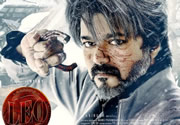
Leo
Synopsis:
Vijay is literally tossing a homemade explosive right into the open jaw of a massive, snarling hyena that has somehow wandered into a quiet little cafe in the snowy mountains, and honestly, if you told me this was going to happen in a movie that somehow gets grouped into discussions about wild bollywood blockbusters and crazy hindi movies even though it is technically a Tamil action fest, I would have laughed right in your face.
Let us back up because the whole thing actually starts with a quiet family running a chocolate factory, and Vijay plays Parthiban, this ridiculously peaceful animal rescuer and cafe owner who just loves his wife Sathya, played by Trisha, and their two kids, living a chill life in Himachal Pradesh until a couple of brutal robbers break into his shop and he has to brutally shoot them dead to protect his daughter, which sounds like standard hero behavior except that the local cops and everyone else start looking at him like he is a complete psychopath because of how effortlessly he slaughtered them, and seriously, look at that one police officer in the background with the most terribly fake mustache you will ever see in cinema history, it is distracting.
Stuff happens and news of the shootout goes viral everywhere, and that is when Sanjay Dutt’s character, Antony Das, a genuinely terrifying gangster with salt-and-pepper hair and a voice that sounds like grinding gravel, sees the footage on TV and instantly convinces himself that Parthiban is actually his long-lost, presumed-dead son Leo Das, who supposedly died in a sacrificial fire decades ago, and and then boom, Antony and his ruthless brother Harold Das, played by Arjun, roll into town with an army of goons to terrorize the family and force Parthiban to admit his true identity.
Parthiban keeps denying it with tears in his eyes, insisting he is just a simple dad from the hills, but Antony refuses to believe him, leading to this utterly insane torture sequence where they kidnap his family and threaten to kill his daughter just to break his spirit, and right before the interval block hits you right in the face with a massive shock, Vijay has to watch his dog get killed, and the sheer rage on his face is just palpable.
God, the interval point is so loud and chaotic as Antony tries to prove Parthiban is Leo by cutting him or forcing a reaction, and then we get thrown into a completely random song and dance number that makes zero narrative sense given that people are literally bleeding out and children are being held hostage, but hey, that is just how things go in these kinds of massive theatrical spectacles, before we plunge right back into the gritty, muddy violence of the second half where the past finally catches up to everyone.
Harold Das starts hunting down Parthiban’s friends and allies, setting fires and burning down buildings, and Parthiban finally snaps, dropping the gentle family-man act entirely because his inner beast wakes up, and we learn through flashbacks that Leo Das was actually a sadistic, bloodthirsty monster who ran a massive drug syndicate with his father and sister before a brutal ritual sacrifice went wrong and he had to fake his own death to escape his psychotic family.
And then the movie speeds past all the psychological trauma in like five minutes to jump straight into the final showdown where Sanjay Dutt and Vijay are swinging machetes at each other in a massive warehouse filled with burning cars and exploding fuel drums, and Arjun is running around shooting guns, and characters are getting impaled left and right in pure, unadulterated cinematic carnage.
Vijay drives a car straight through a concrete wall, crashing right into Antony's hideout, and after a brutal, bone-crunching hand-to-hand fight that leaves both men barely breathing, Vijay puts his foot on Sanjay Dutt’s throat and snaps his neck, ending the gangster's reign of terror once and for all.
Vijay stands alone in the burning ruins of the compound, completely covered in blood and soot, picks up his ringing phone to talk to a mysterious government official, and hangs up before walking away into the snowy night.
Parthiban has a terrible habit of blinking too hard whenever he’s caught off guard in a conversation, which I’m fairly sure is just Vijay finding a physical tic to play against his usual indestructible screen presence. It’s a small thing, but it bugged me throughout the opening reels of Lokesh Kanagaraj’s Leo because it feels less like a character choice and more like a movie star trying very, very hard to look like a man who runs a quiet coffee shop in the snowy hills of Himachal Pradesh. You can put him in cardigans and give him an adorable rescue dog to fuss over in the cold morning fog, but the shoulders are still too wide and the stride is still too heavy, carrying decades of Tamil cinema mythology beneath a layer of synthetic frost. That tension between the ordinary life he is trying to project and the terrifying violence vibrating just beneath his skin drives the first hour with a strange, jittery momentum that doesn’t quite settle into standard genre grooves. If I'm honest, the whole café setup has been done to death across various action industries anyway, feeling suspiciously like the opening act of A History of Violence transplanted into a landscape that looks like it was color-graded by someone who just discovered the blue slider.
Kanagaraj loves a good extended sequence where people just walk toward each other with weapons while the bass drops out of Anirudh Ravichander’s score, leaving only the crunch of gravel and heavy breathing. When a gang of petty criminals stumbles into Parthiban’s establishment looking for easy prey, the resulting brawl relies on frantic, close-quarters framing that sometimes obscures who is hitting whom, though that might actually be the point. The direction trades clean choreography for messy survival, letting coffee cups shatter and tables splinter into splinters that catch the harsh overhead lighting. Yet the screenplay keeps tripping over its own mythology whenever it remembers it has to connect this sleepy baker to a larger, more sprawling criminal empire involving long-lost relatives and vicious drug lords operating out of distant warehouses.
Sanjay Dutt arrives as Antony Das, complete with an eyepatch and a gravelly snarl that sounds like it was recorded in a completely different room, wandering through smoky dens with a menacing swagger. The supporting actors often feel disconnected from the snowy reality of the main plot, drifting in and out of scenes with the strange, weightless quality of video game NPCs waiting for their cue to attack. Trisha, playing Parthiban’s increasingly anxious wife Sathya, has to do an awful lot of heavy lifting with her eyes while standing in doorframes, reacting to revelations about her husband’s past with a mixture of terror and exhausted disbelief that grounds the more outlandish narrative swings. She brings a weary domesticity to the frame that prevents the picture from completely vanishing up its own cinematic universe aspirations.
Anirudh’s soundtrack hits you over the head with the exact same thematic motif every single time Vijay shifts his posture from gentle father to relentless killing machine, which gets exhausting by the third or fourth repetition. You start anticipating the drop before it arrives, listening for that specific vocal chant that signals someone is about to get their head smashed into a glass cabinet. The cinematography by Philomin Raj and Manoj Paramahamsa alternates between washed-out gray daylight and neon-drenched interiors that pulse with a feverish intensity during the flashback sequences, where the narrative really starts to unravel. Those sequences transport us to a sun-baked coastal underworld that feels utterly detached from the chilly mountain aesthetic established in the beginning, creating a jarring tonal whiplash.
The film wrestles with identity, memory, and the inescapable nature of one's past choices, themes that Bollywood movies used to handle with sweeping emotional melodrama before shifting toward slick, patriotic thrillers. Here, those ideas get buried under an avalanche of flying shrapnel and CGI hyenas that look distinctly rubbery under the midday sun. The second half trades psychological ambiguity for a relentless parade of set-pieces where blood splatters across car windshields with monotonous regularity. You lose track of who is fighting whom and why anyone cares about the massive shipment of narcotics that supposedly anchors the entire plot. Vijay sells the physical exhaustion of a man being dragged back into his old life, but the script gives him very little internal conflict to chew on once the cat is out of the bag.
Arjun Sarja enters the fray later as Harold Das, chewing the scenery with a manic energy that suggests he wandered off the set of a different, much louder movie and decided to stay. His interactions with Dutt possess a chaotic charm, even if their dialogue scenes are shot in rapid-fire close-ups that make it impossible to get a sense of geographical space. The editing sometimes drops beats right in the middle of crucial conversational pauses, cutting away to a reaction shot a fraction of a second too late, which robs the dramatic turns of their intended punch. You can feel the studio breathing down the director's neck, demanding crowd-pleasing hero moments every ten minutes even when the story demands quiet contemplation of past sins. It is an uneven, bloated beast that moves at a breathless clip yet somehow feels interminable during the endless third-act firefights.
By the time the dust settles and the final confrontation concludes with the obligatory slow-motion walk away from an explosion, you are left wondering what any of it actually meant beyond providing a vehicle for a major movie star to flex his action credentials. The ambition is undeniable, pulsing through every frame of the hyper-stylized violence and the booming musical cues, but the execution buckles under the sheer weight of its own franchise-building obligations. It tries to be a gritty character study and a mass-market entertainer at the same time, ending up as a loud, messy hybrid that refuses to commit fully to either path. The coffee shop is left in ruins, the snow is stained crimson, and Vijay stands there staring into the middle distance with that same blank intensity, waiting for whatever sequel the box office demands.