

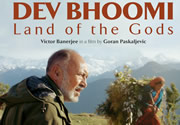
Dev Bhoomi
Synopsis:
God, Dev Bhoomi is such a wild ride.
Let's back up a second because Victor Banerjee plays this aging expat named Rahul who packs up his life in Canada and returns to his remote, snow-dusted ancestral village in Uttarakhand after like forty years away, and honestly, the film is a total outlier compared to your average loud, dance-heavy Bollywood movies that usually dominate the box office with bright colors and massive party tracks.
Rahul's village is suffering through a massive drought and terrible forest fires that are literally burning down everything in sight, and everyone's super bitter about him coming back, especially since he left under a massive dark cloud of scandal and shame years ago involving a young local woman and a tragic local tragedy that nobody in the mountains ever forgets or forgives.
Geetanjali Thapa shows up as this fierce, independent young woman named Maya who lives in the shadows of the village gossip, and she's just trying to survive the harsh environment while dealing with her own family drama, and man, can we talk about that one brown woolen cardigan she wears for like three straight scenes because it has this weird missing button near the collar that keeps distracting you from the heavy emotional dialogue happening right on screen?
Uttara Baokar is also in this, bringing this incredible, quiet gravitas as the village elder who looks at Rahul like she wants to push him off a cliff, and the whole atmosphere is just soaked in this raw, unfiltered mountain grit that you honestly rarely see in mainstream Hindi movies these days.
Stuff happens and tensions boil over big time as Rahul tries to reconnect with his old home, but the villagers treat him like a cursed omen, throwing insults and slamming wooden doors in his face every time he walks down the narrow cobblestone paths.
And then boom, we hit the interval point right when a massive forest fire breaks out near the edge of the settlement and everyone has to scramble to save their cattle and wooden homes, leaving us hanging right in the middle of a literal inferno.
Honestly, the pacing gets super weird right after the intermission because the narrative suddenly pivots hard into an emotional courtroom-style confrontation where the villagers gather in the village square to put Rahul's past sins on trial, dragging up all the ugly secrets he tried to leave behind in Canada.
Rahul has to face Maya and the rest of the angry locals, and he finally confesses his deepest regrets, admitting why he abandoned them all those decades ago and how living abroad didn't fix the guilt eating away at his soul.
And then the movie just speeds through the entire resolution in like two minutes where the local authorities and community leaders reach a fragile peace, the fires finally die down because of a sudden mountain downpour, and the village goes back to its quiet, isolated routine like nothing even happened.
Rahul walks slowly away from the village down the rocky winding mountain trail with his small travel bag slung over his shoulder, his back to the camera as the distant snow peaks fade into the grey mist.
Victor Banerjee wears the hell out of a tweed coat that has seen better decades in the upper reaches of Uttarakhand, and if I am honest, that visual anchor holds together long stretches where the plot threatens to slip completely off the side of a cliff. The opening twenty minutes feature a sound mixing choice that baffled me right out of the gate: the ambient crickets are pushed so high in the mix during a quiet evening conversation that you have to lean forward to catch the dialogue, which is a rookie mistake for a project of this scale, though thankfully it gets ironed out once the narrative moves indoors.
Director Goran Paskaljevic took the bones of Greek tragedy and planted them squarely in the high Himalayan shadows, adapting Sophocles without turning the exercise into some tedious academic chore. The screenplay refuses to rush the return of Rahul, an aging expatriate who comes back to his ancestral village after forty years abroad carrying a quiet ache that Banerjee communicates almost entirely through the way he holds his shoulders when facing away from the camera. There are no grand monologues explaining why he left or why the locals treat him with a cold, glassy suspicion that feels utterly authentic to anyone who has spent time in closed mountain communities where newcomers remain outsiders until their grandchildren are buried in the local soil.
Geetanjali Thapa manages to ground the emotional stakes in a performance that dodges every single trap of the wronged-woman archetype, bringing a prickly, defensive survival instinct to a character who could have easily been written as a saint or a victim. Her scenes with Banerjee crackle with a strained, uncomfortable energy because neither actor plays for cheap sympathy, choosing instead to let small resentments curdle into something genuinely dangerous. Uttara Baokar anchors the village elders with a face carved from walnut wood and centuries of stubborn tradition, though there is one specific reaction shot where the editor holds on her blank stare for three seconds too long, sucking the momentum right out of an otherwise tense confrontation at the edge of a terraced field.
The cinematography treats the landscape less like a travel postcard and more like an indifferent god watching petty human squabbles from the clouds, favoring slate grays and washed-out greens over the hyper-saturated hues you usually get in regional Indian cinema when the camera points at the hills. There is no traditional musical score leaning on your emotions every time someone cries, opting instead for long stretches of natural wind noise and the dull crunch of leather boots on shale. This sonic restraint makes the rare moments of acoustic guitar feel heavy and earned, avoiding the emotional spoon-feeding that ruins so many modern Bollywood movies trying to force a tear out of the cheap seats.
Comparisons to Asghar Farhadi's work are inevitable given the way moral compromise ripples through a tight-knit community, but Paskaljevic keeps his eye much closer to the dirt and the damp stone walls of abandoned houses. The village itself becomes a character defined by emigration and abandonment, its slate-roofed homes slowly collapsing back into the earth while the younger generation chases factory jobs in distant cities, leaving behind only the old and the bitter to guard ancient grudges over land rights and family honor. This economic reality gives the central conflict teeth, turning what could have been a dusty theatrical exercise into a sharp look at what happens when a place loses its young blood.
The third act introduces a revelation regarding parentage that feels slightly melodramatic compared to the observational grit of the earlier scenes, leaning a bit too hard into classical tragedy mechanics when the modern social context was already doing the heavy lifting. Yet Banerjee anchors even the clunkiest plot turns with his physical weariness, walking through the fog like a ghost who showed up twenty years too early for his own funeral. Hindi films rarely trust an audience enough to let a protagonist remain this ambiguous and unlikable for the entire running time without offering some redemptive hug in the final reel.
That refusal to offer easy closure makes the viewing experience scratchy and difficult, the kind of movie that leaves you rubbing your eyes and thinking about the geography of exile long after the screen goes dark. It lacks the polish of a prestige international co-production, and the supporting players sometimes deliver their English and Hindi lines with the awkward cadence of people reading off a slate just out of frame, but those rough edges keep it feeling human and lived-in rather than sterile and calculated. When the screen cuts to black on a wide shot of mist rolling over the pine trees, you realize you have spent two hours watching people break each other's hearts over rocks and dirt that won't remember any of them by next Tuesday.