

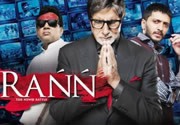
Rann
Synopsis:
It is the first film that solely dedicates itself to exposing the media and its workings, both good and bad. There is the government - a system which runs the country, then there are wealth creators like industrialists etc. and then there are politicians in the ruling party and the opposition.All the above in a democratic society are supposed to be working for the common people and the one and only means of the common people having any idea as to what those are up to is through the media. Hence the media has been invented as a truth telling machinery serving the purpose of the common people so that they know they are in good hands or in case they are told that they are not, they can hope to exercise the power of their vote to bring about a change.But in a free economy system where there is so much competition the media by default is lost in its purpose.The Media is a reporting agency. It reports News. NEWS is what is new. New is what you hear for the first time. So to be able to be the first to tell you the various Newspapers and Channels have an intense competition among themselves and this they do on a need to survive, on an ego to be on the top and on a greed to get rich.To be ahead of competition means more circulation and higher TRPs which in turn generate more and more Ad revenue which will translate into making more and more and more money.Also the fact that in the process the people who run the media realize their power of influencing the common people inevitably makes them power hungry.To sum up this film’s intention would be to expose the behind-the-scenes truth of how a truth telling machinery by the very virtue of its positioning has no choice but to corrupt itself to become a money-making and power-brokering enterprise
Harshvardhan Malik wears his suits like armor he forgot how to take off, which is a choice that tells you everything you need to know about how Ram Gopal Varma directs Amitabh Bachchan in Rann. There is a specific kind of low-frequency hum that starts about twenty minutes into the picture and doesn't quit until the credits roll, a sound design decision that feels less like dramatic scoring and more like somebody left a refrigerator door open in the next room for two and a half hours. If I'm honest, it's a small thing but it bugged me every time the newsroom monitors flashed.
Television news in this country has rarely been filmed with anything approaching subtlety, yet Varma bypasses the usual melodrama for something slicker, noisier, and vastly more paranoid. He shoots the glass-walled offices of India 24/7 like a fishbowl where all the inhabitants are slowly losing their oxygen. Cameras track down corridors at a manic pace, catching Ritesh Deshmukh sweating through his collar as Purab, the idealistic son who believes in the sanctity of the headline. Deshmukh does not look entirely comfortable in a drama of this weight, though that awkwardness actually serves the character reasonably well because Purab is meant to be out of his depth among sharks who eat ethics for breakfast.
Paresh Rawal plays Mohan Pandey, a politician with eyes like peeled grapes and a voice that never needs to rise above a conversational murmur to suggest total corruption. He shares a scene with Bachchan on a terrace where the wind is howling so loudly it almost swallows the dialogue, and neither actor blinks or raises their volume to compensate. That sort of confident stillness is rare in modern Hindi cinema, where directors usually panic if the screen remains quiet for longer than four seconds. Bachchan uses his height to physically loom over smaller characters without ever leaning into moustache-twirling villainy, keeping Malik somewhere in the tragic zone of a man who genuinely believed his own press releases.
Editing choices throughout the middle stretch grow increasingly erratic, cutting away from a conversation between Raima Sen and Rajat Kapoor to lingering close-ups of breaking news tickers that repeat the exact same three words over and over again. Kapoor plays a cynical bureaucrat with weary perfection, though his dialogue sometimes sounds like it was looped in a bathroom during post-production. It is a strange acoustic artifact that pops up intermittently across several supporting performances, muddying lines that should have bitten harder. Gul Panag cuts through that audio mud with sharp, unfussy line deliveries as a reporter who has seen too many campaigns bought and sold over cheap scotch.
Sudeep arrives late as a corporate fixer and immediately shifts the movie's temperature from ideological debate to cold-blooded arithmetic, handling the boardroom scenes with the casual menace of a man calculating depreciation on office furniture. He and Rajpal Yadav—playing a beleaguered office assistant whose panic attacks are handled without the usual comic relief mugging—anchor the film's second half when the plot threatens to spiral off into shouting matches about journalistic integrity. Nobody is reinventing the wheel here, but there is an undeniable momentum to the way information is weaponized, traded, and discarded.
Watching this thing now, right after rewatching Sarkar, the structural similarities in how Varma stages family loyalty versus institutional betrayal become impossible to ignore. Both movies treat large rooms as chessboards where the patriarch sits in the center while everyone else scrambles for the corners. But Rann gets bogged down by its own righteousness once the third act kicks in and every character feels compelled to deliver a speech directly to the lens about the death of truth in the media landscape. When the script stops lecturing and just lets Bachchan stare down a camera lens while his empire crumbles around him, the movie briefly touches something genuinely uncomfortable about how we consume outrage.
The soundtrack relies heavily on percussion that mimics a pounding heartbeat, which gets very old by the fourth time a character has an epiphany while looking at a television screen. Yet the visual texture remains compellingly grim, all slate grays and sickly fluorescent greens that make every face look like it needs twelve hours of sleep and a glass of water. Manisha Koirala drifts through the margins as Malik's estranged wife, given very little to actually do aside from looking profoundly disappointed in everyone within a three-mile radius. She manages to make that sparse material register anyway, mostly by refusing to look at the other actors when they are being particularly loud.
Hindi movies rarely know how to wrap up a conspiracy thriller without resorting to a grand public confession that solves all systemic rot in three minutes flat. This one stumbles over that exact same hurdle during the home stretch, letting loose a torrent of monologues that undoes a lot of the quiet psychological claustrophobia built up in the first hour. Yet even when the machinery creaks under the weight of its own message, the performances keep pulling your attention back to the screen. You stay for Bachchan's posture, for Rawal's terrifyingly calm smiles, and for the way the background extras in the newsroom never stop typing even when the building is metaphorically burning down around them.