

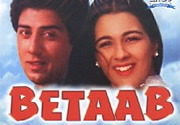
Betaab
Synopsis:
This film is a love story of two youngsters who fall in love despite the status gaps between their families. Sunny (Sunny Deol), is a young, poor and happy guy who lives with his mother Sumitra (Nirupa Roy) in his home-made town farm. Formerly, His father Avenash had been a big businessman, but he went bankrupt. For this reason, he committed suicide. Avenash was in close friends with Sardar Dinesh Singh Girji (Shammi Kapoor) who is one of the richest and most powerful men in the city. When Sardar reveals that Avenash has gone bankrupt, he turns his back to him. Sardar has one daughter called Roma (Amrita Singh). She is spoiled, snob and accustomed to have all the people who surround her beneath her. She was Sunny''s childhood friend.
Now, Sardar purchases a new horse farm out of the city in the town, which is nearby Sunny''s farm. When Sunny accompanies his mother to the train station, he encounters Roma after many years they haven''t seen each other. Sunny instantly recognizes her, but Roma doesn''t. consequently, they coincidentally meet each other various times in the farm. They quarrel continually, but soon she comes to know that he is her childhood friend and they reconstruct their childhood love.
There is a specific kind of horse whistle that haunts the background of Rahul Rawail’s Betaab, and if I am honest, it gets under your skin long before the actual plot decides to show up. It belongs to Sunny Deol, hauling himself up a steep, sun-baked incline in the shadows of the Kashmir valley, announcing his arrival with the raw-throated urgency of a rookie actor who knows he only has one shot at the frame. Hindi films in the early eighties were drowning in factory-pressed urban angst, Amitabh Bachchan brooding behind a desk while the system ground him down into cinematic dust, so this abrupt lurch toward open air and mud-spattered corduroy felt less like a genre shift and more like an emergency exit. The screenplay, credited to Javed Akhtar, doesn't bother with polite introductions or soft-focus preamble, preferring instead to shove two teenagers into a violent class collision disguised as a romantic misunderstanding before the audience has even settled into the velvet seats of the single-screen theater. Sardar Dinesh Singh’s camera doesn't romanticize the geography so much as it treats the mountains like hostile witnesses, framing the cliffs as jagged barriers that must be conquered or endured rather than admired from a tour bus. Rahul Rawail keeps the momentum jagged too, occasionally letting scenes stretch out into awkward, uncomfortable silences where the characters simply stare across property lines, breathing hard, waiting for the other person to blink. There is a roughness to the way scenes transition from the sprawling, misty meadows to the cramped, high-ceilinged drawing-room of Amrita Singh’s wealthy, imperious father, played with a wonderful, mustache-twirling disdain by Shammi Kapoor, who looks like he is having far too much fun shouting at people who are half his age. It’s a small thing, but it bugged me how the boom mic dips into the upper corner of the frame during a crucial shouting match by the stables, a clumsy technical slip that reminds you nobody was losing sleep over digital purity back when celluloid was king.
Sunny Deol’s introduction as Sunny is the kind of star-making turn that actors spend decades trying to fake, relying entirely on physical disorientation and a voice that sounds like it’s perpetually recovering from a cold. He doesn't act so much as he reacts with his entire upper body, shoulders heaving, fists clenching, eyes bulging with a mixture of adolescent rage and absolute terror whenever Amrita Singh’s character, Roma, rolls up in her imported jeep and treats him like hired help. He lacks the practiced polish of Rishi Kapoor or the effortless swagger of Jackie Shroff in Hero, coming across instead like an overgrown kid who was pulled off a tractor and told to look menacing in front of seventy millimeter lenses. That awkwardness becomes the character’s primary armor, shielding him from the slickness of the urban elite he despises so thoroughly. Amrita Singh, making her debut opposite him, matches that defensive energy with a cold, aristocratic detachment that gradually thaws into genuine panic when she realizes this brooding peasant isn't going to fold just because her father owns half the district. Their chemistry doesn't sparkle with witty banter or clever wordplay; it burns with the miserable, stubborn heat of two people who are furious that they cannot stop looking at each other across a crowded bonfire. Shammi Kapoor towers over both of them simply by standing still and barking commands through a cigar smoke haze, anchoring the melodrama with the authority of an actor who spent the sixties playing the hyperactive rebel and had now comfortably settled into the role of the capitalist heavy who views romance as a hostile corporate takeover. When Sunny and Roma finally drop their respective guards, the emotional release feels earned precisely because neither performer knows how to express vulnerability without shouting or throwing something across the room. It’s a messy, sweaty kind of acting that belongs to a different era of filmmaking, one where subtlety was often sacrificed for raw physical impact and actors were allowed to look profoundly silly in pursuit of a grand emotion.
R.D. Burman’s score hits you right in the chest with a brassy, synthesized wallop that completely ignores the pastoral quiet of the locations, leaning instead into disco-adjacent percussion and soaring romantic violins that threaten to lift the actors right off the screen. "Jab Hum Jawan Honge" plays on a loop across the narrative, mutating from a childish taunt into a swelling anthem of forbidden longing, and while the repetition wears thin by the third hour, it anchors the emotional trajectory of the couple with ruthless efficiency. The choreography by Suresh Bhatt relies heavily on running through tall grass, leaping over fallen logs, and dramatic hair-tosses that capture the sheer, breathless exhaustion of young love pursued by angry relatives on horseback. You can hear the budget strains in the way the crowd scenes are mixed, with background actors looking thoroughly confused about whether they are supposed to be cheering or fleeing from the commotion in the village square. The editing by Waman Bhonsle and Gurudutt Shirali cuts aggressively between the sweeping landscape shots and tight, sweaty close-ups of the leads, creating an erratic rhythm that prevents the audience from ever getting too comfortable with the narrative arc. It’s a sensory overload of primary colors, screaming match dialogue, and thunderous percussion that defines the particular aesthetic of commercial cinema from that decade, proving that logic was frequently subordinate to spectacle when it came to keeping the front-benchers awake through the post-intermission stretch. The supporting cast populates the margins with colorful caricatures, particularly the loyal sidekicks who exist solely to get punched in the jaw or deliver exposition while holding a bridle, adding a layer of predictable genre texture to a story that is otherwise trying desperately to tear down the fences between the rich and the poor.
The entire structure of the narrative hinges on the ancient, dusty trope of feudal arrogance versus honest labor, a dynamic that Indian cinema had been chewing on since Mother India and would continue to digest for another thirty years without finding a fresh angle. What saves Betaab from sinking entirely into didactic sociology is the sheer, unbridled ferocity of Sunny Deol’s anger, which feels directed not just at the villainous father but at the very system that expects him to bow his head simply because his pockets are empty. The romance isn't about shared values or intellectual compatibility; it’s an act of mutual survival against a world that wants to grind them both into obedient components of a rigid social hierarchy. Shammi Kapoor represents that machinery with terrifying, charismatic ease, playing a man who believes that human emotions can be budgeted, audited, and liquidated if they don't align with the family balance sheet. The screenplay doesn't offer any easy compromises or modern solutions to this clash, preferring instead to throw its protagonists off a cliff metaphorically and literally, letting gravity and fistfights resolve what polite conversation never could. It’s a blunt instrument of a movie, hammering its ideological points home with the subtlety of a sledgehammer swung by an angry lumberjack in the middle of a crowded bazaar, yet it captures something essential about the adolescent experience of love as an absolute, world-ending emergency. By the time the final confrontation explodes into a chaotic free-for-all involving sticks, stones, and galloping stallions, you stop caring about the implausibility of the logistics and just surrender to the noise, the dust, and the relentless, pounding rhythm of a cinema that refused to whisper when it could scream at the top of its lungs.