

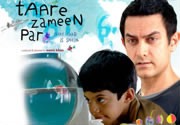
Taare Zameen Par
Synopsis:
Ten minutes in, there is a shot of a blue school uniform being dragged across concrete that feels less like an establishing detail and more like a bruise you didn’t ask to poke. I kept waiting for the needle to drop on some heavy synthesized strings to tell me I should feel bad for this kid. Aamir Khan directs Taare Zameen Par with a patience that borders on stubborn, refusing to let the misery of an eight-year-old dyslexic boy turn into a predictable soap opera about the Indian education system. It’s messy. It drags in the middle. The boarding school segment in the second half takes forty minutes just to find its footing, lingering on long, agonizing stretches of discipline and silence that almost tested my patience entirely. But that reluctance to rush toward the emotional payoff ends up saving the whole enterprise from sliding into standard sentimentality.
Darsheel Safary plays Ishaan Nandkishore Awasthi with a raw, unpolished energy that completely bypasses the usual precocious child actor routine. His eyes don't just look sad; they dart around the frame like trapped insects, desperate to escape whatever demands the adults around him are placing on his erratic attention span. He is awkward, messy, frustratingly stubborn, and entirely convincing as a kid who has internalized the idea that he is fundamentally broken because letters dance on the page when he tries to read them. When he finally breaks down in front of his mother—played by Tisca Chopra with a quiet, devastating fatigue that tells a whole story about domestic compromise—there is no background score to cushion the blow. The sound design drops out completely, leaving only the sound of ragged breathing and the dull thud of a schoolbag hitting the floor.
Enter Aamir Khan as Ram Shankar Nikumbh, the substitute art teacher who arrives halfway through with a cargo bike full of finger paint and a peculiar swagger that initially feels a bit too much like a movie star slumming it for social credit. If I'm honest, his early scenes with the children rely a little too heavily on that manic, manicured charm that tends to dominate commercial Hindi films when they want to look whimsical. He does this funny little walk, smiles wide, and immediately wins over the oppressed children with a song about dogs and cats. It’s a bit much, honestly. But then the film recalibrates as Nikumbh realizes the depth of Ishaan's isolation, shifting from broad comedy to a devastatingly quiet examination of shame. Khan keeps his performance remarkably restrained once the core conflict is established, letting Safary carry the heavier emotional lifting without trying to steal every frame.
The cinematography by Setu catches the chaotic sensory overload of Ishaan's internal life through bursts of animation that crawl across the screen, turning boring math equations into swimming fish and tumbling letters into menacing monsters. These animated sequences aren't just cute visual flourishes; they are frantic, jagged little windows into a brain that processes the world through color and movement rather than rigid grids. Yet the film doesn't constantly rely on these tricks. It grounds itself in the dull grays and institutional blues of the boarding school corridors, where every doorway looks like a judgment and every chalkboard is a threat. Shankar-Ehsaan-Loy provide a soundtrack that mostly stays out of the way, though that title track comes back just one too many times during scene transitions when a simple cut to black would have done the job.
The screenplay by Amole Gupte avoids the standard hero’s journey structure by letting the adult protagonist fail quietly and often before figuring out how to reach the boy. Nikumbh doesn't just show up and fix everything with a single inspired art lesson; he has to go to Ishaan’s parents, argue with a stubborn father who views academic failure as a moral defect, and practically dismantle his own assumptions about what intelligence looks like. Vipin Sharma plays that father with a terrifying, recognizable rigidity that hits close to home for anyone who grew up in households where report cards were the only currency that mattered. He isn't a cartoon villain twirling a mustache; he’s just a tired man parroting the exact same generational pressure that was inflicted on him. The domestic scenes pulse with an authentic, unglamorous tension that makes you want to look away from the screen because it feels too much like sitting in your own living room during a family argument.
There is a specific kind of middle-class anxiety that threads through modern Hindi cinema, often dealing with the crushing weight of expectations in a rapidly modernizing economy where every child is expected to become an engineer or a doctor or nothing at all. This picture leans directly into that claustrophobia, contrasting sharply with the sprawling, action-heavy blockbusters that usually dominate the box office conversation. It shares some DNA with Shyam Benegal’s earlier explorations of institutional cruelty, though wrapped in a much more accessible, mainstream package that occasionally threatens to drown in its own earnestness. The supporting cast, particularly the various schoolmasters and indifferent principals, are uniformly solid, though the English teacher with the slicked-back hair feels like a refugee from an entirely different, much cheaper drama.
By the time the final art competition arrives, the narrative risks drowning in its own redemptive syrup, especially when the adults start crying tears of pure validation while the camera slowly tracks across their glistening faces. It’s manipulative, sure. You see the emotional trap being laid from three scenes away, and yet the sheer vulnerability of Safary's face keeps you from rolling your eyes entirely. He doesn't deliver an Oscar-worthy monologue or suddenly transform into a genius academic; he just learns to paint on a canvas without his hands shaking. That small, fragile victory carries more weight than any grand courtroom climax or sports-field triumph you'll find in standard Bollywood melodramas. The film lets the quiet linger after the credits start to roll, refusing to offer a neat little bow for the future, leaving you to wonder how many other kids are currently sitting at the back of a classroom staring blankly at a page of dancing letters while everyone else looks straight ahead.