

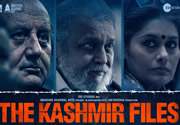
The Kashmir Files
Synopsis:
And then boom, we have to rewind because The Kashmir Files starts back in 1990 in the Kashmir Valley where life is about to get unimaginably awful for the Hindu minority.
Anupam Kher plays Pushkar Nath Pandit, a retired school teacher who loves his grandchildren and his homeland more than anything else, and honestly, the guy just wants to live in peace, but militant leader Bitta Karate and his radicalized followers have other plans, and things escalate so fast it's genuinely terrifying.
People are getting dragged from their homes, names are being broadcast from mosque loudspeakers, and Mithun Chakraborty plays Brahma Dutt, this high-ranking IAS officer trying to navigate the sheer bureaucratic horror and political betrayal while civilians are literally packing into trucks and fleeing for their lives.
Look, Darshan Kumaar plays Krishna, who's Pushkar’s grandson in the present day living in Delhi, and he’s been completely brainwashed by university professors like Radhika Menon played by Pallavi Joshi, believing that Kashmir is this romanticized paradise of peaceful resistance and that his grandfather's stories are just exaggerated right-wing propaganda.
Before we even get to the heavy stuff, there’s this random background extra wearing a neon green puffer jacket in a tense university protest scene that completely distracts you because who wears neon green during a high-stakes dramatic argument about regional geopolitics?
Stuff happens and Pushkar passes away in Delhi, leaving behind a group of his old college friends who are played by veteran actors, and they make it their mission to take Pushkar's ashes back to Kashmir and force Krishna to finally look the brutal historical truth square in the face.
Krishna goes along on this trip because he's confused and looking for closure, but seriously, the pacing of these hindi movies can be wild because you're sitting there processing an absolute massacre of a family hiding in a rice drum, and then suddenly the movie hits the interval block right when the tension is peaking.
Krishna discovers court records, police files, and personal testimonies from people who survived the 1990 exodus, including Bitta Karate confessing to murders on camera with a chillingly blank expression that makes your stomach turn.
God, the scene in the hospital where a woman is forced to eat rice soaked in her own dead husband's blood is so harrowing you just want to look away, and it totally shatters Krishna's entire worldview built by his leftist professors.
And then he returns to that exact same university auditorium where Radhika Menon is holding another seminar praising separatists, and Krishna walks right up to the stage, grabs the microphone, and delivers a furious, tear-soaked speech exposing the entire cover-up, denouncing the sanitized version of history taught in classrooms across the country, and calling out the hypocrisy of intellectual elites who ignore genocide for political convenience.
As the credits roll, real documentary footage and photographs of actual Kashmiri Pandit refugees flash across the screen, showing the real people who lost everything, and Krishna stands alone on the stage weeping.
Anupam Kher breathes through his nose in a way that suggests a man who hasn’t slept properly in thirty years, and honestly, that detail stays with you longer than half the historical exposition dropped in the first forty minutes. Vivek Agnihotri’s The Kashmir Files drops you right into the middle of a political seminar in Delhi before violently yanking the steering wheel toward the snow and blood of 1990s Kashmir, demanding that you look at things most commercial Hindi films prefer to gloss over with a romantic song in the valley. It’s loud, it’s messy, and it refuses to let you sit comfortably in your seat while a multi-generational tragedy unfolds through the eyes of a bewildered college student played by Darshan Kumaar. The screenplay doesn’t care about pacing in the traditional sense, jumping between decades with the blunt force of a sledgehammer, constructing scenes that go on for ten minutes past the point where a normal editor would yell cut, yet somehow maintaining a strange, breathless grip on the audience that keeps everyone glued to the screen until the house lights come up. Agnihotri directs with the zeal of an agitprop artist who just discovered the power of a close-up lens, shoving cameras into faces until pores and sweat become landscape. The framing often feels claustrophobic on purpose, trapping characters against stark walls or under harsh fluorescent lights that drain any romanticism out of the mountains, turning what should be a breathtaking geographic backdrop into a prison of memory and violence. There’s a distinct lack of cinematic breathing room, meaning you don't get wide establishing shots that let you appreciate the geography because the camera is too busy vibrating with rage, tracking footsteps down narrow corridors where danger waits behind every doorframe.
Mithun Chakraborty brings a weary authority to the screen as a retired civil servant who has seen too much and said too little, anchoring the chaotic chronology with his gravelly voice and tired eyes. He plays the bureaucrat who knows where the bodies are buried metaphorically and literally, moving through scenes with a slumped posture that communicates defeat long before he opens his mouth to deliver dialogue that sounds like it was written in a hurry. Then you have Pallavi Joshi, whose performance as a radical academic manages to be terrifying precisely because she plays her with such chilling calmness, never raising her voice when she justifies the unthinkable to a room full of nodding students. She’s the intellectual engine of the opposing ideology, and Joshi makes her frighteningly plausible, avoiding the moustache-twirling villainy that ruins lesser political dramas. Darshan Kumaar has the hardest job, playing the grandson who has been fed a sanitized version of history and must undergo a brutal deprogramming process over the course of two and a half hours, which leads to screaming matches that push his vocal cords to the absolute limit. He goes from blank-faced apathy to trembling hysteria so fast it gives you whiplash, though if I'm honest, the script pushes him into a few too many tear-soaked monologues that feel cribbed from a soap opera rather than a serious inquiry into historical trauma. The supporting cast is packed with theatre veterans who pop up for single scenes to deliver gut-wrenching accounts of displacement, though a couple of the local militia actors are clearly dubbed by someone in a studio with a microphone too close to their face, creating a distracting audio disconnect that pulls you right out of the tragedy.
The cinematography relies heavily on a muddy, desaturated palette that makes every interior look like it's lit by a dying generator, matching the internal decay of a society tearing itself apart from the inside. When the violence hits, the camera doesn’t look away, lingering on bloodied doorways and shattered household items with an unflinching gaze that borders on exploitation yet feels entirely necessary to convey the scale of the horror. The background score by Rohit Sharma, however, is a relentless machine that refuses to stop telling you how to feel, blasting heavy orchestral strings and wailing vocals every time someone sheds a tear, which gets exhausting by the third reel. It’s the kind of sonic wallpaper that defines too many contemporary Bollywood movies, drowning out the natural sound design of wind and screaming crowds with synthesized dread that feels pasted on in post-production. The editing cuts between archival footage and dramatic reconstructions with jarring speed, blurring the line between documentary evidence and narrative fiction in a way that feels deliberately disorienting, forcing the viewer to question the very nature of cinematic truth. Sometimes a scene will cut away just as a character is about to answer a crucial question, leaving a jagged void where closure should be, a stylistic choice that works twice before becoming an annoying tic that halts narrative momentum in its tracks.
At its core, the film wrestles with the ghosts of displacement and the weaponization of collective memory, asking uncomfortable questions about who gets to write the history of a region soaked in blood. Agnihotri isn't interested in nuance when he has a point to make about state apathy and media complicity, pushing his thesis forward with the subtlety of a freight train barreling down a single track. The ideological battles fought in university lecture halls mirror the physical violence in the valley, suggesting that words on a chalkboard can be just as lethal as bullets fired in the dark, a theme that resonates far beyond the specific borders of Jammu and Kashmir. Yet by reducing complex geopolitical fractures into a binary struggle between pure victims and irredeemable monsters, the narrative occasionally flattens the very human tragedy it seeks to rescue from historical oblivion, painting with broad strokes where a fine brush was desperately needed. It reminds one of Mani Ratnam’s Roja in its desire to frame personal loss against the backdrop of Kashmiri unrest, but where Ratnam sought a fragile emotional bridge through romance and confusion, Agnihotri plants a flag in the rubble and dares anyone to pull it down. The storytelling operates like a series of closed-fist punches to the jaw, leaving little room for reflection until the credits are already rolling and the house lights force you to confront your own neighbors in the dark cinema.
This is a polarizing piece of cinema that bypassed traditional critical consensus by connecting directly with an audience hungry to see their pain projected onto a 70-millimeter screen, regardless of the artistic collateral damage left in the wake. It’s too loud and too long, bogged down by repetitive flashbacks and an intrusive soundtrack that treats emotional manipulation as a primary directive, yet it leaves an indelible mark that standard prestige dramas rarely manage to scratch. You might walk out angry at the politics, angry at the filmmaking, or angry at the world, but you will not walk out indifferent, and for a certain segment of the Hindi film industry, that raw provocation is apparently the only currency that matters anymore.