

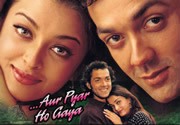
Aur Pyar Ho Gaya
Synopsis:
Rahul Kumar wears oversized sweaters in the middle of a Swiss summer with an earnestness that suggests nobody warned him about wardrobe continuity, and honestly, it bugs me. Rahul Mehrotra directs this 1997 romance with the breathless pace of a man who just discovered what a soft-focus lens can do and refused to turn it off for two and a half hours. The screenplay, credited to Honey Irani, relies heavily on the kind of dramatic misunderstandings that could be cleared up by a five-minute conversation, but characters in these productions stubbornly refuse to speak plainly when a dramatic stare out of a train window is available. We are dropped into a Switzerland that looks less like a real country and more like a greeting card factory that exploded into the Alps, complete with cascading waterfalls and extras who appear to have been recruited from a local ski resort's lost-and-found bin.
Bobby Deol plays Bobby, a name that requires no creative heavy lifting from the writer, and he spends the first half-hour operating under the assumption that aggressive grinning counts as character development. He arrives on screen with a mop of curly hair that belongs in a shampoo commercial rather than a serious dramatic narrative, though calling this film serious requires a very loose definition of the term. Aishwarya Rai, making her Hindi film debut here following her pageant victories, carries herself with a frozen, sculptural beauty that makes every scene she is in feel like an oil painting someone accidentally plugged into a generator. When she smiles, the temperature in the theater drops three degrees because it is so clearly rehearsed in front of a three-way mirror. Priya Tendulkar and Anupam Kher chew the scenery with the comfortable competence of actors who have collected their paychecks and decided to have a bit of fun with the dialogue, even when the dialogue consists mostly of shouting about family honor over a dining room table laden with cold fruit.
Rahul and Aashi meet cute in Europe because Bollywood movies of this vintage treated the continent like a personal playground for affluent youngsters who had never encountered a delayed train or a rude waiter. The plotting pivots on a deception where Bobby pretends to be someone else named Rohit, a classic trope that is stretched past the breaking point long before Shammi Kapoor shows up to wag his finger and dispense folksy wisdom with a twinkle in his eye that feels entirely contractual. Shammi is good, naturally, because Shammi could play this exact grandfather role in his sleep while solving a crossword puzzle, but his presence only highlights how stiff the young leads are when they have to share a two-shot without a musical number masking their lack of chemistry. The editing by V. N. Mayekar is choppy during the dramatic sequences, occasionally lingering a beat too long on Aishwarya's tear-filled eyes as if daring the audience to check their watches.
Nuance is consistently sacrificed for the sake of a glossy wide shot, which brings me to the cinematography by Harmeet Singh. Every frame is bathed in a perpetual golden hour that makes even a mundane trip to the grocery store look like an insurance commercial for a retirement fund. Nusrat Fateh Ali Khan's music score is the only element holding the enterprise together, soaring over the rough editorial patches and giving the romantic sequences a weight they simply have not earned on the page. Songs like Meri Saanson Mein manage to elevate the proceedings despite the awkward choreography by Ahmed Khan, who seems determined to make every dancer look like they are trying to swat away a swarm of invisible bees while maintaining direct eye contact with the lens. It is hard to stay annoyed at the narrative logic gaps when a qawwali track kicks in and suddenly everyone is clapping on the upbeat with an intensity that borders on alarming.
Aishwarya looks stunning in every single costume designed by Neeta Lulla, but her dramatic range in these early scenes is roughly equivalent to a mood ring stuck on blue. She has the star quality that would eventually conquer international red carpets, yet here she is trapped in a loop of sighing against pillars and dropping her books in slow motion so Bobby can pick them up. Avtar Gill and Aasif Shaikh pop up in various supporting capacities to shout exposition at key narrative junctures, functioning less like human beings and more like human toll booths that the plot must pass through to reach the next song. If I'm honest, the film feels longer than *Dilwale Dulhania Le Jayenge* by at least forty-five minutes, largely because it lacks that picture's narrative momentum once the lovers are separated by parental disapproval and stubborn pride.
Beena plays the doting mother with a sigh that sounds pre-recorded, drifting through rooms filled with velvet cushions and heavy drapes that trap the stifling atmosphere of manufactured melodrama. The themes of tradition versus modern desires are handled with the subtlety of a brass band playing inside a telephone booth, screaming its moral lessons directly into the ear of anyone unfortunate enough to sit in the front rows. Hindi cinema has told this exact story of youthful rebellion and eventual parental capitulation a thousand times before and a thousand times since, usually with more greasepaint and fewer Swiss chalets. By the time the climax rolls around in a dusty Indian train station that looks suspiciously like a studio backlot, the emotional fatigue has set in so deeply that the reconciliation feels like a bureaucratic requirement rather than a triumph of love. It is a movie that exists in a strange vacuum of pristine surfaces and hollow conflicts, leaving behind no lasting impression other than the lingering suspicion that nobody involved in the production ever drank a cup of real coffee during the entire shoot.