

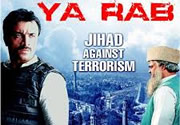
Ya Rab
vcdSynopsis:
Ikram (Raju Kher) is a practicing Muslim living happily with his family in Lucknow. His brother, Maulana Jilani (Akhilendra Mishra) is a much respected Muslim face. Having a huge following, the maulana gets his followers out of trouble with the authorities thus adding to his power. But the maulana’s intentions are not what they seem to be. He has a sinister side to him, that of inciting mobs and spreading terrorism. He specialises in choosing boys for suicide bombing missions and brainwashes them in various ways including showing them films of atrocities against Muslims.
On the tail of the maulana is the ATS cop, Rann Vijay Singh (Ajaz Khan), who has information that something is slated to happen in Lucknow on a certain date. Khan''s love life has been shattered after his Muslim fiancée learnt that her brother is also a terrorist. She decides to atone for him by not marrying! Gradually,Ran Vijay has zeroed down on the maulana and worked out that a suicide bomber will destroy a crowded mall in the city. He makes it to the mall only to see the bomb going off.
The bomb blast will haunt the maulana as one of the victims is his brother’s pregnant daughter-in-law, Amreen(Arjumman Mughal). Ran vijay’a hopes rested on her since she was seen talking to the bomber before it went off which meant she knew him. She is the only witness to the bombing but she is brain-dead. While the surgeon Dr.Mazhar (Manzar Sehbai) wants to keep her alive till the doctors can bring the child out of her, the maulana makes all the efforts to kill her including threatening Dr.Mazhar with mob violence and destruction of his hospital.
Ajaz Khan sounds like he is shouting across a windy parking lot during every single dialogue exchange in Ya Rab, which gets tiring by minute twenty, if I'm honest. He plays a fundamentalist firebrand with zero modulation, just a steady climb from loud to louder until his throat appears to be shredding itself on the soundstage. You can practically hear the boom mic straining to handle the concussive force of his consonants. Bollywood movies have a long and storied tradition of the shouting villain, but usually there is a quiet moment in a tea stall somewhere to balance out the decibels. Here, we just get more shouting, amplified by an audio mix that treats every whispered threat like a thunderclap.
Director Hasnain Hyderabadwala shoots the dramatic sequences like he is worried the audience has wandered off to check their phones in the middle of a sentence, framing every single reaction shot from a low angle that makes ordinary living rooms look like gothic cathedrals. Characters stand in doorframes and deliver philosophical dilemmas about religious extremism with the grim urgency of men defusing a bomb with a pair of rusty kitchen scissors. Manzar Sehbai does what he can with the role of a moderate cleric, bringing a tired dignity that feels imported from a completely different, much better project. He holds his silences well. While everyone else is chewing the scenery until it turns to wet pulp, Sehbai just looks out windows and sighs like a man who forgot his umbrella in a rainstorm.
There is a scene in the second act involving a stolen motorcycle that goes on for roughly four minutes too long, purely because the editor refused to cut away from a kid crying behind a plastic crate. It's a small thing, but it bugged me, mostly because the film keeps grinding its narrative engine to a halt just to linger on suffering that has already been thoroughly established by previous scenes. Akhilendra Mishra turns up as a cynical bureaucrat and gives us that familiar performance where he stares blankly into the middle distance while someone else explains the plot, which reminds me of his work in Sarfarosh except with half the budget and a quarter of the narrative patience. The screenplay lurches between courtroom drama and domestic melodrama without ever figuring out how to transition from a shouting match between neighbors to a constitutional debate about state security, leaving the cast stranded in hallways that all seem to smell faintly of fresh paint.
Vikram Singh and Arjumman Mughal occupy the romantic subplot, which is about as necessary to the central ideological conflict as a sunroof on a submarine, appearing every twenty minutes to look sad near a water fountain and remind us that young love is complicated when you disagree on the finer points of theology. Their scenes together have the spontaneous energy of a high school rehearsal for a play nobody wants to be in, devoid of chemistry yet stubbornly present, lingering in the cut just long enough to make you forget what the argument in the previous scene was even about. Meanwhile, Raju Kher and Kishori Shahane try to anchor the family scenes with a bit of seasoned professionalism, yet even they eventually succumb to the gravitational pull of the script's heavy-handed moralizing, shouting their final lines over a musical score that sounds like a church organ being dragged down a flight of concrete stairs.
Cinematographer Jehangir Choudhary bathes everything in a sickly amber filter that makes every exterior look like it was filmed inside a jar of industrial honey, stripping out whatever natural textures might have anchored the drama to a recognizable reality. Hindi films often rely on color grading as a crutch when the lighting department runs out of ideas, but this particular shade of yellow becomes an active distraction, turning actor's teeth into glowing signifiers of cheap post-production work. The soundtrack follows suit with a battery of percussion instruments that hammer away at your skull during scenes where two people are merely sitting across a desk from each other discussing property taxes or school admissions, mistaking volume for importance at every single turn.
The core problem isn't the movie's message about peace and tolerance, which is noble enough if somewhat aggressively obvious, but rather the way it treats the audience like a collection of slow learners who need every metaphor explained twice by a man pointing a finger at a whiteboard. When a film like this tackles communal harmony, it usually stumbles over its own desire to be fair to everybody while still delivering a neat villain you can hiss at from the popcorn line, and Ya Rab is no exception to that weary formula. Yet for all its clumsy framing and blaring string sections, there is an accidental honesty in how thoroughly exhausted the production feels by its own earnestness. Nobody is having fun here. The actors look tired, the director looks tired, and by the time the credits finally drop over a freeze-frame of a pigeon taking flight, you will probably feel ready for a very long nap yourself.