

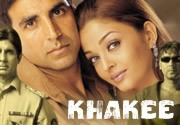
Khakee
Synopsis:
Akshay Kumar is chewing on a toothpick during a shootout that makes no geographical sense, and if I am honest, that little bit of business tells you more about how Rajkumar Santoshi built Khakee than any three-page thesis on its politics. Hindi movies in the early two-thousands were obsessed with slickness, but Santoshi kept his hands dirty, dragging stars through dusty Maharashtrian backroads until their designer threads looked like rags. You have Amitabh Bachchan playing an aging cop whose spine is bent by institutional disappointment, hauling himself out of bed at dawn to take on a suicide mission that nobody in the department actually wants solved. It is messy storytelling from the very first frame, refusing to polish its edges or apologize for its runtime, though it definitely drags around the hour mark when the romantic subplot shows up like an uninvited uncle.
The screenplay, co-written by Santoshi and Sridhar Raghavan, has this habit of letting conversations bleed into violence without giving you the courtesy of a musical cue or a dramatic zoom to brace yourself. Bachchan's Anant Shrivastav is escorting a radical academic played by Atul Kulkarni from a remote village to Mumbai, and every gas station and tea stall they hit feels like an actual place where someone might get a stray bullet in the ribs. There is a weight to the boots hitting the pavement and the way doors slam shut in government offices that reminds you of how Ghatak felt before it traded its arthouse grit for mainstream muscle. Yet the dialogue sometimes drops into melodrama so thick you could slice it with a knife, especially when the speeches about duty and corruption start echoing through empty train stations, sounding less like real cops talking and more like a playwright trying to win an argument with the home ministry.
Then there is Ajay Devgan as Angad, the rogue intelligence officer turned assassin who wears black leather in ninety-degree heat and still manages to look genuinely terrifying without raising his voice once. Devgan operates in a completely different register from everyone else on screen, refusing to play to the cheap seats, choosing instead to stare through people like they are made of glass. When he kills a minor police official in a crowded railway yard, the camera stays wide, refusing to glamorize the knife work or give you the usual slow-motion payoff you expect from commercial cinema. It is a performance that anchors the entire second half, preventing the picture from sliding into pure noise when the car chases start piling up on top of each other. Aishwarya Rai shows up as Mahima, a local college girl caught in the crossfire, and she does her best with a character written mostly in margin notes and reaction shots, though her introduction sequence involving a burning bus stretches credibility even by the loose physics of masala entertainment.
Akshay Kumar gets the showy transformation arc, starting as a corrupt, bribe-hungry inspector who takes cash from politicians before finding his spine somewhere around the third reel when the bullets start coming too close to his head. His comedic timing bleeds into his action beats in a way that feels organic rather than tacked on, throwing out throwaway remarks while reloading a service revolver with shaking fingers. The sound design during these sequences deserves a special mention for being aggressively loud, rattling the speakers every time a shotgun goes off in an enclosed space, though whoever mixed the Foley track for the footsteps in the cave sequence made them sound like horses walking on hardwood floors. It's a small thing that bugged me every time it popped up, pulling me right out of the tension Santoshi had spent twenty minutes building.
The visual palette relies heavily on washed-out browns and bleached yellows, making every exterior look like it was shot during a heatwave that never broke. Cinematographer T. Surendra doesn't indulge in the neon-soaked excess that was ruining half the productions coming out of Bombay at the time, preferring naturalistic lighting that throws deep shadows across Bachchan's lined face during the nocturnal interrogation scenes. Ram Sampath’s score stays mostly out of the way until it needs to punch up a confrontation, though the primary theme tends to recur just a bit too often whenever Bachchan looks pensively out of a jeep window. Bollywood movies have always struggled to balance ensemble casts without turning into vanity projects for the top-billed names, but here the character actors get room to breathe, from D. Santosh as the weary driver to Tanuja in a brief, devastating cameo.
What keeps the picture from settling into routine genre exercises is the bitterness underlying its second half, where the heroes discover that the system they are bleeding for has already sold them out to the highest bidder. Santoshi does not offer clean resolutions or moral redemption for characters who have crossed the line, leaving the survivors to limp away from a bloodbath with more questions than answers about who they are actually serving. When the credits finally drop over a montage of the debris left behind in the desert, you are not thinking about the box office numbers or the star power on display, but rather the sound of Devgan's heavy boots walking away from another burning vehicle while the local police stand around waiting for orders that are never going to come.