

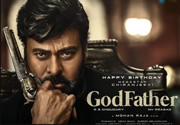
Godfather
vcdSynopsis:
Let's back up for a second because this whole mess starts because the ruling party's chief minister kicks the bucket.
Godfather starring Chiranjeevi and Salman Khan drops us right into this chaotic political vacuum where everybody is scrambling for the throne and things get ugly fast.
Chiranjeevi plays Brahma, this silent, brooding ex-convict who wears all black, sunglasses indoors, and apparently runs a parallel welfare state out of a massive warehouse while everyone else is trying to figure out how to steal public funds.
Nayanthara plays Satyapriya, the dead leader's daughter who hates Brahma's guts because he stands in the way of her political ambitions, and she's married to Varma, played by Murali Sharma, who is secretly a giant slimeball scheming with Satyadev's character, Govardhan, to turn the entire state into a massive narcotics trafficking hub.
Govardhan wants total control of the party and the drug money, but Brahma keeps blocking his shipments and ruining his parties, which makes Govardhan lose his absolute mind.
There is this one background extra sitting behind Satyadev during a cabinet meeting who is wearing the most aggressively lime green patterned sweater you've ever seen, and I genuinely could not take my eyes off it for three whole minutes while characters were plotting industrial-scale corruption.
Anyway, Govardhan tries framing Brahma for all sorts of crimes, leaks fake news through media channels, and tries to get him assassinated, but none of it works because Brahma just stares menacingly and beats up thirty guys at once without breaking a sweat.
Then boom, we hit the interval block.
Right when a massive riot breaks out outside a hospital and knives are flying everywhere, the movie just pauses for a completely random, wildly unnecessary song and dance number featuring Puri Jagannadh as a hyperactive fan-favorite sidekick, which is honestly a classic move in big commercial bollywood movies that test your patience in the best possible way.
After the break, the plot goes into overdrive and Salman Khan suddenly shows up as Masood Bhai, this absolute absolute unit of an underworld don with heavy artillery, riding in on a massive truck just to save Brahma's life in a ridiculous gunfight that completely defies the laws of physics.
Salman and Chiranjeevi share screen space, fire endless machine guns at bad guys, and ride motorbikes through explosions like they are thirty years younger.
Govardhan loses control of the drug cartels, his secret operations get exposed on live television by the surviving journalists, and his political allies abandon him the second things turn south.
Brahma corners Govardhan in his secret underground bunker where all the chemical drugs are manufactured.
Govardhan tries to pull a hidden pistol, but Brahma is too fast, disarms him with a brutal kick, pins him to the concrete floor, and delivers the final crushing blow before walking out into the blinding sunlight as the credits start rolling.
There is a specific kind of sweat that clings to the neck of a mid-budget Telugu political thriller when the background score starts doing too much heavy lifting during a conversation about land acquisition, and GodFather has it right from the jump. If I'm honest, the first twenty minutes feel less like an orchestrated narrative opening and more like a car engine trying to turn over on a freezing morning with bad fuel. Mohan Raja directs like a man who has watched Lucifer four too many times on a flight and decided that every single dialogue delivery needs to be punctuated by a helicopter landing or a slow-motion push-in on a pair of aviator sunglasses. It’s a small thing but it bugged me how often the camera cuts away from an actor's face just as they are figuring out where to put their hands.
Chiranjeevi enters the frame not as a man returning from exile but as a monument waiting for pigeons to find it, which works surprisingly well for the first act because he barely speaks. He has this way of standing in a dark room where his posture alone does the narrative work, letting Satyadev Kancharana chew the scenery around him into little bits of emotional confetti. Satyadev plays the treacherous brother-in-law with an oily confidence that occasionally threatens to tip over into cartoon territory, yet he anchors the central conflict simply by refusing to blink during their confrontations. That kind of stillness is rare in modern masala cinema where everyone usually has to be doing five things with their eyebrows at once. Nayanthara walks through the carnage with a tired elegance that suggests she read the script, realized her character was mostly reacting to men yelling about power, and decided to just look vaguely disappointed by the entire state of Andhra politics instead.
The screenplay takes a sharp left turn somewhere around the middle when Salman Khan shows up on a motorcycle, and that is where the whole enterprise threatens to slide off the road into a ditch of cross-industry pandering. Bringing star power from Hindi films into a regional political drama always creates a weird gravitational pull that bends the plot around the visitor's schedule, leaving scenes that exist solely so two famous men can look at each other with mutual admiration while explosions bloom behind them. You can practically hear the producers calculating opening weekend collections every time Salman adjusts his leather jacket. It feels less like a narrative necessity and more like a marketing meeting that got accidentally filmed and put into the DCP. Yet, despite the cynical packaging of this particular bromance, there is an undeniable kinetic charge to their shared sequences that reminds you why movie stars used to rule the culture before IP took over.
Nirav Shah’s cinematography loves blue and gold filters about as much as a 2000s action movie directed by Michael Bay, coating every government office and underground warehouse in a teal sheen that makes everyone look slightly seasick. Thaman’s soundtrack hits you over the head with brass instruments every time someone walks down a corridor with purpose, though the percussion tracks during the fistfights occasionally find a genuinely nasty groove that elevates the choreography above standard template beating. It is not great, not bad, just there, functioning as sonic wallpaper that prevents you from noticing how many times the exact same hallway gets used for a standoff. Murali Sharma pops up as the exhausted police commissioner, bringing a weary realism that grounds the more operatic nonsense happening around him, even if he looks like he needs a solid eight hours of sleep and a cup of black coffee.
Puri Jagannadh also makes an appearance as a journalist, and watching him deliver lines feels like listening to someone read a telegram through a screen door. The film wants to be about the rot at the center of political succession, but it keeps getting distracted by its own desire to service the image of its lead actor as an infallible moral force who only uses violence reluctantly. That contradiction sits at the heart of most modern commercial cinema across industries, whether you are looking at south Indian actioners or big-budget Hindi movies where the hero must remain spotless while destroying half the state infrastructure. GodFather stumbles through these ideological knots by simply turning up the volume on the score whenever the logic gets too thin to support its own weight. You leave the theater with a slight headache from the brass section and the memory of Chiranjeevi’s posture, which is probably all the production ever wanted from you anyway.