

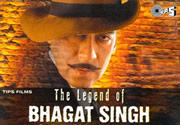
The Legend of Bhagat Singh
Synopsis:
Ajay Devgan does this thing with his lower lip in the courtroom scenes that I just can't get out of my head, a tiny little tuck right before he delivers lines about British imperialism that makes him look less like a saintly freedom fighter and more like a stubborn kid who refuses to eat his vegetables. It is an acting choice so granular, so delightfully unheroic, that it nearly saves a picture which is otherwise very loud and very long. Rajkumar Santoshi made this in 2002 alongside that other Independence-era drama starring Sunny Deol, and while both pictures shared a release window and a thematic obsession with the gallows, Santoshi went for something much heavier, much browner in its color palette, and infinitely more impatient with the traditional conventions of Bollywood melodrama. The screenplay, which Santoshi co-wrote with Piyush Mishra, avoids the usual biographical crawl of birth, schoolyard patriotism, and weeping mothers, dropping us instead into the middle of Lahore with bodies on the street and smoke hanging thick over the rail yards.
The direction has this breathless, shoving energy where every scene feels like it was shot in a hallway that was five feet too narrow for the cameras. Santoshi doesn't let the audience catch its breath, cutting away from a hanging before the rope even stops swinging just to throw us into a committee room where Rajguru and Sukhdev are arguing about revolvers over lukewarm tea. That restless camera work occasionally makes the movie look cheap, the lighting in the jail cells having that flat, fluorescent quality you usually associate with a television serial from the late nineties, but it also gives the dialogue scenes an urgency they wouldn't have possessed if they had been staged with traditional breathing room. The actors are clearly sweating under those heavy woolen khadi shirts, and you can tell nobody bothered to turn on the cooling fans between takes because of the boom mic shadows bouncing off the whitewashed walls. It's a small thing, but it bugged me every time they did a close-up on Rajguru's sweaty forehead.
Devgan anchors the entire enterprise through sheer stubbornness of gaze, refusing to play Bhagat Singh as an icon from a textbook or a bronze statue waiting for pigeons. When he smiles, which isn't often, it looks like a reflex he had to learn out of books, and that stiffness works because this man was twenty-three years old and had already decided he was going to die on a specific Tuesday in March. He doesn't have the theatrical roar that Sunil Dutt brought to the role in Shaheed decades ago, opting instead for a quiet, almost dismissive intensity when dealing with British magistrates who expect him to beg for clemency. Amrita Singh plays his mother with a gravelly exhaustion that feels entirely earned, never once hitting those high-pitched wails that usually pass for grief in Hindi films, sitting in the corner of the courtyard shelling peas while her house falls apart around her. Then you have Ranjeet Kapoor as Jawaharlal Nehru, appearing in precisely two scenes with a white cap that looks slightly too large for his head, delivering his lines with a hesitant, professorial cadence that makes you wish the movie had spent half an hour longer on the ideological splits inside the Congress party instead of staging yet another slow-motion march toward a firing squad.
A.R. Rahman's score does heavy lifting whenever the script threatens to stall out in a swamp of speechifying, though the mixing on the patriotic anthems is loud enough to rattle the popcorn tubs in the back row. The drum roll that hits every time Bhagat Singh enters a room starts to feel like a heavy-handed cue after the fourth or fifth repetition, yet the soft, reed-heavy motifs that play during the hunger strike scenes are genuinely haunting. Cinematographer Anuj Dhawan shoots the prison interiors with a jaundice-yellow filter that makes every frame look like an old photograph left too long in the sun, capturing the dust motes dancing in the high barred windows with a tactile precision that almost makes you smell the damp stone and carbolic soap. The action sequences, particularly the shooting of Saunders on the bicycle, are edited with a jagged, discontinuous rhythm that leaves you slightly disoriented about who is running where, which actually works to convey the panic of an assassination carried out by twenty-year-olds who had never fired a real pistol before that Tuesday morning.
What makes the picture linger past its runtime is its stubborn refusal to simplify the politics of terror and martyrdom into a clean, easy parable for modern consumption. These young men read Marx and Bakunin by the light of tallow candles while their parents back in Punjab were trying to arrange marriages for them with girls from the next village, and Santoshi is remarkably uninterested in smoothing over those contradictions. When Bhagat Singh argues with Batukeshwar Dutt about whether throwing pamphlets in the assembly is worth getting themselves locked up forever, there is a petty, argumentative edge to their voices that feels real, the kind of irritation that only develops between people who have been sleeping on the same lumpy cot for six months. They aren't thinking about posterity when they set the timer on the smoke bomb; they are just hoping the damn thing goes off properly so the newspaper editors in Delhi will have to print their manifesto on page one.
The closing stretch of the film abandons all pretense of narrative subtlety and just goes straight for the tear ducts with a sledgehammer, lingering on the final letters and the last meals that were never finished. Yet even there, Devgan keeps his chin tucked, refusing to give the hangmen the satisfaction of a grand, operatic final speech, stepping onto the wooden planks with his boots scuffing against the grain in a way that sounds like gravel underfoot. Hindi movies have returned to this particular well of nationalist history every few years since the nineties without ever quite figuring out how to dramatize an execution without turning it into a music video, but this one works because it stays small when it should be big, letting the scrape of a boot and the drop of a heavy latch do the work that a hundred grand speeches couldn't quite pull off.