

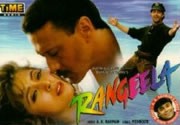
Rangeela
Synopsis:
Halfway through the film, Urmila Matondkar is standing in this blindingly bright orange dress that's honestly a whole character on its own with its ridiculous amounts of ruffles and shiny fabric, and she's dancing around on a crowded street in this massive crowd scene while Aamir Khan is watching her from the sidelines looking completely heartbroken because he knows she's slipping away into this fancy celebrity life, and I swear that specific outfit just lives rent-free in my head whenever I think about nineties fashion. But to understand why she's even in that ridiculous dress and why Aamir's character Munna is crying on a curb, you have to look at how this whole thing started on the dusty streets of Mumbai where everybody's just trying to hustle and make ends meet. Munna is this lovable local ticket blacker who's totally in love with his neighborhood friend Mili, played by Urmila, and she's this aspiring background dancer who's obsessed with the movies and spends all her time practicing her moves in front of the mirror. They have this really sweet dynamic where he's always hanging out by her house, and she's totally oblivious to his romantic feelings because she just sees him as her goofy buddy who brings her cheap snacks and listens to her gossip about film stars. She's got this amazing mom played by Reema Lagoo who's super supportive and grounds the whole family while they deal with their tiny apartment and daily financial worries. One day Mili gets a random gig dancing in a big song sequence for a movie shoot, and she's just glowing with excitement because it's her actual big break in the world of bollywood movies where she usually just blends into the background. And that random background gig puts her directly in the path of Raj Kamal, this massive superstar played by Jackie Shroff who is the undisputed king of hindi movies at that exact moment. Raj Kamal is chilling on set and he spots Mili nailing her routine and he's instantly blown away by her natural charm and screen presence, so he actually requests her to do a retake closer to the main camera. Right after that, she accidentally bumps into him at a posh hotel or something and spills a drink, and instead of getting mad, he's totally charmed by her clumsiness and decides to take her under his wing. So then Raj casts her as the lead actress in his brand new multimillion-dollar project, which is completely insane because she was literally just a background dancer a week ago, and suddenly her face is plastered all over billboards and she's hanging out in upscale hotel lobbies with people like Gulshan Grover playing some slimy producer character. As Mili gets sucked deeper and deeper into this glamorous high-society bubble of glittering lights and expensive parties, she starts drifting away from her old life and her messy neighborhood friends who don't fit into her new PR-managed image. Munna tries to keep up and act cool when he visits her on lavish studio sets, but he constantly feels out of place and humiliated by fancy directors and snobby crew members who don't know who he is, and honestly it's just so painful to watch him try to wear a suit that doesn't fit him right. He's totally heartbroken and starts drinking tea alone at his usual tapri, brooding over the fact that she's now rubbing shoulders with a megastar who can offer her a lifestyle he could never dream of providing in a million years. Raj Kamal starts falling for Mili too because she's so refreshingly honest compared to all the fake industry people he usually deals with, and he even confesses his feelings to her during a quiet moment on a scenic outdoor shoot. Mili is completely starstruck and confused because she's idolized Raj for years, but she also has this lingering emotional attachment to Munna that she can't just switch off like a lightbulb, even though her agent and everyone else are telling her that dating her co-star is the best career move she could possibly make. She visits Munna's chawl one last time to try and clear the air, but they just end up having a massive emotional fight where all their unspoken tensions finally spill out into the open, and she runs back to her car crying while Munna stands in the middle of the street looking completely dead inside. Bollywood is brutal. The climax happens at this massive, over-the-top award show where Mili wins a bunch of trophies and gives a tearful speech thanking Raj Kamal, and Munna is watching the whole thing on a tiny television screen through a storefront window with a bunch of random neighborhood kids cheering wildly. He decides right then and there that he's packing his bags and leaving the city forever because he doesn't want to get in the way of her shiny new future, and he hops onto the back of a moving truck with his few belongings tied up in a ragged bundle. Mili gets wind of his sudden departure right before the after-party wraps up, and she literally abandons her entourage of publicists and adoring fans, ripping off her heavy designer shoes and running through the Mumbai traffic in a frantic panic to stop him. She catches the truck just as it's pulling away from a red light, and she jumps down into the dusty street and tackles Munna in a messy, tear-filled hug while traffic blares around them. Munna smiles his goofy gap-toothed grin and drops his bags on the pavement.
There is a specific kind of background hiss on the dialogue tracks of mid-nineties Hindi movies that immediately tells you someone had to loop their lines in a tiny room with a condenser mic three days before prints shipped to the theatres. It isn't necessarily a bad thing, just a sonic texture you get used to, but in Ram Gopal Varma’s Rangeela it occasionally pops up in places where the actors are breathing too hard, like Gulshan Grover trying to sound menacing while his lapel mic rustles against his silk shirt. You forget about the audio glitches pretty fast though because the camera is moving somewhere else, usually tracking across a dusty Mumbai street or chasing Urmila Matondkar's pink scarf down a crowded alleyway. It’s a very physical picture, sweaty and bright, operating on instincts that feel closer to Brian De Palma's early studio thrillers than the traditional sentimental melodrama of the period. We were all supposed to be watching a standard romantic triangle about a poor orphan and a rich movie star fighting over a backing dancer, except the way the thing was shot made the city itself look like a co-star who refused to hit her marks. If I'm honest, the plot is practically non-existent on paper, which is probably why the movie works as well as it does on film.
Aamir Khan plays Munna, a black-market ticket scalper with a heart of gold and a yellow cap that probably smells like stale popcorn and sweat. He lives in a chawl, eats off tin plates, and carries a torch for Mili, his neighborhood friend who spends her days dodging lecherous choreographers and dreaming about top-billing. Jackie Shroff is Raj Kamal, the reigning superstar of the industry who happens to see Mili on a film set, gets mesmerized by her natural rhythm, and instantly casts her as the lead in his next big production. A proper love triangle gets set up without any fuss, but Varma and his writer Neeraj Vora aren't particularly interested in the usual moral agonizing that usually bogs down these situations in Hindi films. They just let the characters inhabit their clothes. Jackie Shroff wears these impossibly wide linen suits that make him look like an affluent lounge lizard who wandered onto the wrong set, playing the megastar with a drooping, bored exhaustion that feels surprisingly authentic to the actual weight of being famous. He isn't a villain trying to steal the girl away from the hero, he is just an option, a shiny and terribly convenient escape hatch out of the slums. Aamir plays his jealousy with a twitchy, defensive body language that avoids all the usual noble nobility you get from leading men in these parts, squatting on walls and chewing on matchsticks while his heart quietly breaks in the background. It is a performance full of rough edges and sudden, ugly outbursts.
Then there is Urmila, who does something here that completely recalibrated what an actor could achieve commercially in Mumbai without ever giving a speech about women's empowerment. She dances like the floor is on fire, yes, but she also has this way of looking slightly exhausted even when she is smiling for the cameras, as if she already knows the glamour is going to be a lot of work. The camera adores her, obviously, lingering on her face during close-ups with a fetishistic intensity that could easily feel sleazy if the performance underneath wasn't so grounded in mundane ambition. She wants nicer things. She wants to be seen. When Raj takes her to a fancy five-star restaurant and she stares at the cutlery with quiet panic, the movie finds a sweet spot between social observation and pop fantasy. It reminds me a bit of how timelessly cool Madhuri Dixit felt in Khalnayak, that effortless command of the frame where you literally cannot look away even when someone else is speaking. The supporting cast fills in the cracks without demanding extra scenes to justify their existence, especially Reema Lagoo as the weary mother who has seen too many dreams go south in this town to get very excited about a movie poster.
A huge part of the picture's cultural footprint came down to A.R. Rahman’s score, which arrived when Bollywood music was still mostly recycling the same three Punjabi folk hooks from the previous decade. Rahman used synthetic bass lines that sounded like they were bouncing off the concrete walls of an empty warehouse, mixing traditional tabla hits with drum machines that hit you right in the chest. When the title track kicks in with that weird vocal loop and Urmila steps out in a yellow dress that practically sears your retina, the cinematic grammar shifts from a standard drama into a pure music video sensibility that somehow doesn't feel cheap. It's loud, rhythmic, and relentless. The cinematography by W.B. Rao uses heavy color gels and aggressive sun flares to make even mundane traffic jams look like they are happening inside an advertisement for soft drinks. Sometimes the lighting gets so saturated that the actors look like neon cutouts pasted against real sky, but it fits the artificial, high-gloss aspirations of the entertainment industry being depicted on screen. There's a little visual motif involving ceiling fans spinning too fast that shows up in three different dialogue scenes, and every time it happens, it feels like a low-key editing choice that didn't quite earn its keep, but the pacing is so frantic you forget about it by the next scene change.
The screenplay doesn't have a traditional third act where the hero fights twelve guys to prove his love or the heroine makes a tearful speech on a railway platform. Munna just kind of figures out that his presence in her glamorous new life is becoming an anchor instead of a support system, and he decides to clear out before she has to ask him to leave. It's a remarkably understated resolution for a mainstream commercial release from that era, bypassing the expected histrionics in favor of a quiet cab ride through the predawn traffic. You get the sense that Varma was making up the visual language as he went along, stealing ideas from Hong Kong action flicks and MTV broadcasts and local theater productions all at once, throwing them at the wall to see what stuck. The film lacks the self-conscious grandeur of later blockbusters, preferring instead to stay scruffy and alive, a snapshot of an industry on the verge of changing its skin completely. It remains watchable not because it's some profound statement on class mobility or fame, but because every single frame is vibrating with a messy, undeniable energy that most modern studio product would kill to replicate.