

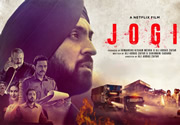
Jogi
Synopsis:
Jogi is desperately slicing through the metal locks on a school bus gate while terrified children scream and pandemonium erupts all around him in the dusty streets of Delhi because his entire world is suddenly burning down in 1984. Honestly, it's a terrifying setup for a movie, and Diljit Dosanjh plays this ordinary guy who just wants to save his family when everything goes completely sideways after the Prime Minister gets assassinated. You know how bollywood movies love a good peaceful family dinner before absolute chaos strikes, and this one opens right there with Jogi and his loved ones living a normal life in their neighborhood, eating, laughing, and ignoring the ominous political tension crackling on the radio in the background. And then boom, the Indira Gandhi assassination happens, and local politicians like Tejpal, played by Kumud Mishra with the most punchable face ever, decide to use the tragedy to orchestrate a systematic pogrom against the Sikh community. I couldn't stop staring at this one background extra wearing a ridiculously bright mustard yellow sweater who just keeps running back and forth across the street carrying random buckets of water while buildings are literally catching fire behind him, like buddy, those buckets aren't going to help, your sweater is distracting everyone, and why is nobody talking about this wardrobe choice. Anyway, mobs start swarming the streets with voter lists in hand, hunting down Sikh households, and Jogi's family realizes they're trapped in their own home as police officers like Hiten Tejwani's corrupt cop character actively collaborate with the rioters instead of protecting citizens. It's frantic, it's loud, and the movie wastes zero time dropping us into the violence.
Stuff happens so fast that Jogi and his family are forced to hide, but the thugs breach the house and execute Jogi's grandfather in cold blood, which is just gut-wrenching and brutal to watch. And then right after this horrific murder when you're emotionally shattered and gripping your popcorn, the movie suddenly pauses the tension for a completely bizarre song sequence that feels entirely out of place, proving that even the most serious hindi films still feel obligated to squeeze in a musical beat wherever they can. Jogi escapes with his life alongside his parents, but they get separated, and he ends up teaming up with his childhood best friend Rawinder, played by Mohd. Zeeshan Ayyub, who is a cop trying to secretly do the right thing despite his corrupt department. They hatch a desperate escape plan involving a truck and fake IDs to evacuate their colony to a refugee camp, but the local authorities led by Tejpal catch wind of the operation and lock down the entire district. Look, the pacing here gets wild because Jogi runs into his ex-girlfriend Kammo, played by Amyra Dastur, whose father is unfortunately tied up with Tejpal's political party, and she has to help them secure fuel and safe passage through the barricades. They're hiding out in a cramped abandoned warehouse with dusty crates everywhere, whispering in the dark, and you can practically hear people's heartbeats through the speakers. Rawinder uses his police badge to bluff checkpoints, but Tejpal is relentless and smells a rat, setting up a massive roadblock right outside the city limits.
We hit the interval point right as Jogi's truck is barreling toward a massive military barricade with guns pointed right at the windshield, and everybody in the theater was holding their breath. After the break, things get even crazier because it turns out Tejpal wants Jogi specifically, not just as a random target of the riots, but because Jogi dared to stand up to him politically before all this started. They capture the truck, they torture Rawinder to find out where Jogi is hiding, and Jogi voluntarily walks right into the lion's den at the local police station to trade his own life for the safety of his remaining family and neighbors. He walks down the hallway, stares Tejpal dead in the eye, and says he'll take all the blame if they let the bus of children and refugees cross the border to safety. It's a heavy emotional climax that hits hard without relying on cheesy dialogue. Tejpal agrees, or so he thinks, because he plans to murder Jogi anyway the second the bus rolls out of sight. But Rawinder manages to break free from his holding cell with the help of some honest cops who finally grow a conscience, and they storm the courtyard just as Tejpal raises his pistol to shoot Jogi in the head. A massive shootout breaks out with bullets flying everywhere, shattering glass and tearing up the courtyard walls, and amidst the chaos, Jogi lunges forward, tackles Tejpal, and beats him down while screaming out all the rage and grief of a community betrayed by the state. The corrupt cops are neutralized, the curfew is finally lifted as army reinforcements roll in down the main avenue, and the refugee buses successfully cross the bridge into safety. Jogi stands alone in the middle of the ruined, smoke-filled courtyard, surrounded by ash and empty bullet casings, dropping his head into his hands as he silently weeps for everyone they lost.
There is a specific kind of breathless editing in modern streaming dramas that makes every footstep sound like a cue for a drum roll, which is why the opening twenty minutes of Jogi actually kind of annoyed me before the story even found its legs. Director Ali Abbas Zafar has never been known for his subtlety, preferring the broad brushstrokes of theatrical blockbusters where subtext is usually painted in neon across the back wall of the set, but here he strips away some of the glossy artifice that ruined Bharat and forces his actors into narrow corridors and dusty lanes. The year is 1984, the air in Delhi smells like kerosene and panic, and the camera tracks Diljit Dosanjh as he navigates a neighborhood that is rapidly turning into a hunting ground. Hindi films have historically struggled to talk about communal violence without sliding into either preachy melodrama or jingoistic posturing, yet this narrative chooses to frame the horror through the claustrophobia of a single apartment complex where neighbors suddenly refuse to make eye contact. You can feel the sweat dripping off the foreheads of the extras, the production design clearly prioritizing the gritty textures of brick dust and torn curtains over clean period-accurate symmetry. It is a messy environment, full of loose wires and slamming doors, and the sound design leans heavily into the distance of sirens that never seem to get any closer until they are right outside the gate. Dosanjh plays the title character with a quiet, grounded urgency that immediately marks him out as someone who knows the city's alleys better than the men currently hunting him with iron rods and cans of gasoline. He doesn't get a grand heroic entry because the script drops us right into the middle of his ordinary Tuesday morning, buying milk and greeting shopkeepers who will soon be looking away.
The screenplay by Zafar alongside Sukhmani Sadana moves with an aggressive, pounding momentum that leaves very little room for character reflection once the riots officially begin, opting instead for a relentless chase structure that feels closer to the gritty survival mechanics of a Paul Greengrass picture than the usual emotional beats of Bollywood melodramas. There's a supporting turn by Mohd. Zesan Ayyub as a local cop who has to balance his uniform against his conscience, and while Ayyub is always reliable, it's pretty transparently dubbed in several crucial confrontation scenes where the audio track doesn't quite match the wet echo of the alleyways. That kind of post-production shortcut pulls you out of the illusion just as the tension is getting thick, but the sheer physical commitment of the cast carries the weight past those technical bumps. Kumud Mishra arrives later as the antagonist, chewing up the scenery with a chilling, bureaucratic calmness that makes his hatred feel scarily institutional rather than just the result of a sudden street-level mob mentality. He doesn't shout his bigotry; he arranges it on a clipboard with a fountain pen while the smoke drifts past his office window. Hiten Tejwani shows up too, bringing a quiet dignity to a role that could have easily been sidelined into a generic victim stereotype, though the script occasionally forgets he is even in the room for twenty-minute stretches while the central trio of escapees hides beneath a floorboard. The pacing hits a weird lull right around the middle hour where everyone is just whispering in the dark, and if I'm honest, the editing starts to drag its feet on reaction shots of wide-eyed children that we've already seen three times before.
Cinematography by Marcin Laskawski relies on a pale, washed-out palette that drains the warmth out of the capital's streets, trading golden hour nostalgia for harsh, overexposed daylight that makes every shadow look like a place to hide. The camera rarely sits still, opting for handheld tracking shots that stay glued to the backs of running actors, so you are constantly tripping over loose gravel and ducking behind brick pillars right alongside them. Aided by a brooding, percussive score that occasionally overstays its welcome by hammering the same three-note motif during every single door-kicking sequence, the audiovisual design works overtime to manufacture dread even when the dialogue is just functional exposition. There is a specific recurring guitar strum that plays every time Jogi looks at a family photograph, and it gets deployed so often that it loses its emotional sting before the second act is even finished. It's a small thing, but it bugged me because the actual performances are doing plenty of heavy lifting without the orchestra needing to spell out the tragedy in bold italics. The costume department deserves a nod for how quickly the bright, colorful turbans and crisp kurtas get stained with dirt, sweat, and soot, mapping the physical degradation of the characters directly onto their clothing as the hours tick by.
What sets the film apart from standard-issue streaming fare is its refusal to turn its central character into a saintly martyr who only speaks in poetic aphorisms about brotherhood and peace. Jogi gets scared, he makes mistakes, he snaps at people who are trying to help him, and his hands shake when he tries to load a bolt or tie a piece of rope. Dosanjh brings a bruised vulnerability to the screen that reminds you why he became a massive star in the first place, stripping away the smooth-talking charisma of his romantic comedy roles to reveal someone whose entire world has shrunk to the size of a single battered truck. The film touches on themes of political complicity and systemic betrayal without ever turning into a boring civics lecture, preferring to stay down in the dirt with the people running for their lives. When the vehicle finally hits the highway at the end, escaping the burning perimeter of the city, there is no celebratory fist-pump or triumphant musical swell to release the built-up pressure. The engine is coughing, the windows are cracked, and everyone is just staring blankly out at the grey morning light, wondering how they are going to explain any of this to the relatives who didn't make it onto the floorboards.