

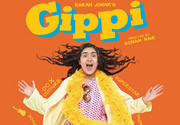
Gippi
Synopsis:
It movie is a coming-of-age story of an ordinary, overweight girl, who, through the course of the film, learns to love herself for exactly who she is.
It who is a 14-year-old girl who lives in Simla with her mother Pappi and little brother Booboo. She is overweight and awkward and doesn''t know how to handle the physical, emotional and social changes happening in her life.
In school, she is a backbencher and is constantly bullied by the popular queen-bee Shamira. At home, she''s trying to figure out how to deal with living in a broken home. In the middle of all this chaos, she falls madly in love with an older, brooding heartbreaker.
When her love story comes to a humiliating end, and she is publicly scorned, she decides to take her life in her hands and accepts Shamira''s challenge to stand against her in the school elections.
Whatever the final outcome might be, It makes sure she has a great time in the journey, filling it with delicious desserts, funny teachers, school crushes, and Shammi Kapoor dances.
It is also a tale of an underdog, who picks herself up from nothing and finds herself at the top of her own little world.
That one kid in the back row who is clearly way too old to be in middle school is going to bug me for the entire runtime of Gippi. Let's get that out of the way right now because it's a small thing, but it bugged me every single time he appeared in the background of the cafeteria scenes. Dharma Productions has always excelled at creating these impossibly sanitized, sun-drenched campuses where the lockers actually work and nobody smells like stale sweat, yet Sonam Nair’s directorial debut still manages to feel surprisingly lived-in despite the glossy budget backing it. Most hindi movies about teenage angst usually suffer from a terminal case of thirty-something writers remembering their high school days through a thick, golden-hued Instagram filter that strips away every ounce of actual awkwardness, but this one catches a specific kind of late-night hormonal misery without winking at the camera.
Gurpreet Kaur, known to everyone as Gippi, is played by Riya Vij with a total lack of vanity that immediately disarms you. She isn’t the kind of quirky, bespectacled movie outcast who just needs to take her glasses off to reveal she’s Miss World; she is genuinely, painfully, recognizably chubby, obsessed with junk food, and agonizing over the fact that her body is changing while everyone else’s seems to be settling into symmetrical magazine proportions. If I'm honest, the script gives her a few too many snappy comebacks that sound like they were workshopped in a writers' room by people who haven't spoken to an actual thirteen-year-old since the nineties, yet Vij delivers them with enough clumsy defensive energy that you forgive the occasional heavy-handed bit of dialogue. Her mother, played with weary, single-parent warmth by Divya Dutta, anchors the domestic scenes in a way that reminds you how rarely hindi films actually let mothers be messy, tired human beings instead of walking statues of unconditional sacrifice. Dutta has this habit of sighing while she chops vegetables that tells you everything you need to know about the exhaustion of running a household in Shimla on a tight budget without a single line of exposition to explain it.
The plot kicks into gear when Gippi decides to run for school captain primarily to spite the resident queen bee, Shamira, a girl who weaponizes lip gloss and synchronized dance routines with terrifying efficiency. Taaha Shah shows up as the older heartthrob Arjun, and his entire performance consists of looking vaguely confused while leaning against various doorframes in tight jeans, functioning less as a character and more as a walking plot device designed to jumpstart teenage insecurities. The visual language of the film relies heavily on pastel tones, sketchbook animations, and whimsical transitions that sometimes threaten to push the whole enterprise into the realm of a very expensive greeting card. Still, cinematographer Santhana Krishnan keeps the camera at eye level with the kids, refusing to look down on their trivial dramas, which makes the heartbreak of losing a school election feel just as devastating as any adult catastrophe you might find in a more prestigious drama.
What elevates the movie above standard coming-of-age fluff is its refusal to offer a neat little moral about loving yourself just the way you are, because the script acknowledges that loving yourself at fourteen is basically impossible when the world is constantly telling you to shrink. When Gippi attempts a disastrous diet involving raw cabbage and severe starvation, the film doesn't treat it as a quirky montage, letting the physical misery linger on screen through dark circles and fainting spells that genuinely scare the people around her. It’s an interesting companion piece to something like Wake Up Sid, sharing that same fascination with urban middle-class growing pains, except it dares to focus on a protagonist who doesn't get to fall back on the comforting cushion of generational wealth or a cozy apartment in Bandra. The supporting cast of school kids feels remarkably naturalistic, largely because they don't all speak in perfectly enunciated Mumbai slang, bringing regional textures to the dialogue that ground the high-stakes drama of who is sitting at which table during lunch.
The soundtrack by Vishal-Shekhar leans heavily into catchy, guitar-driven pop numbers that tend to over-explain the emotional beats of the scenes they accompany, a common crutch in commercial cinema that occasionally robs the quiet moments of their impact. Whenever Gippi starts crying in her bedroom, you can guarantee a melancholy acoustic guitar is going to swell up right on cue, underlining feelings that the actors are already conveying quite adequately through their expressions. Yet, despite those predictable musical cues, the emotional honesty of the climax—where Gippi realizes that dignity matters more than winning a popularity contest judged by people who won't even remember her name in five years—lands with surprising force. It doesn't revolutionize the genre, and it definitely trips over its own earnestness on more than one occasion, but it remains a remarkably sweet, sharp little piece of work that understands how the small humiliations of youth are actually the ones that leave the deepest scars. By the time the credits roll over a delightfully messy school talent show performance involving a lot of neon body paint, you realize you've watched a mainstream release that actually remembers what it felt like to have your heart broken by someone who didn't even notice you were standing in the room.