

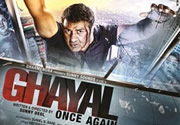
Ghayal Once Again
Synopsis:
The film opens with flashbacks of Ghayal. Angry young Ajay Mehra shoots and kills Balwant Rai (who had murdered Ajay''s brother) and surrenders himself to upright cop Joe DSouza. Ajay is sentenced to prison. Upon his release he begins a new career as a reporter for an independent newspaper. He doubles as a vigilante who assists the police with their hard-to-prosecute cases (including cases where the accused are prominent and influential members of society).
One such case involves small town reporter Renu who was drugged and raped by her boss, the media baron Rajguru. Renu killed herself and Rajguru''s men quashed the matter and implicated her innocent boyfriend. Ajay swings into action and abducts Rajguru and forcibly obtains a DNA swab. Rajguru is arrested. Ajay is a hero, a sensation. (It is revealed that Ajay still suffers panic and anxiety attacks from his painful memories of his past. His girlfriend Rhea, a psychiatrist, helps him with his problems.) Joe DSouza has retired and is a social activist. Ajay often collaborates with him and helps him out.
Joe DSouza is killed in a traffic accident near Nanded. Young blogger Zoya is shocked to discover that Joe was, in fact, shot dead; she had accidentally captured the murder on video. Joe was shot by Kabir Raj Bansal, son of the tycoon Raj Bansal. Zoya and her young friends panic and want to take the video to the cops but Zoya''s grandfather infers that Raj Bansal had staged the road accident (where 8 other innocent people were killed) and stops them. Bansal is too powerful. It is further revealed that DSouza had visited Raj Bansal and directly accused him of a land grab. Bansal tried to buy him off, there was an argument, and Kabir Raj Bansal, in a fit of rage, shot DSouza. The accident was a cover up. Bansal privately realizes that Kabir is still a bratty kid and decides to enrol him into a military school.
On her grandfather''s advice Zoya turns the video over to the lawyer Kriplani who quietly returns it to Bansal in order to ensure the children remain safe. But Kriplani''s son, a friend of Zoya, realizes that his father has given up the video and thus urges Zoya to reach Ajay Mehra. As the children hurry to reach Ajay they are intercepted by Bansal''s goons. There is a chase. Ajay saves the children and recovers the video. Rhea takes the children to the hospital where they are abducted by Bansal''s men.
It is revealed that one of the children is Ajay''s own daughter. Kabir tortures the children until Bansal, tired of his son''s tantrums, warns him away. Bansal holds Ajay''s daughter and releases the other children. He tells Ajay that Ajay''s daughter will henceforth stay with Bansal in order to ensure the safety of Kabir. Bansal''s mother objects but Bansal, locked in moral conflict, waves her away. Bansal gets the Home Minister to order Ajay''s arrest.
Ajay overcomes the cops and mounts an attack on the Bansal mansion to rescue his daughter. There is a fierce figh
The sound design during the opening action sequence of Ghayal Once Again features a distinct metallic ping every time Sunny Deol throws a punch, which is the kind of sonic choice that makes you wonder if the foley artist just found a spoon they really liked and decided to use it for every single impact in the Mumbai skyline. If I'm honest, it took me completely out of the movie for a solid five minutes, right when the plot was trying to establish the terrifying reach of a corporate titan who apparently owns half the city and can make witnesses disappear with the flick of a pen. Ajay Mehra is back, older now, sporting the kind of grizzled beard that usually signifies a character who has spent the last two decades brooding in a cabin, though here he runs a neighborhood newspaper and moonlights as a vigilante guardian for troubled youths who keep finding themselves holding flash drives they really shouldn't have.
That plot engine kicks off when four teenagers, played with varying degrees of breathless panic by Shivam Patil, Rishabh Arora, Diana Khan, and Aanchal Munjal, accidentally film a murder committed by the primary antagonist. They run, they hide, and they eventually end up at the doorstep of Deol's character because every other adult in the Hindi film ecosystem is either corrupt, terrified, or entirely useless when a billionaire is waving a court order. The direction, handled by Deol himself after Rajkumar Santoshi stepped away from the project, suffers from a severe case of nostalgia poisoning that makes the pacing erratic and the tone lurch wildly from gritty urban thriller to high-octane 90s-style melodrama without warning. There are scenes where the camera lingers on a villain's evil smirk for three beats too long, draining all the tension out of a chase and reminding you of editing choices from older action films that honestly should have stayed in the last century.
Om Puri makes a late-career appearance as a weary advocate trying to keep the legal system from collapsing under the weight of corporate intimidation, and he brings a ragged authenticity to scenes that would otherwise dissolve into pure noise. Narendra Jha steps in as the billionaire puppet master with a cold, terrifying calm that grounds the picture whenever Deol's tendency to roar at the heavens threatens to pull the whole enterprise into unintentional self-parody. Tisca Chopra, playing the antagonist's high-powered legal counsel, does heavy lifting with dialogue that feels like it was translated from a legal drama broadcast on cable at three in the morning, finding subtle shades of menace in a role that could easily have been reduced to a scowling cardboard cutout in a tailored suit.
The cinematography relies heavily on a blue-tinted filter that makes daylight scenes look as though they were shot during an eclipse over industrial parklands, which is a choice that feels somewhat dated even by the standards of mid-decade action thrillers coming out of Bollywood. When the camera finally stabilizes during the hand-to-hand combat sequences, you can appreciate the physical toll the production took on its aging star, who still moves with a heavy, unstoppable momentum that recalls his glory days in Ghatak. Yet the soundtrack operates on a loop of thunderous percussion and swelling electric guitars that telegraph every emotional beat long before the actors can reach them, robbing the narrative of any genuine surprise.
Beneath the bluster of car chases and exploding warehouses, the film tries to engage with contemporary anxieties about corporate malfeasance, wealth inequality, and the erosion of journalistic integrity in modern cities. These themes surface in dialogue heavy with righteous anger, yet the script never slows down long enough to let the younger characters process the trauma of being hunted by mercenaries through abandoned industrial sites. The teenagers function mostly as plot tokens who need rescuing, which is a pity because the actors show occasional flashes of real chemistry when they are allowed to just sit in a car and argue about who dropped the incriminating camera.
There is a specific kind of exhaustion that sets in when a sequel arrives twenty years after the original cultural touchstone, dragging its aging hero back into the arena to fight the exact same class battles with slightly shinier props. Deol has crafted a movie that honors his own cinematic legacy with absolute sincerity, for better and for worse, refusing to let go of the righteous fury that made him a star in the first place even if the world around him has changed beyond recognition. As the credits roll on a chaotic rooftop confrontation that defies every law of physics and municipal zoning, you are left with the distinct impression of having watched an artifact from a different era stubbornly trying to plant its flag in the present day.