

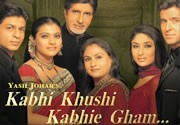
Kabhi Khushi Kabhie Gham
Synopsis:
So anyway, right in the middle of this massive three-hour family drama, Kareena Kapoor is literally strutting through a British university campus wearing the most ridiculous pink crop top and cargo pants combination you've ever seen in your life, totally ignoring her poor friend who's trying to study, and she's just completely obsessed with herself and her own fabulousness while loudly demanding to know how her hair looks. It's wild. But to understand why she's even in London prancing around like she owns the place, you have to rewind a bunch and look at how this whole crazy thing started back in Delhi with Amitabh Bachchan playing this insanely wealthy, terrifyingly strict patriarch named Yashvardhan Raichand who lives in a mansion that looks more like a European palace than a family home, and he's walking around in these immaculate three-piece suits treating his household like a military base where nobody's allowed to question his authority ever. Jaya Bachchan plays his soft-spoken, incredibly elegant wife Nandini who mostly just stands by the grand staircase holding a pooja thali and sensing emotional vibes before anyone else even knows they're upset. They've got two sons, the older adopted one Rahul played by Shah Rukh Khan and the younger biological one Rohan, and the dad has this whole rigid philosophy about family tradition and matching your social status that he won't shut up about, which brings us to Rahul growing up and falling madly in love with Anjali, this loud, warm-hearted middle-class girl from the local neighborhood who loves sweets and speaks her mind and basically shatters every single rule the dad cares about. The dad finds out and completely loses his mind because she isn't high-class enough for the Raichand legacy, and when Rahul dares to marry her anyway, the patriarch disowns him on the spot in front of the whole horrified family. Rahul packs up his crying wife and her little sister Pooja, who is the mini version of Kareena Kapoor's character, and they all just pack their bags and move to London to start completely over from scratch without a single penny of the family fortune, and honestly, the dad doesn't even blink an eye about banishing his favorite kid. Cold.
So then years pass by in London where Rahul and Anjali are just living a normal life in a cozy house with their young son, and little Rohan has now grown up into a buff adult who finally finds out the real reason his big brother left all those years ago, and he basically decides he's gonna fix this broken family whether his parents want him to or not. He hatches this absurd secret mission to fly to London, enroll in the exact same university where Pooja is currently studying fashion and driving every guy crazy, and he manages to track down his estranged brother without letting on who he really is at first. Right after that, Rohan pulls off this elaborate plot during a college talent show to reunite with Rahul, and once they're hugging and crying, Rohan immediately starts nagging Rahul and Anjali to pack up and come back home to face the angry patriarch. They don't want to go because of the massive blowout, but Rohan secretly invites their mom and dad to London too, orchestrating a surprise family reunion inside a massive department store where Jaya Bachchan's character just instinctively knows her son is nearby and turns around to see him standing right there. It's a huge emotional moment where the mom tells the dad he was completely wrong to cast Rahul out, but the stubborn old man still refuses to budge an inch and stays mad.
The funny thing is, Kareena Kapoor's character Pooja ends up falling totally head over heels for Rohan because he's charming and handsome and actually calls her out on her nonsense, and they have this whole big engagement party where everyone is dancing up a storm in typical bollywood fashion with massive backup dancers and way too many costume changes. During all the wedding festivities, Rohan finally confronts his dad about how miserable the whole family has been since Rahul left, reminding the old man that pride isn't worth losing your children over. The dad finally breaks down and realizes he's been a total jerk for a decade, so he drives over to Rahul's house in the middle of the rain to apologize. Rahul opens the door, and the stern billionaire dad just collapses into tears, hugging his son and begging for forgiveness. They all head back to the massive Delhi mansion together, the mom happily welcomes them at the front doors with her trusty pooja thali, and they all pose for one final massive family group photo on the lawn as the credits roll.
The helicopter landing in the opening sequence costs more than most independent productions back then, kicking up enough dust to choke half of Delhi while Yashvardhan Raichand steps out looking like he owns the concept of gravity itself. It is a lot, honestly, too much if I am being honest, establishing a baseline of excess that Karan Johar sustains for three and a half hours without pausing for breath. You walk into this thing expecting a standard melodrama about family values, but what you actually get is an endurance test disguised as a festive dinner party where the silver cutlery is probably heavier than your entire apartment. Amitabh Bachchan plays the patriarch with a furrowed brow that could cut glass, delivering every line about lineage and tradition as though he is reading inscriptions off an ancient monolith. His character demands obedience with the casual cruelty of a feudal lord who genuinely believes he is doing everyone a favor by destroying their autonomy. Opposite him, Jaya Bachchan does the heavy lifting of looking deeply pained across massive drawing rooms, communicating centuries of maternal grief entirely through the tilt of her head and the trembling edge of a heavy silk pallu. That dynamic sets the emotional tempo for the entire first half, grinding forward on the heavy machinery of generational expectation and wounded pride.
Then the movie moves to London, or rather, Johar’s aggressively artificial conceptualization of London, which looks less like the British capital and more like a high-end furniture showroom that has been granted municipal status. Shah Rukh Khan enters via a dramatic helicopter shot that mirrors his on-screen father's entrance, signaling that despite the geographical shift, nothing has fundamentally changed about the sheer scale of the staging. Rahul Raichand is the adopted son who dares to fall in love beneath his social station, marrying Anjali, played by Kajol with a frantic, breathless energy that threatens to blow the camera right off its tripod. Kajol’s performance in these early domestic sequences runs entirely on high-frequency giggles and aggressive Punjabi stereotyping, creating a character who is intensely grating for the first twenty minutes before somehow winning you over through sheer kinetic persistence. When Rahul is disowned in a fit of patriarchal pique, the film hits its emotional anchor with a scene of such operatic cruelty that it almost circles back around to being funny. Amitabh delivers the dismissal with cold finality, turning his back on his eldest son while Jaya stands frozen in the doorway, unable to cross the invisible line drawn by her husband’s ego. It is a massive, sprawling mess of a sequence that nevertheless works because the actors commit to the emotional absurdity with absolute, terrifying sincerity.
Years pass, the younger sibling grows up, and Kareena Kapoor arrives on screen as Poo, a character who essentially operates as a walking neon sign reading pure camp. Kareena struts through her college scenes in outfits that defy both weather patterns and basic logic, chewing up the scenery with a delightfully obnoxious confidence that makes every other actor in the frame look like they are sleepwalking through a rehearsal. She is playing a caricature of the uber-rich South Bombay brat, but she leans into it so hard that the performance transcends its own superficiality and becomes something genuinely iconic. Her interrogation of Rahul’s younger brother about his clothes is a masterclass in comic timing, delivered with a casual cruelty that is deeply funny. Yet the film struggles to integrate this hyper-modern, self-aware irony with the crushing emotional sincerity of the family reconciliation plotline that takes up the entire third act. You get whiplash going from Kareena tossing off insults about fashion to Shah Rukh and Amitabh glaring at each other across a dimly lit room with the intensity of two rival warlords.
The soundtrack, composed by a committee of heavyweights, blasts through the speakers at volume ten during every single emotional beat, leaving no room for subtext or silence. Every time a character remembers their mother or feels a pang of guilt, the main theme swells up like a tidal wave, drowning out the dialogue and demanding an immediate emotional response from the audience. It is an exhausting way to watch a movie, especially when the background score repeats the exact same melancholic piano motif for the fifteenth time in a single hour. The cinematography by Kiran Deohans matches this sonic excess, bathing every single frame in a warm, buttery golden glow that makes even a suburban kitchen look like the Versailles Hall of Mirrors. Yet despite the glossy surfaces and the endless parade of designer clothes, there are moments of genuine awkwardness that slip past the editor's eye, like a continuity error where Kajol’s hair changes length between shots during a crying fit in a London park. It is a small thing, but it bugged me, dragging you out of the fantasy and reminding you that you are just watching people in heavy makeup hit their marks on a soundstage.
Hindi movies of this vintage often relied on the sheer star power of their casts to paper over narrative gaps, and this film uses its ensemble the way a blockbuster action flick uses stunt doubles. Nobody is allowed to simply exist in a scene; they have to emote, weep, pose, or deliver a life-altering monologue about the sanctity of bloodlines. This heavy-handed approach to theme places it right alongside Sanjay Leela Bhansali’s Devdas in terms of sheer visual opulence masking a rather thin narrative core, though Johar lacks Bhansali’s eye for tragic symmetry. Instead, Johar prefers a messy, kitchen-sink approach where modern consumerism and traditional family values smash into each other until everyone is crying into their expensive upholstery. The ideology at play is deeply conservative, insisting that no matter how tyrannical a father might be, his children are morally obligated to crawl back to him on their knees and beg for forgiveness. Yet the film is so relentlessly entertaining in its absurdity that you almost forget you are watching a two-hundred-minute commercial for patriarchal obedience. When the final family reunion finally happens at a lavish London estate, complete with slow-motion running and swelling choral arrangements, it feels less like a narrative resolution and more like surviving a very long, very loud roller coaster ride.