

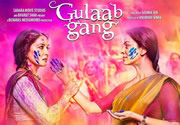
Gulaab Gang
Synopsis:
Kajri, a battered & bruised woman living in North India enlists with the gang of pink, the It, when she meets them after being thrown out of her married home when her parents weren’t able to pay the dowry.
This It, armed with axes and sickles and dressed in pink nine yards, mete out the evil and seek out justice for one and all, while making hand-ground spices, hand-woven baskets and hand-woven clothes, is led by Rajjo, played by Madhuri Dixit.
When an innocent teenage girl from the village is raped by a reigning politician’s son, Rajjo decides to stand against them via the ballot box.
Rajjo’s was with the oppressors, those who were injust to women, but now she stands against a machinery much larger than she ever encountered, in the form of Sumitra Devi, the party’s head. Rajjo has to battle Sumitra Devi’s money, connections & bullets and strive for the welfare of the common person, using the ‘power of pink’
The pink sari is a loud garment, which sounds obvious until you see how it moves across the screen in Gulaab Gang, catching the harsh dust of Bundelkhand like a beacon. If I'm honest, the shade they chose is slightly more magenta than the actual gulabi worn by the real-life Sampat Pal Devi and her Mahila Gang, though maybe that is just color grading at work in a medium that rarely trusts the actual dirt on the ground. Still, the visual of fifty women marching in unison with bamboo lathis resting on their shoulders has an undeniable gravity, even when the script underneath them starts wobbling under the weight of its own righteousness. Hindi films have spent decades finding new ways to put lathis in the hands of men who shout dialogue about honor, so shifting those sticks to the women feels like a sideways yank on a very old steering wheel.
Soumik Sen directs with a heavy hand, piling on the melodrama until the quieter beats get completely drowned out, though he does know how to frame a face during a confrontation. The screenplay by Sen and Aparna Singh tries to balance a sprawling social justice narrative with the breathless pacing of a commercial thriller, meaning we leap from domestic abuse interventions to state-level political corruption without pausing to catch our breath, which makes the quieter character moments feel a bit rushed. It is a small thing, but it bugged me how the background score swells with aggressive percussion every single time Rajjo enters a room, as if the audience couldn't figure out who the hero was without an orchestral shove. That kind of mechanical signaling drains the tension from scenes that should have felt genuinely dangerous, reducing a complex regional caste conflict into a straightforward western where the good guys wear matching cotton.
Madhuri Dixit plays Rajjo with a controlled, almost weary intensity that keeps the movie anchored, avoiding the trap of playing her as an infallible saint by letting flashes of stubbornness and exhaustion show through the armor. Her action sequences are remarkably staged, though wire-work occasionally betrays the illusion of rural grit, making her leaps across rooftops look less like a local activist and more like something out of a franchise actioner. Opposite her, Juhi Chawla steps into the role of Sumitra Devi, a cunning and entirely unrepentant politician who treats state power like her personal estate, and the sheer joy Chawla takes in playing pure, unfiltered malice is the best thing the movie has going for it. Watching Chawla lean back in a plush leather armchair while casually destroying a rival's career reminds you why she was never just the bubbly romantic lead of nineties blockbusters like Darr, giving us a villain who uses a sweet smile and a folded khadi kurta to mask a terrifying coldness.
Tannishtha Chatterjee appears in a supporting role that deserved twice the screen time, bringing a grounded, tragic weight to the ensemble that contrasts sharply with the broader strokes used by the leads. The cinematography by Alphonse Roy relies too heavily on golden-hour filters that make rural poverty look like an oil painting commissioned by a tourism board, though he captures the brutal glare of the midday sun quite well when the characters are out on the open road. The soundtrack, credited to and performed largely by the cast members themselves in terms of promotional hype, leans hard into folk rhythms that sound heavily processed in a studio, stripping away the raw, abrasive edge of actual regional music. It is hard to listen to these polished tracks without thinking of Vishal Bhardwaj's work in Maqbool, where the folk elements felt embedded in the soil rather than pasted on top of it for trailer cuts.
There is a recurring tension in the movie between wanting to tell a grounded story about female solidarity and needing to deliver the kind of punchy, single-line clapbacks that get mass applause in crowded single-screen theaters across northern India. This split personality prevents the social commentary from landing any deep punches, keeping the critique of feudal patriarchy at a surface level where bad men are bad because of personal malice rather than systemic design. Whenever the plot threatens to examine the complicated economics of rural labor or caste hierarchies, it quickly pivots back to a personal rivalry between Rajjo and Sumitra, reducing a massive societal fracture down to a catfight between two strong-willed women. Bollywood movies have always struggled to critique the status quo without eventually retreating into individual heroism, and Gulaab Gang falls squarely into that old trap, trading structural critique for a showdown that settles everything with fists rather than reform.
The editing is erratic in the second half, chopping up dialogue exchanges with reaction shots that linger a beat too long, which drains the momentum right when the narrative needs to be tightening the screws on its central conflict. One particular supporting actor, playing a corrupt local police inspector, is so obviously dubbed by a voice artist whose studio acoustics don't match the outdoor desert locations that every single one of his scenes pulls you right out of the fiction. It is a shame, because the ambition behind this project is clearly massive, even if the execution gets bogged down by commercial compromises and predictable narrative beats that feel lifted straight from nineties revenge dramas. Hindi movies have a long history of dressing up social causes in the bright neon lights of masala entertainment, and while that approach sometimes sparks real conversation, it also tends to sand down the jagged edges of the very anger it purports to channel.
Dixit and Chawla sharing a frame together for the first time should have felt like an apocalyptic event for fans of commercial cinema, yet the direction keeps them apart for large stretches of the runtime, saving their face-offs for heavily choreographed climactic sequences. When they finally do go toe-to-toe, trading threats in low, measured tones across a dusty courtyard, the screen practically hums with a history of past stardom that neither actor needs to lean on overtly to make felt. That shared screen presence elevates material that otherwise might have collapsed under its own heavy-handed messaging, proving that great actors can sometimes drag a mediocre script across the finish line purely on the strength of their timing. As the credits roll over a final, defiant image of women marching into the distance, you are left wishing the film had trusted its quieter observations half as much as it trusted its star power, leaving us with a messy, uneven artifact that remains fascinating precisely because of the risks it didn't quite manage to pull off.